Back
BackThe Epidermis: Structure, Cells, and Skin Types
Study Guide - Smart Notes
 Tailored notes based on your materials, expanded with key definitions, examples, and context.
The Epidermis
Module 5.2: The Epidermis
The epidermis is the outermost layer of the skin, serving as a protective barrier against environmental damage, pathogens, and water loss. Understanding its structure and cellular composition is essential for comprehending skin physiology and pathology.
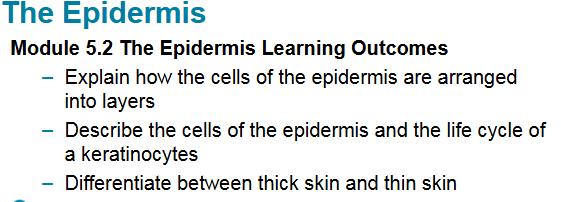
Arrangement of Epidermal Cells into Layers
The cells of the epidermis are organized into distinct layers, each with specialized functions:
Stratum Basale (Basal Layer): The deepest layer, consisting of a single row of stem cells that continuously divide to produce new keratinocytes.
Stratum Spinosum (Prickly Layer): Several layers of keratinocytes connected by desmosomes; cells begin to produce keratin.
Stratum Granulosum (Granular Layer): Keratinocytes accumulate granules containing keratin and glycolipids, which help waterproof the skin.
Stratum Lucidum (Clear Layer): Present only in thick skin (e.g., palms, soles); consists of a few rows of clear, flat, dead keratinocytes.
Stratum Corneum (Horny Layer): The outermost layer, composed of many layers of dead, flattened keratinocytes filled with keratin; provides durable protection.
Example: The stratum corneum is responsible for the skin's resistance to abrasion and dehydration.
Cells of the Epidermis and the Life Cycle of Keratinocytes
The epidermis contains several cell types, each with unique roles:
Keratinocytes: The most abundant cell type; produce keratin, a protein that strengthens the skin. Keratinocytes originate in the stratum basale and migrate upward, undergoing changes until they reach the stratum corneum and are eventually shed.
Melanocytes: Located in the stratum basale; produce melanin, which protects against UV radiation.
Langerhans Cells: Immune cells found in the stratum spinosum; help defend against pathogens.
Merkel Cells: Sensory cells in the stratum basale; associated with touch sensation.
Life Cycle of a Keratinocyte:
Originates in the stratum basale through mitosis.
Migrates upward, differentiating and accumulating keratin.
Reaches the stratum corneum, where it is eventually shed.
Example: Keratinocytes take approximately 4 weeks to migrate from the stratum basale to the stratum corneum.
Thick Skin vs. Thin Skin
The epidermis varies in thickness depending on location:
Thick Skin: Found on the palms of the hands and soles of the feet; contains all five epidermal layers, including the stratum lucidum. Lacks hair follicles and sebaceous glands.
Thin Skin: Covers most of the body; lacks the stratum lucidum and has fewer layers overall. Contains hair follicles, sebaceous glands, and sweat glands.
Example: The skin on the fingertips is classified as thick skin, providing enhanced protection and grip.