 Back
The Human Body: An Orientation – Foundational Concepts and Anatomical Terminology
Study Guide - Smart Notes
 Tailored notes based on your materials, expanded with key definitions, examples, and context.
The Human Body: An Orientation
Introduction to Anatomical Terminology
Understanding anatomy and physiology requires learning a specialized vocabulary of over 4000 terms. This foundational knowledge is essential for accurately describing the human body, its regions, and its functions. Visualization techniques and standardized terminology allow for clear communication among medical professionals.
Visualization Techniques in Anatomy
Medical Imaging Modalities
X-ray: Uses ionizing radiation to visualize dense structures such as bones.
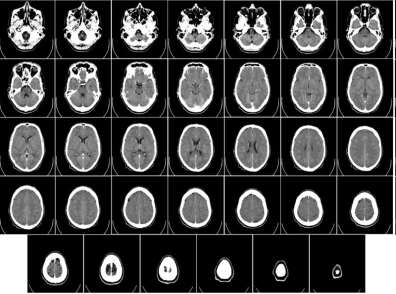
Computerized Tomography (CT): Produces cross-sectional images using computer-processed combinations of X-ray measurements.
Digital Subtraction Angiography: Visualizes blood vessels by subtracting pre-contrast images from post-contrast images.
Positron Emission Tomography (PET): Detects metabolic activity using radioactive tracers.
Sonography (Ultrasound): Uses high-frequency sound waves to produce images of soft tissues and organs.
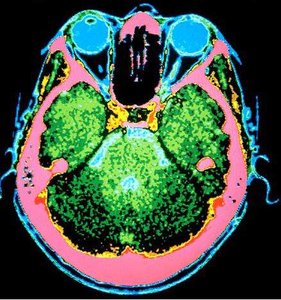
Magnetic Resonance Imaging (MRI): Uses strong magnetic fields and radio waves to generate detailed images of organs and tissues.
Magnetic Resonance Spectroscopy: Analyzes chemical composition of tissues.
Functional MRI (fMRI): Measures brain activity by detecting changes in blood flow.
M2A Swallowable Imaging Capsule: Captures images of the gastrointestinal tract.

Anatomical Position and Regional Terms
Standard Anatomical Position
The anatomical position is a standardized posture used as a reference in describing the body and its parts. In this position, the body stands erect, feet slightly apart, palms facing forward, and thumbs pointing away from the body. Directional terms always refer to this position, regardless of the actual posture of the body.
Regional Terms
The body is divided into two major regions:
Axial: Includes the head, neck, and trunk.
Appendicular: Includes the limbs (arms and legs).
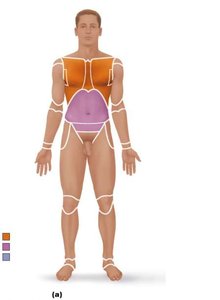
Regional terms specify particular areas within these divisions, such as cephalic (head), thoracic (chest), abdominal, pelvic, and limb regions.
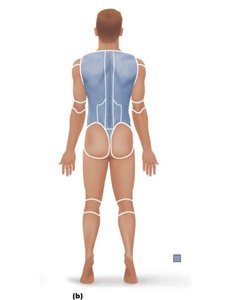
Orientation and Directional Terms
Definitions and Examples
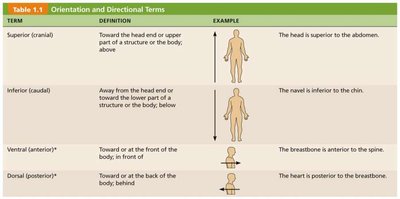
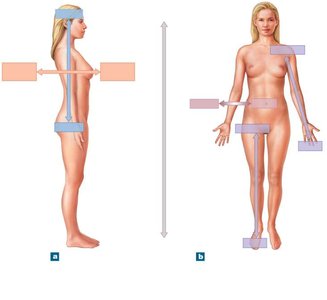
Directional terms describe the locations of structures relative to other structures or locations in the body. These terms are essential for clear anatomical communication.
Term | Definition | Example |
|---|---|---|
Superior (cranial) | Toward the head end or upper part of a structure or the body; above | The head is superior to the abdomen. |
Inferior (caudal) | Away from the head end or toward the lower part of a structure or the body; below | The navel is inferior to the chin. |
Ventral (anterior) | Toward or at the front of the body; in front of | The breastbone is anterior to the spine. |
Dorsal (posterior) | Toward or at the back of the body; behind | The heart is posterior to the breastbone. |
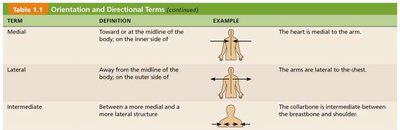
Medial | Toward or at the midline of the body; on the inner side of | The heart is medial to the arm. |
Lateral | Away from the midline of the body; on the outer side of | The arms are lateral to the chest. |
Intermediate | Between a more medial and a more lateral structure | The collarbone is intermediate between the breastbone and shoulder. |
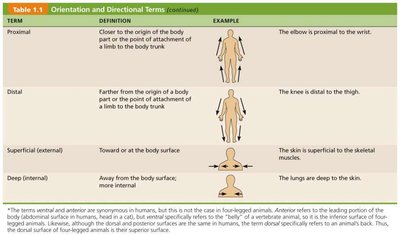
Proximal | Closer to the origin of the body part or the point of attachment of a limb to the body trunk | The elbow is proximal to the wrist. |
Distal | Farther from the origin of a body part or the point of attachment of a limb to the body trunk | The knee is distal to the thigh. |
Superficial (external) | Toward or at the body surface | The skin is superficial to the skeletal muscles. |
Deep (internal) | Away from the body surface; more internal | The lungs are deep to the skin. |
Anatomical Variability
Individual Differences
While most human anatomical structures are consistent, about 10% of individuals have variations such as extra blood vessels, nerves, or muscles. Extreme anatomical variations are generally incompatible with life, as structure reflects function.
Body Planes and Sections
Major Body Planes
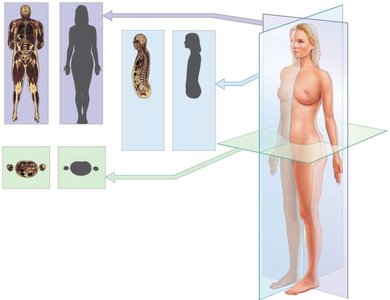
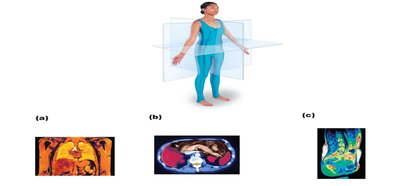
Body planes are imaginary flat surfaces that divide the body or organs into sections for anatomical study. The three most common planes are:
Sagittal Plane: Divides the body into right and left parts. The midsagittal (median) plane lies exactly at the midline, while a parasagittal plane is offset from the midline.
Frontal (Coronal) Plane: Divides the body into anterior (front) and posterior (back) parts.
Transverse (Horizontal) Plane: Divides the body into superior (upper) and inferior (lower) parts, producing a cross-section.
Oblique Section: A cut made at an angle other than 90° to the vertical plane.
Body Cavities and Membranes
Major Body Cavities
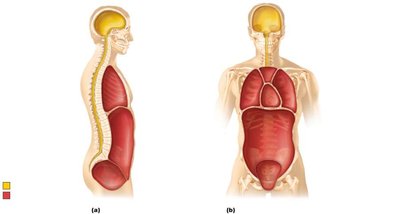
The body contains two main sets of internal cavities that protect organs and allow for organ movement:
Dorsal Body Cavity: Protects the nervous system and has two subdivisions:
Cranial cavity: Encases the brain.
Vertebral cavity: Encases the spinal cord.
Ventral Body Cavity: Houses internal organs (viscera) and is divided by the diaphragm into:
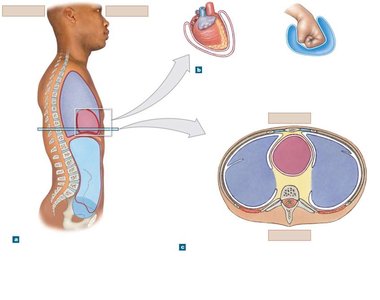
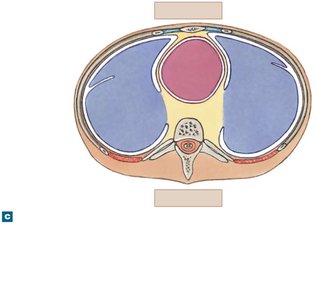
Thoracic cavity: Contains the heart and lungs, further divided into pleural cavities (lungs), mediastinum (thoracic organs), and pericardial cavity (heart).
Abdominopelvic cavity: Contains the abdominal cavity (digestive organs) and pelvic cavity (urinary bladder, reproductive organs, rectum).
Serous Membranes
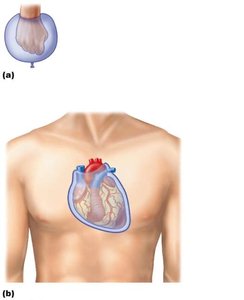
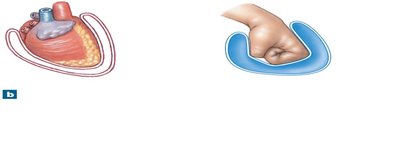
Serous membranes (serosa) are thin, double-layered membranes that line body cavities and cover organs. The parietal serosa lines the cavity walls, while the visceral serosa covers the organs. The space between these layers is filled with serous fluid to reduce friction.
Pericardium: Surrounds the heart.
Pleurae: Surround the lungs.
Peritoneum: Surrounds the abdominopelvic cavity.
Abdominopelvic Quadrants and Regions
Quadrants
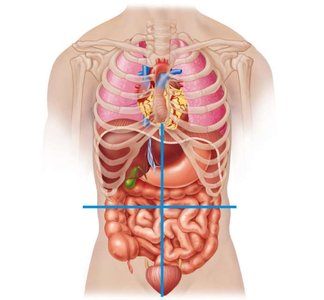
Medical personnel often divide the abdominopelvic cavity into four quadrants for diagnostic and descriptive purposes:
Right Upper Quadrant (RUQ)
Left Upper Quadrant (LUQ)
Right Lower Quadrant (RLQ)
Left Lower Quadrant (LLQ)
Regions
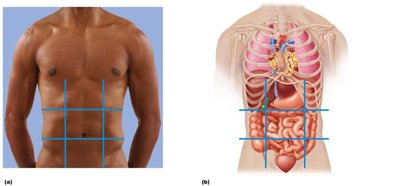
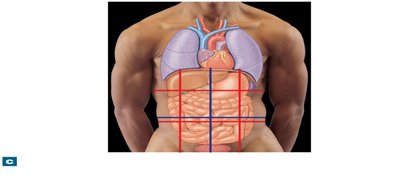
Anatomists use nine regions for more precise localization:
Right hypochondriac region
Epigastric region
Left hypochondriac region
Right lumbar region
Umbilical region
Left lumbar region
Right iliac (inguinal) region
Hypogastric (pubic) region
Left iliac (inguinal) region
Other Body Cavities
Additional Cavities
Exposed to environment: Oral and digestive cavities, nasal cavity, orbital cavities, middle ear cavities.
Not exposed to environment: Synovial cavities (joint cavities).
Summary Table: Directional Terms
Term | Definition | Example |
|---|---|---|
Superior (cranial) | Toward the head end or upper part of a structure or the body; above | The head is superior to the abdomen. |
Inferior (caudal) | Away from the head end or toward the lower part of a structure or the body; below | The navel is inferior to the chin. |
Anterior (ventral) | Toward or at the front of the body; in front of | The breastbone is anterior to the spine. |
Posterior (dorsal) | Toward or at the back of the body; behind | The heart is posterior to the breastbone. |
Medial | Toward or at the midline of the body; on the inner side of | The heart is medial to the arm. |
Lateral | Away from the midline of the body; on the outer side of | The arms are lateral to the chest. |
Intermediate | Between a more medial and a more lateral structure | The collarbone is intermediate between the breastbone and shoulder. |
Proximal | Closer to the origin of the body part or the point of attachment of a limb to the body trunk | The elbow is proximal to the wrist. |
Distal | Farther from the origin of a body part or the point of attachment of a limb to the body trunk | The knee is distal to the thigh. |
Superficial (external) | Toward or at the body surface | The skin is superficial to the skeletal muscles. |
Deep (internal) | Away from the body surface; more internal | The lungs are deep to the skin. |
Additional info: This guide provides foundational terminology and concepts essential for further study in anatomy and physiology, including the use of medical imaging, anatomical planes, and body cavity organization.
