 Back
BackThe Human Body: An Orientation – Structure, Function, and Anatomical Terminology
Study Guide - Smart Notes
 Tailored notes based on your materials, expanded with key definitions, examples, and context.
Structure and Function in Human Anatomy
Core Concept: Structure and Function
The relationship between structure and function is a foundational principle in anatomy and physiology. The organization of living things, from molecules to organ systems, determines their physiological roles and capabilities.
Basic units of structure define the function of all living things.
Structural complexity is built from combinations of subunits, leading to diverse physiological responses.
Many molecular and cellular processes are conserved through evolution, resulting in the diversity of biological systems.
Levels of Structural Organization
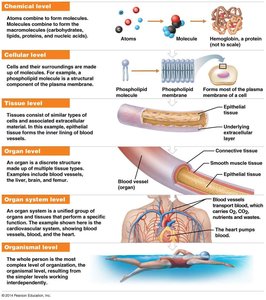
The human body is organized into hierarchical levels, each with distinct structural and functional properties.
Chemical Level: Atoms combine to form molecules (e.g., proteins, lipids, carbohydrates).
Cellular Level: Cells are the basic units of life, composed of molecules and organelles.
Tissue Level: Tissues are groups of similar cells performing a common function (e.g., epithelial, muscle, connective, nervous tissue).
Organ Level: Organs are structures composed of at least two tissue types, performing specific functions.
Organ System Level: Organ systems consist of related organs working together (e.g., cardiovascular system).
Organismal Level: The human organism is the sum of all structural levels working together.
Anatomical Position and Body Regions
Anatomical Position
The anatomical position is a standardized reference posture used to describe the location and orientation of body parts. In this position, the body stands upright, facing forward, with arms at the sides and palms facing forward.
Provides a consistent frame of reference for anatomical terminology.
Organs are also described as being in anatomical position.
Body Regions
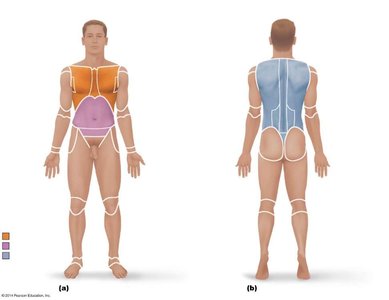
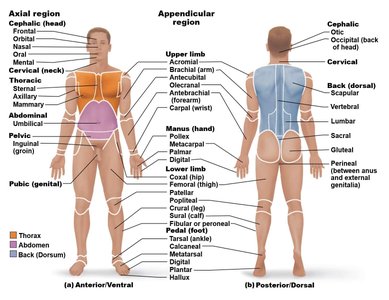
The body is divided into regions for precise anatomical description. Regional terms are often nested within each other (e.g., antecubital < upper limb < appendicular < anterior).
Regions are used to name associated structures and organs (e.g., femoral artery in the femoral region).
Planes and Sections of the Body
Body Planes
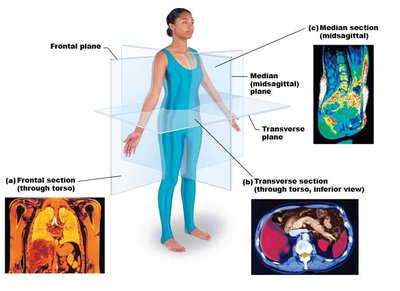
Body planes are imaginary lines used to divide the body for anatomical study and medical imaging.
Frontal (Coronal) Plane: Divides the body into anterior (front) and posterior (back) parts.
Sagittal (Median) Plane: Divides the body into right and left halves.
Parasagittal Plane: Parallel to the sagittal plane but offset from the midline.
Transverse (Horizontal) Plane: Divides the body into superior (upper) and inferior (lower) parts.
Oblique Plane: Cuts made at an angle between the horizontal and vertical planes.
Orientation and Directional Terms
Directional Terms
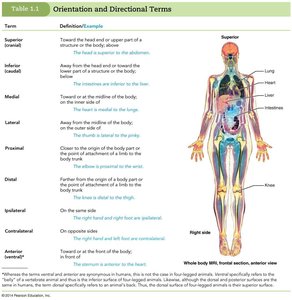
Directional terms describe the positions of structures relative to other structures or locations in the body. Most terms are used in pairs.
Term | Definition/Example |
|---|---|
Superior (cranial) | Toward the head or upper part of a structure (e.g., The head is superior to the abdomen.) |
Inferior (caudal) | Away from the head or toward the lower part of a structure (e.g., The navel is inferior to the chin.) |
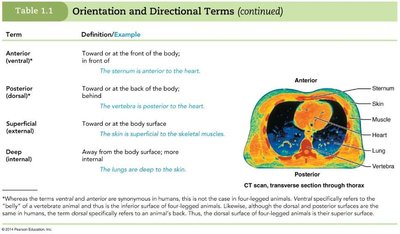
Anterior (ventral) | Toward or at the front of the body (e.g., The sternum is anterior to the heart.) |
Posterior (dorsal) | Toward or at the back of the body (e.g., The vertebra is posterior to the heart.) |
Medial | Toward the midline of the body (e.g., The heart is medial to the arm.) |
Lateral | Away from the midline of the body (e.g., The arms are lateral to the chest.) |
Proximal | Closer to the origin of the body part (e.g., The elbow is proximal to the wrist.) |
Distal | Farther from the origin of a body part (e.g., The knee is distal to the thigh.) |
Superficial (external) | Toward or at the body surface (e.g., The skin is superficial to the skeletal muscles.) |
Deep (internal) | Away from the body surface (e.g., The lungs are deep to the skin.) |
Ipsilateral | On the same side of the body (e.g., The right hand and right foot are ipsilateral.) |
Contralateral | On the opposite side of the body (e.g., The right hand and left foot are contralateral.) |
Body Cavities and Membranes
Major Body Cavities
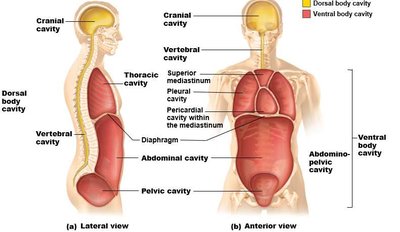
The body contains several major cavities that house and protect internal organs.
Dorsal Cavity: Includes the cranial cavity (brain) and vertebral cavity (spinal cord).
Ventral (Anterior) Cavity: Includes the thoracic cavity (heart, lungs) and abdominopelvic cavity (digestive, urinary, reproductive organs), separated by the diaphragm.
Membranes of Body Cavities
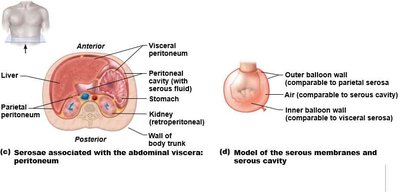
Body cavities are lined by membranes that protect organs and reduce friction.
Mucous Membranes: Line cavities that open to the exterior (e.g., respiratory, digestive tracts).
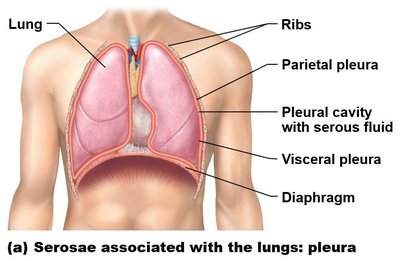
Serous Membranes: Line cavities that do not open to the exterior; consist of a visceral layer (covers organs) and a parietal layer (lines cavity walls) with serous fluid in between.
Examples include the pleura (lungs), pericardium (heart), and peritoneum (abdominal organs).
Abdominopelvic Quadrants and Regions
Abdominopelvic Quadrants
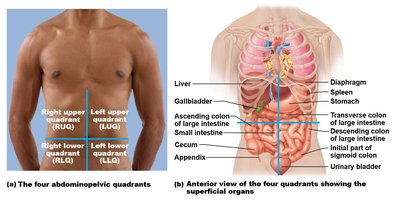
The abdominopelvic cavity is divided into four quadrants by two perpendicular lines intersecting at the umbilicus. These quadrants are used in clinical descriptions to localize pain or pathology.
Right Upper Quadrant (RUQ)
Left Upper Quadrant (LUQ)
Right Lower Quadrant (RLQ)
Left Lower Quadrant (LLQ)
Abdominopelvic Regions
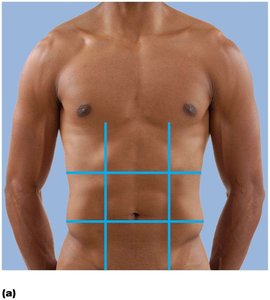
Nine regions are delineated by four planes (two parasagittal and two transverse) for more precise anatomical localization of organs.
Right/Left Hypochondriac
Epigastric
Right/Left Lumbar
Umbilical
Right/Left Iliac (Inguinal)
Hypogastric (Pubic)
Additional info: The use of quadrants and regions is essential in clinical practice for describing the location of symptoms, injuries, or surgical sites.
