 Back
The Human Body: An Orientation – Structured Study Notes
Study Guide - Smart Notes
 Tailored notes based on your materials, expanded with key definitions, examples, and context.
The Human Body: An Orientation
Introduction to Anatomy and Physiology
Anatomy is the study of the structure of body parts and their relationships to one another, while physiology focuses on the function of these parts and how they work to sustain life. Understanding both is essential for comprehending how the human body operates as an integrated whole.
Macroscopic (Gross) Anatomy: Study of large, visible structures.
Microscopic Anatomy: Study of structures too small to be seen with the naked eye (e.g., cytology and histology).
Developmental Anatomy: Study of anatomical and physiological development throughout life.
Levels of Structural Organization
The human body is organized into a hierarchy of structural levels, each building on the previous one:
Chemical Level: Atoms, molecules, and organelles.
Cellular Level: Single cells.
Tissue Level: Groups of similar cells with a common function.
Organ Level: Structures composed of at least two tissue types.
Organ System Level: Organs working closely together.
Organismal Level: The sum of all structural levels working together to keep us alive.
Basic Tissue Types
The body is composed of four basic tissue types, each with specialized functions:
Epithelial Tissue: Covers body surfaces and lines cavities.
Muscle Tissue: Provides movement.
Connective Tissue: Supports and protects body organs.
Nervous Tissue: Enables rapid internal communication by transmitting electrical impulses.
Subdivisions of Anatomy and Physiology
Regional Anatomy: All structures in a particular area of the body.
Systemic Anatomy: Focuses on one system (e.g., cardiovascular, nervous).
Surface Anatomy: Studies internal structures as related to overlying skin.
Physiology: Often based on organ systems and focuses on cellular and molecular levels.
Necessary Life Functions
To maintain life, the body must perform several essential functions:
Maintaining Boundaries: Separation between internal and external environments (e.g., plasma membranes, skin).
Movement: Muscular system allows movement of body parts and substances.
Responsiveness: Ability to sense and respond to stimuli.
Digestion: Breakdown and absorption of nutrients.
Metabolism: All chemical reactions in the body, including catabolism and anabolism.
Excretion: Removal of metabolic wastes.
Reproduction: Cellular division for growth/repair and production of offspring.
Growth: Increase in size of a body part or organism.
Survival Needs
Nutrients: Chemicals for energy and cell building (carbohydrates, proteins, fats, vitamins, minerals).
Oxygen: Essential for energy release from foods.
Water: Most abundant chemical in the body; solvent for reactions.
Normal Body Temperature: Necessary for proper metabolic reactions (about 37°C).
Appropriate Atmospheric Pressure: Required for adequate breathing and gas exchange.
Homeostasis
Homeostasis is the maintenance of relatively stable internal conditions despite continuous environmental changes. It is a dynamic state of equilibrium, maintained by all organ systems.
Components of Homeostatic Control:
Receptor: Monitors environment and responds to stimuli.
Control Center: Determines set point and appropriate response.
Effector: Carries out the response to restore balance.
Feedback Mechanisms:
Negative Feedback: Reduces or shuts off original stimulus (e.g., regulation of body temperature, blood glucose).
Positive Feedback: Enhances original stimulus (e.g., labor contractions, blood clotting).
Homeostatic Imbalance: Disturbance increases risk of disease and contributes to aging.
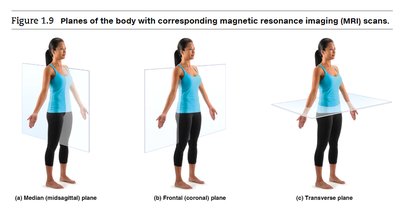
Body Planes and Sections
Body planes are used to describe locations or directions in the body:
Sagittal Plane: Divides body into right and left parts. The midsagittal (median) plane is exactly in the midline; parasagittal is offset from the midline.
Frontal (Coronal) Plane: Divides body into anterior and posterior parts.
Transverse (Horizontal) Plane: Divides body into superior and inferior parts; also called a cross section.
Oblique Sections: Cuts made diagonally between horizontal and vertical planes.
Body Cavities and Membranes
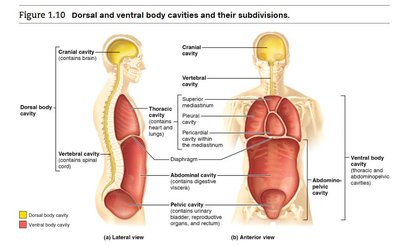
The body contains internal cavities that protect organs and allow for organ movement and expansion:
Dorsal Body Cavity: Protects nervous system organs; includes cranial cavity (brain) and vertebral cavity (spinal cord).
Ventral Body Cavity: Houses internal organs (viscera); includes thoracic cavity (pleural and pericardial cavities) and abdominopelvic cavity (abdominal and pelvic cavities).
Serous Membranes (Serosa): Thin, double-layered membranes that cover ventral body cavity walls and organs. Parietal serosa lines cavity walls; visceral serosa covers organs. Separated by serous fluid for lubrication.
Abdominopelvic Regions
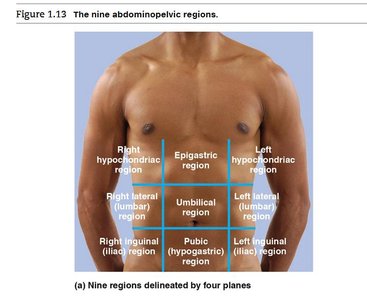
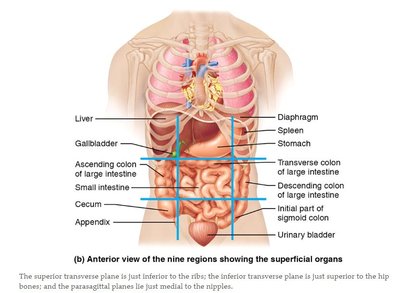
The abdominopelvic cavity is divided into nine regions for anatomical reference. These regions help in locating organs and describing pain or injury locations.
Right/Left Hypochondriac Regions
Epigastric Region
Right/Left Lumbar Regions
Umbilical Region
Right/Left Iliac (Inguinal) Regions
Hypogastric (Pubic) Region
Directional and Regional Terms
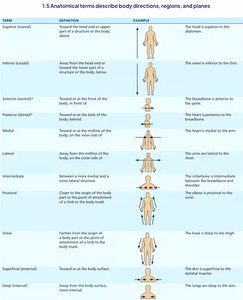
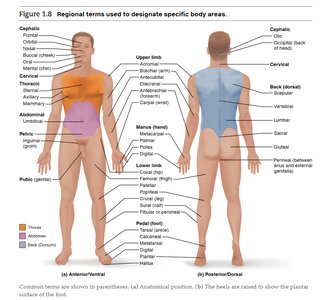
Directional terms describe the positions of structures relative to other structures or locations in the body. Regional terms specify particular areas within major body divisions.
Superior (Cranial): Toward the head or upper part of a structure.
Inferior (Caudal): Away from the head or toward the lower part of a structure.
Anterior (Ventral): Toward the front of the body.
Posterior (Dorsal): Toward the back of the body.
Medial: Toward the midline of the body.
Lateral: Away from the midline of the body.
Proximal: Closer to the origin of the body part or point of attachment.
Distal: Farther from the origin of the body part or point of attachment.
Superficial (External): Toward or at the body surface.
Deep (Internal): Away from the body surface; more internal.
Vocabulary and Key Concepts
Contractility: Movement at the cellular level.
Stimulus: Any detectable change in the internal or external environment that triggers a response.
Metabolism: All chemical reactions within cells.
Catabolism: Breakdown of substances into simpler components.
Anabolism: Synthesis of complex molecules from simpler ones.
Receptor: Sensor that monitors the environment and responds to stimuli.
Afferent Pathway: Nerves carrying messages to the brain (approaching).
Efferent Pathway: Nerves carrying messages from the brain to the body (exiting).
Axial: Main axis of the body (head, neck, trunk).
Appendicular: Limbs attached to the body's axis.
Dorsal Body Cavity: Posterior, fluid-filled space (cranial and vertebral cavities).
Meninges: Membranes covering the brain and spinal cord.
Distal, Lateral, Superior, Anterior, Posterior, Superficial: Directional terms for anatomical reference.
Summary Table: Anatomical Directional Terms
Term | Definition | Example |
|---|---|---|
Superior (Cranial) | Above or toward the head | The head is superior to the abdomen. |
Inferior (Caudal) | Below or away from the head | The navel is inferior to the chin. |
Anterior (Ventral) | Toward the front | The breastbone is anterior to the spine. |
Posterior (Dorsal) | Toward the back | The heart is posterior to the breastbone. |
Medial | Toward the midline | The heart is medial to the arm. |
Lateral | Away from the midline | The arms are lateral to the chest. |
Proximal | Closer to the origin | The elbow is proximal to the wrist. |
Distal | Farther from the origin | The knee is distal to the thigh. |
Superficial (External) | Toward the body surface | The skin is superficial to the muscles. |
Deep (Internal) | Away from the body surface | The lungs are deep to the skin. |
Additional info: These notes provide foundational terminology and concepts essential for all subsequent study in anatomy and physiology, including the understanding of body systems, planes, and regions.
