 Back
The Human Body: An Orientation – Study Notes for BIOL 2120K
Study Guide - Smart Notes
 Tailored notes based on your materials, expanded with key definitions, examples, and context.
The Human Body: An Orientation
Overview of Anatomy and Physiology
Anatomy and physiology are foundational sciences in understanding the structure and function of the human body. Anatomy focuses on the physical structures, while physiology examines how these structures operate.
Anatomy: The study of body structure, including gross (macroscopic), microscopic, and developmental anatomy.
Physiology: The study of body function, often subdivided by organ systems (e.g., cardiovascular, lymphatic, respiratory).
Principle of Complementarity: Structure and function are inseparable; the function of a body part depends on its structure.
Methods to study anatomy: Mastery of terminology, observation, manipulation, palpation, and auscultation.
Levels of Structural Organization
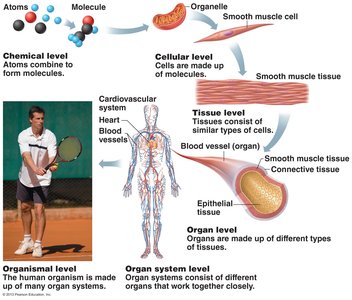
The human body is organized into hierarchical levels, each building upon the previous. Understanding these levels is essential for grasping how the body functions as a whole.
Chemical Level: Atoms combine to form molecules.
Cellular Level: Cells are made up of molecules and are the basic unit of life.
Tissue Level: Groups of similar cells form tissues.
Organ Level: Organs are made up of different types of tissues.
Organ System Level: Organ systems consist of different organs that work together closely.
Organismal Level: The human organism is made up of many organ systems.
Maintaining Life: Necessary Life Functions
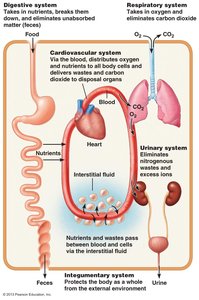
To sustain life, the human body must perform several essential functions. These functions are carried out by the cooperation of various organ systems.
Maintaining boundaries: Separation between internal and external environments (e.g., skin).
Movement: Includes contractility of muscles and movement of substances within the body.
Responsiveness: Ability to sense and respond to stimuli.
Digestion: Breakdown of ingested food.
Metabolism: All chemical reactions within the body.
Excretion: Removal of wastes.
Reproduction: Production of offspring.
Growth: Increase in size of a body part or organism.
Interdependence of Body Cells and Organ Systems
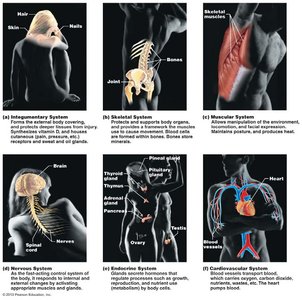
Humans are multicellular organisms, and the survival of each cell depends on the proper functioning of organ systems. These systems work together to maintain life and homeostasis.
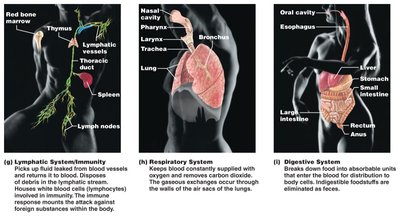
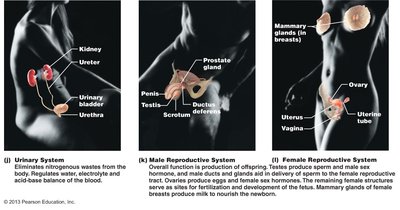
Organ systems: There are 11 major organ systems, each with specific functions and major organs.
Cooperation: Organ systems cooperate to fulfill body functions and maintain life.
Survival Needs
Several factors are necessary for life, and their absence or imbalance can threaten survival.
Nutrients: Essential for energy and cell building.
Oxygen: Required for cellular respiration. Equation:
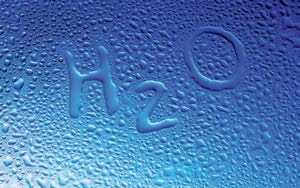
Water: Most abundant chemical in the body; vital for chemical reactions.
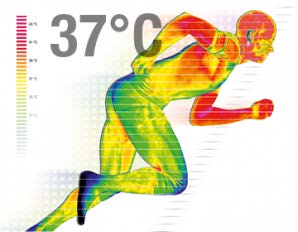
Body temperature: Must be maintained for proper metabolic function.
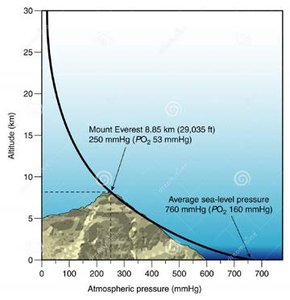
Atmospheric pressure: Necessary for proper breathing and gas exchange.

Homeostasis and Homeostatic Control Mechanisms
Definition and Importance of Homeostasis
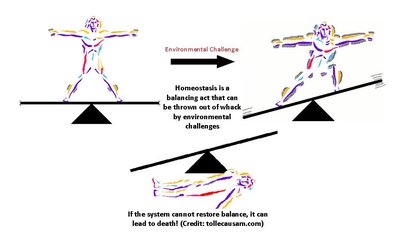
Homeostasis is the condition in which the body maintains a relatively stable internal environment, despite external changes. It is essential for normal body functioning and survival.
Continuous monitoring: All organ systems monitor and regulate variables.
Communication: Organ systems communicate to maintain balance.
Components of Homeostatic Control Mechanisms
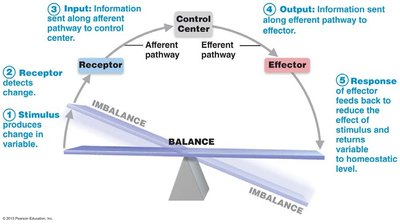
Homeostatic control involves three main components: receptor, control center, and effector. These elements interact to maintain stable internal conditions.
Receptor: Detects changes (stimuli) in the environment.
Control center: Determines the set point and processes information.
Effector: Responds to restore balance, either reducing (negative feedback) or enhancing (positive feedback) the stimulus.
Negative Feedback Mechanisms
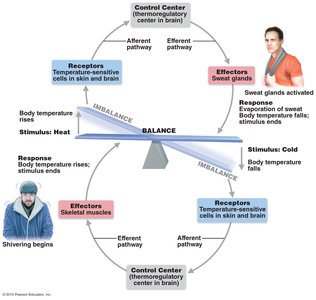
Negative feedback mechanisms are the most common in the body. They reduce or shut off the original stimulus, helping to maintain homeostasis.
Example: Regulation of body temperature.
Process: When body temperature rises, mechanisms activate to cool the body; when it falls, mechanisms activate to warm the body.

Positive Feedback Mechanisms
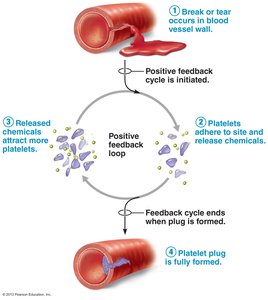
Positive feedback mechanisms enhance or exaggerate the original stimulus. They are less common and usually control infrequent events that require rapid change.
Example: Platelet plug formation and blood clotting.
Process: A break in a blood vessel initiates a cycle where platelets adhere, release chemicals, and attract more platelets until the plug is formed.
Homeostatic Imbalance
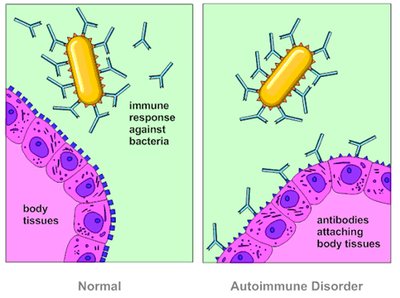
Disturbances in homeostasis can lead to disease and contribute to aging. If negative feedback mechanisms are overwhelmed, destructive positive feedback mechanisms may take over.
Example: Autoimmune disorders, where the immune system attacks body tissues.
Language of Anatomy
Anatomical Position
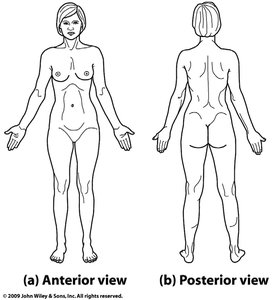
The anatomical position is the standard frame of reference for anatomical descriptions. It ensures consistency in terminology and orientation.
Standard position: Person stands erect, feet flat and slightly apart, arms at sides, head and palms facing forward.
Directional terms: Always used as if the body were in anatomical position.
Directional Terms
Directional terms are used to describe the location of structures relative to other structures or locations in the body.
Term | Definition |
|---|---|
Superior (cranial) | Toward head or upper part; above |
Inferior (caudal) | Away from head or lower part; below |
Ventral (anterior) | Toward front; in front of |
Dorsal (posterior) | Toward back; behind |
Medial | Toward midline; on inner side |
Lateral | Away from midline; on outer side |
Intermediate | Between more medial and more lateral structure |
Proximal | Closer to origin or point of attachment |
Distal | Farther from origin or point of attachment |
Superficial (external) | Toward or at body surface |
Deep (internal) | Away from body surface |
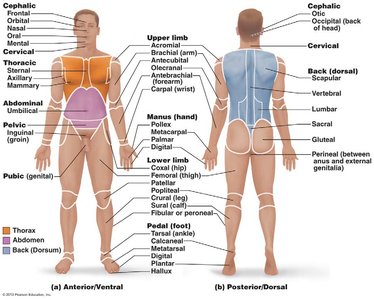
Regional Terms
Regional terms designate specific areas within body divisions. The body is divided into axial (head, neck, trunk) and appendicular (limbs) regions.
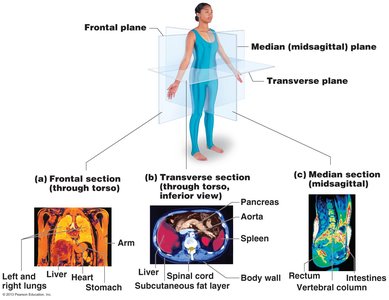
Body Planes and Sections
Body planes are imaginary flat surfaces that divide the body for anatomical study. Sections are cuts along these planes.
Sagittal plane: Divides body into left and right parts.
Midsagittal (median) plane: Lies on midline.
Parasagittal plane: Not on midline.
Frontal (coronal) plane: Divides body into anterior and posterior parts.
Transverse (horizontal) plane: Divides body into superior and inferior parts.
Oblique plane: Cuts at an angle.
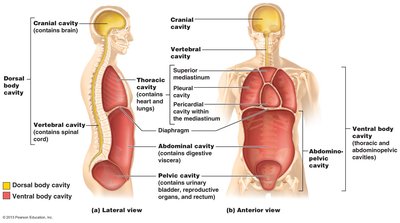
Body Cavities
Body cavities are closed environments that provide protection to organs. They are classified as dorsal and ventral cavities.
Dorsal body cavity: Protects nervous system (cranial and vertebral cavities).
Ventral body cavity: Houses internal organs (thoracic and abdominopelvic cavities).
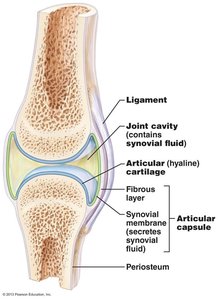
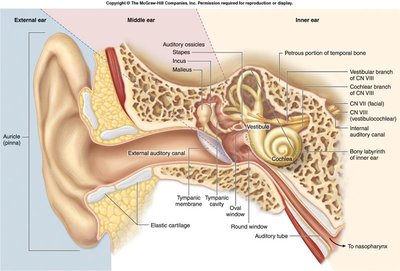
Other cavities: Oral, nasal, orbital, middle ear, and synovial cavities.
Serous Membranes
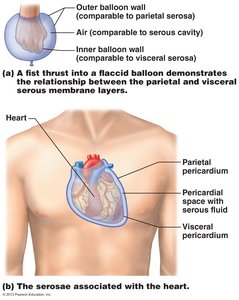
Serous membranes (serosa) are thin, double-layered membranes that cover organs and line cavities. They are named for the specific cavity and organs they are associated with.
Parietal serosa: Lines cavity walls.
Visceral serosa: Covers organs.
Serous fluid: Separates layers and reduces friction.
Examples: Pericardium (heart), pleurae (lungs), peritoneum (abdominopelvic cavity).
Abdominopelvic Quadrants and Regions
The abdominopelvic cavity is divided into quadrants and regions for medical and anatomical reference.
Quadrants: Used by medical personnel (right upper, left upper, right lower, left lower).
Regions: Nine divisions used by anatomists.
Example:
When describing pain or pathology, clinicians may refer to the right upper quadrant (RUQ) or the left lower quadrant (LLQ) to localize symptoms.
Additional info: The notes above expand brief points into full academic explanations and add context for clarity and completeness.
