 Back
BackThe Human Reproductive System: Structure, Function, and Regulation
Study Guide - Smart Notes
 Tailored notes based on your materials, expanded with key definitions, examples, and context.
The Reproductive System Overview
The human reproductive system enables sexual reproduction, which involves the fusion of haploid gametes (sperm and egg) to form a diploid zygote. This process increases genetic diversity and is regulated by complex hormonal interactions between the brain and the gonads (testes in males, ovaries in females).
Male Reproductive System
Anatomy of the Male Reproductive System
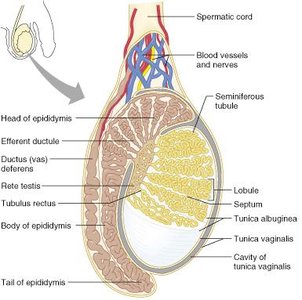
The male reproductive system consists of paired testes, a series of ducts, accessory glands, and supporting structures such as the penis. The testes are the primary male gonads responsible for sperm production and hormone secretion.
Testes: Site of sperm production within seminiferous tubules.
Epididymis: Coiled tube where sperm mature and gain motility.
Vas deferens: Duct that transports sperm from the epididymis to the urethra.
Accessory glands: Seminal vesicles, prostate gland, and bulbourethral glands produce seminal fluid that nourishes and protects sperm.
Spermatogenesis
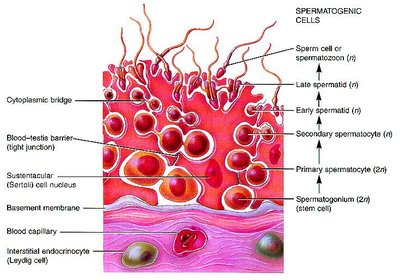
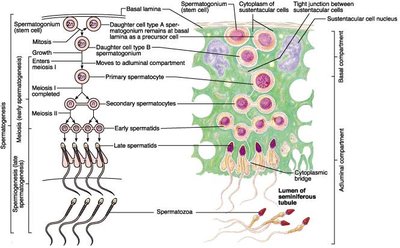
Spermatogenesis is the process by which diploid spermatogonia develop into mature haploid spermatozoa within the seminiferous tubules of the testes. This process involves mitosis, meiosis, and morphological maturation.
Spermatogonia: Diploid stem cells that either remain as stem cells or differentiate into primary spermatocytes.
Primary spermatocytes: Undergo meiosis I to form secondary spermatocytes (haploid).
Secondary spermatocytes: Undergo meiosis II to produce spermatids (haploid).
Spermatids: Mature into spermatozoa (sperm cells).
Structure of a Sperm Cell
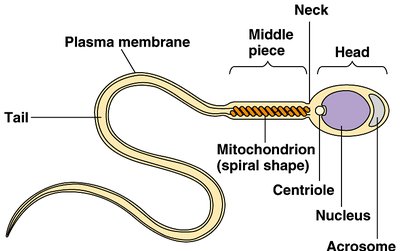
A mature sperm cell is specialized for motility and fertilization, consisting of three main parts:
Head: Contains the nucleus with 23 chromosomes and is capped by the acrosome, which contains enzymes for penetrating the egg.
Middle piece: Packed with mitochondria that provide energy for movement.
Tail (flagellum): Propels the sperm forward.
Hormonal Regulation in Males
The production of sperm and male sex hormones is regulated by the hypothalamic-pituitary-gonadal axis:
GnRH (Gonadotropin-releasing hormone): Secreted by the hypothalamus; stimulates the anterior pituitary.
FSH (Follicle-stimulating hormone): Promotes spermatogenesis in the seminiferous tubules.
LH (Luteinizing hormone): Stimulates interstitial cells to produce testosterone.
Testosterone: Essential for sperm production and development of male secondary sexual characteristics.
Negative feedback: High testosterone inhibits GnRH and LH secretion; inhibin from seminiferous tubules inhibits FSH.
Female Reproductive System
Anatomy of the Female Reproductive System
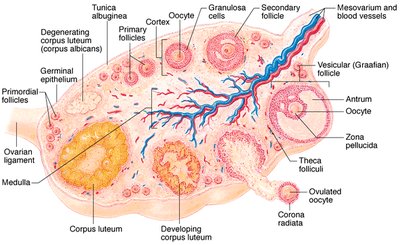
The female reproductive system includes the ovaries, oviducts (fallopian tubes), uterus, and vagina. The ovaries are the primary female gonads, producing oocytes (eggs) and sex hormones.
Ovaries: Site of oogenesis and hormone production.
Oviducts: Transport oocytes from the ovaries to the uterus; site of fertilization.
Uterus: Site of embryo implantation and development.
Vagina: Muscular canal for intercourse and childbirth.
Oogenesis
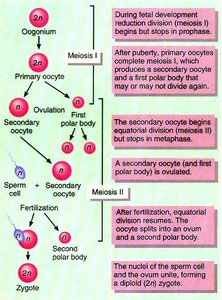
Oogenesis is the process by which diploid oogonia develop into mature haploid ova (eggs) in the ovaries. This process involves mitosis, meiosis, and follicular development.
Oogonia: Diploid stem cells present during fetal development.
Primary oocytes: Arrested in prophase I until puberty.
Secondary oocytes: Produced after meiosis I; ovulated and arrested in metaphase II until fertilization.
Fertilization: Completion of meiosis II produces a mature ovum and a second polar body.
Ovarian Cycle
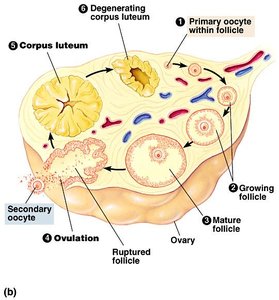
The ovarian cycle describes the maturation of ovarian follicles and the release of a secondary oocyte (ovulation). It consists of the follicular phase, ovulation, and the luteal phase.
Follicular phase: Follicles mature under the influence of FSH; estrogen levels rise.
Ovulation: Triggered by a surge in LH; secondary oocyte is released.
Luteal phase: Corpus luteum forms from the ruptured follicle and secretes progesterone.
Hormonal Regulation of the Ovarian and Menstrual Cycles
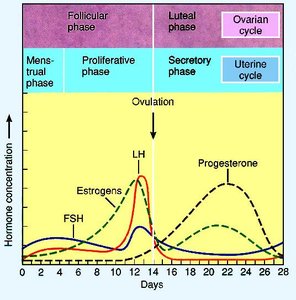
The ovarian and menstrual cycles are regulated by the interplay of hormones from the hypothalamus, pituitary gland, and ovaries. These cycles ensure the maturation of oocytes and preparation of the uterine lining for possible implantation.
FSH: Stimulates follicle development and estrogen production.
Estrogen: Promotes proliferation of the endometrium and regulates feedback to the hypothalamus and pituitary.
LH: Triggers ovulation and corpus luteum formation.
Progesterone: Maintains the endometrium for potential implantation.
Negative and positive feedback: High estrogen triggers LH surge (positive feedback); high progesterone and estrogen inhibit FSH and LH (negative feedback).
Female Reproductive Cycle
The female reproductive cycle consists of the ovarian cycle (events in the ovary) and the menstrual (uterine) cycle (changes in the endometrium). The cycle typically lasts 24–35 days and is coordinated by hormonal signals.
Ovarian hormones (estrogen, progesterone): Target the uterus and breasts to prepare for pregnancy.
Anterior pituitary hormones (FSH, LH): Target the ovaries to regulate follicle development and ovulation.
Cycle phases: Menstrual, proliferative, and secretory phases in the uterus correspond to follicular, ovulatory, and luteal phases in the ovary.
Summary Table: Comparison of Spermatogenesis and Oogenesis
Feature | Spermatogenesis | Oogenesis |
|---|---|---|
Location | Seminiferous tubules (testes) | Ovarian follicles (ovaries) |
Timing | Begins at puberty, continues throughout life | Begins before birth, completes upon fertilization |
Number of gametes per precursor cell | 4 sperm per spermatogonium | 1 ovum per oogonium (plus polar bodies) |
Duration | ~64 days per cycle | Years (arrested stages) |
