 Back
BackThe Human Skeleton: Structure and Organization
Study Guide - Smart Notes
 Tailored notes based on your materials, expanded with key definitions, examples, and context.
The Human Skeleton
Overview of the Skeletal System
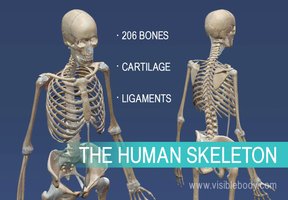
The human skeleton forms the internal framework of the body, providing support, protection, and facilitating movement. It is composed of bones, cartilage, and ligaments, which together maintain the structure and function of the body.
206 Bones: The adult human skeleton consists of 206 distinct bones, each with specific roles in support, movement, and protection.
Cartilage: A flexible connective tissue found in joints, the rib cage, ear, nose, bronchial tubes, and intervertebral discs. It reduces friction and acts as a cushion between bones.
Ligaments: Strong bands of fibrous connective tissue that connect bones to other bones, stabilizing joints and supporting movement.
Key Functions of the Skeleton:
Support: Provides a rigid framework that supports the body and cradles soft organs.
Protection: Encloses and protects vital organs (e.g., skull protects the brain, rib cage protects the heart and lungs).
Movement: Acts as levers for muscles to pull on, enabling movement.
Mineral Storage: Stores minerals such as calcium and phosphorus, which can be released into the bloodstream as needed.
Blood Cell Formation: Hematopoiesis occurs in the red marrow of certain bones.
Divisions of the Skeleton:
Axial Skeleton: Consists of the skull, vertebral column, and rib cage. It forms the long axis of the body and supports and protects the organs of the head, neck, and trunk.
Appendicular Skeleton: Includes the bones of the upper and lower limbs and the girdles (pectoral and pelvic) that attach them to the axial skeleton.
