 Back
BackThe Immune System: Innate and Adaptive Defenses
Study Guide - Smart Notes
 Tailored notes based on your materials, expanded with key definitions, examples, and context.
Immune System Overview
The immune system is the body's defense mechanism against pathogens and harmful substances. It is divided into two main types: innate (non-specific) and adaptive (specific) immunity.
Innate Immunity
Physical Barriers
Physical barriers are the first line of defense, preventing pathogen entry into the body.
Skin: Forms a protective wall, secretes antimicrobial substances, and supports normal flora that outcompete pathogens.
Mucosal Membranes: Line body openings, produce mucus to trap substances, and secrete lysozyme, defensins, and IgA.
Inflammation
Inflammation is an immediate, local response to injury or infection in vascularized tissue. It is a major innate immune response that eliminates most infectious agents.
Events:
Tissue damage triggers release of chemicals (e.g., histamine, heparin, chemotactic factors).
Vascular changes: vasodilation, increased capillary permeability, and expression of cell-adhesion molecules (CAMs).
Recruitment of leukocytes: margination, diapedesis, and chemotaxis guide immune cells to the site of infection.
Delivery of plasma proteins: includes hemostasis and kinins, which increase permeability and stimulate pain receptors.
Effects: Increased fluid movement, formation of exudate, removal of unwanted substances, and promotion of healing.
Signs: Redness, heat, swelling, pain, and temporary loss of function.
Fever
Fever is an abnormal elevation of body temperature, usually in response to pyrogens released by infectious agents or immune cells.
Events: Pyrogens stimulate the hypothalamus to raise the set temperature point, leading to heat conservation and increased metabolic rate.
Benefits: Inhibits microbial replication, promotes interferon activity, increases adaptive cell activity, and enhances tissue repair.
Risks: High fevers can denature proteins, cause seizures, brain damage, or death.
Cells of Innate Immunity
Neutrophils & Macrophages: Phagocytize and digest unwanted substances.
Dendritic Cells: Destroy infectious agents and present antigens to initiate adaptive immunity.
Basophils & Mast Cells: Pro-inflammatory, secrete histamine, heparin, and eicosanoids.
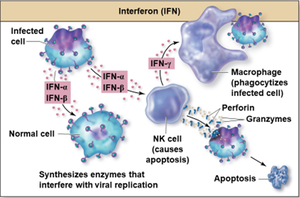
Natural Killer (NK) Cells: Patrol for unhealthy cells, release perforin and granzymes to induce apoptosis.
Eosinophils: Target parasites, increase inflammation, and participate in allergies/asthma.
Antimicrobial Proteins
These molecules function against microbes and include interferons and the complement system.
Interferons (IFN): Cytokines that provide nonspecific defense against viral infections. IFN-α and IFN-β protect neighboring cells by inducing antiviral enzymes; IFN-γ activates macrophages to destroy infected cells.
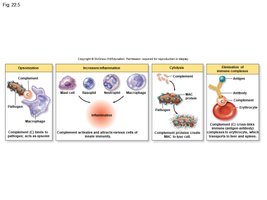
Complement System: A group of 20 plasma proteins produced by the liver, circulating in the blood, and activated by pathogens. Functions include:
Function | Description |
|---|---|
Opsonization | Binding of opsonin proteins to bacteria, increasing phagocytosis |
Increased Inflammation | Activation of mast cells and basophils, attracting immune cells |
Cytolysis | Formation of membrane attack complex (MAC) that lyses pathogens |
Elimination of Immune Complexes | Antigen-antibody complexes are transported to the spleen for removal |
Adaptive Immunity
General Features
Adaptive immunity targets specific antigens and involves lymphocytes (T and B cells). It is characterized by specificity and memory.
Antigens
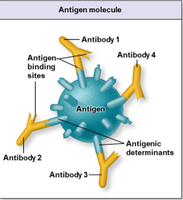
Antigen: A substance bound to a pathogen's plasma membrane, recognized as foreign by the immune system.
Antigenic Determinant (Epitope): The specific site on an antigen recognized by immune cells.
Immunogen: An antigen that induces an immune response; recognition increases with foreignness, size, complexity, and quality.
Haptens: Small molecules that elicit an immune response only when attached to a larger protein, often causing allergies.
Lymphocytes
Origin: All lymphocytes originate in the red bone marrow; T cells mature in the thymus.
Receptor Complex: Each lymphocyte has a unique receptor (TCR for T-cells, BCR for B-cells) that binds a specific antigen.
T-Cells: Include helper, cytotoxic, memory, and regulatory T-cells.
B-Cells: Differentiate into active B-cells (produce antibodies) and memory B-cells.
Antibodies (Immunoglobulins)
Antibodies are proteins produced by B-cells that bind specific antigens, tagging them for destruction.
Structure: Four polypeptide chains (2 heavy, 2 light) in a Y-shape. The variable region binds antigens; the constant region determines function.
Classes: IgG, IgM, IgA, IgD, IgE—each with distinct roles (e.g., neutralization, agglutination, allergic reactions).
Antibody Actions
Neutralization: Antibody covers the antigen, preventing its pathogenic effect.
Agglutination: Antibody cross-links cells, causing clumping.
Precipitation: Antibody cross-links soluble particles, forming insoluble complexes for phagocytosis.
Complement Fixation: Antibody activates complement proteins, leading to cell lysis.
Opsonization: Antibody tags pathogens for phagocytosis.
Activation of NK Cells: Antibody binding triggers NK cells to release cytotoxic chemicals, causing apoptosis.
Antigen Presentation
Antigen presentation is the display of antigen fragments on cell membranes, allowing T-cells to recognize and respond to pathogens.
Major Histocompatibility Complex (MHC): Glycoproteins unique to each individual, with two classes:
Class I MHC: Present on all nucleated cells; display endogenous antigens to cytotoxic T-cells.
Class II MHC: Present on antigen-presenting cells (APCs); display exogenous antigens to helper T-cells.
