 Back
BackThe Immune System: Innate and Adaptive Body Defenses
Study Guide - Smart Notes
 Tailored notes based on your materials, expanded with key definitions, examples, and context.
The Immune System: Overview
Introduction
The immune system protects the body from disease-causing organisms and cancerous cells through a complex network of defenses. These defenses are categorized into innate (nonspecific) and adaptive (specific) immunity, each with distinct mechanisms and cellular components. 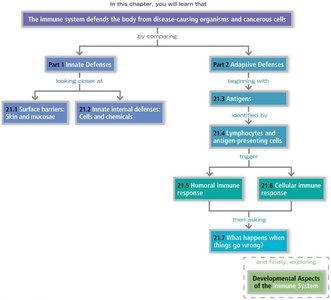
Innate (Nonspecific) Defenses
Surface Barriers: The First Line of Defense
Surface barriers, including the skin and mucous membranes, form the body's initial defense against pathogens. These barriers are supported by various protective chemicals and physical mechanisms.
Skin (Intact Epidermis): Provides a tough, keratinized barrier that prevents entry of pathogens and harmful substances.
Mucous Membranes: Line body cavities open to the exterior, trapping and removing microbes.
Protective Chemicals:
Acid Mantle: Skin and vaginal secretions are acidic, inhibiting bacterial growth.
Keratin: Resists acids, bases, and bacterial enzymes.
Lysozyme: Enzyme in saliva, tears, and other secretions that destroys bacteria.
Mucus: Traps microorganisms in respiratory and digestive tracts.
Other Secretions: Gastric juice, urine, and sebum also contribute to microbial defense.
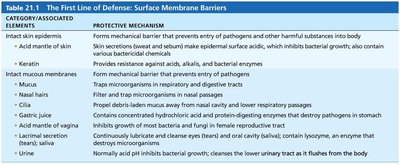
CATEGORY/ASSOCIATED ELEMENTS | PROTECTIVE MECHANISM |
|---|---|
Intact epidermis | Mechanical barrier; prevents entry of pathogens |
Acid mantle of skin | Inhibits bacterial growth; contains bactericidal chemicals |
Keratin | Resists acids, alkalis, and bacterial enzymes |
Mucus | Traps microorganisms in respiratory/digestive tracts |
Lysozyme (tears, saliva) | Destroys bacteria |
Gastric juice | Destroys pathogens in stomach |
Urine | Inhibits bacterial growth; flushes urinary tract |
Other (e.g., vaginal secretions, cilia) | Additional regional protection |
Internal Defenses: The Second Line of Defense
When pathogens breach surface barriers, internal defenses are activated. These include cellular and chemical mechanisms.
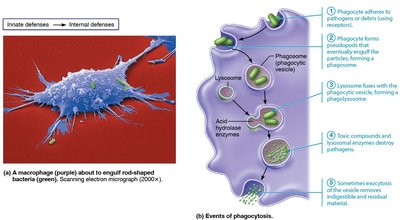
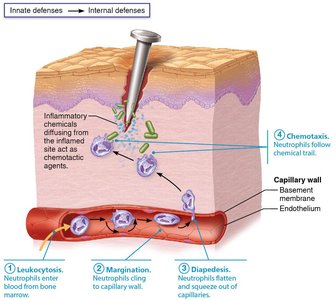
Phagocytes: Neutrophils and macrophages engulf and destroy pathogens through phagocytosis.
Phagocytosis involves adherence, ingestion, formation of a phagolysosome, and destruction of the pathogen.
Natural Killer (NK) Cells: Destroy virus-infected and cancer cells by inducing apoptosis.
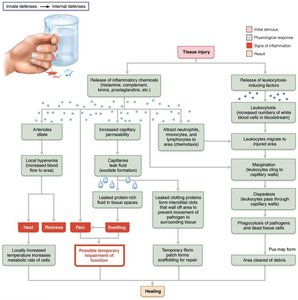
Inflammation: Local response to injury or infection, characterized by redness, heat, swelling, and pain.
Functions: Prevents spread of damage, disposes of debris, alerts adaptive immunity, and initiates repair.
Antimicrobial Proteins:
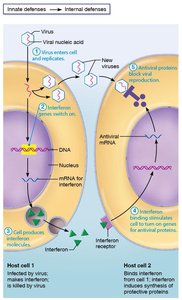
Interferons: Released by virus-infected cells to protect neighboring cells by inhibiting viral replication.
Complement System: Plasma proteins that enhance phagocytosis, inflammation, and cell lysis.
Fever: Systemic response to infection; increases body temperature to inhibit microbial growth and enhance repair.
Adaptive (Specific) Defenses
Overview of Adaptive Immunity
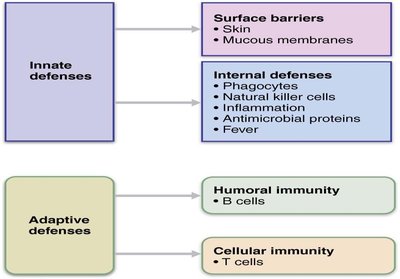
Adaptive defenses are highly specific and involve recognition of particular antigens. They consist of humoral (antibody-mediated) and cellular (cell-mediated) immunity.
Humoral Immunity: Mediated by B cells, which produce antibodies that target extracellular pathogens.
Cellular Immunity: Mediated by T cells, which directly attack infected or abnormal cells.
Antigens and Antigenic Determinants
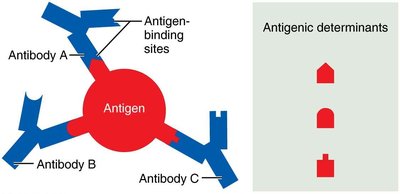
Antigens: Substances that trigger adaptive immune responses. They possess immunogenicity (ability to stimulate lymphocyte proliferation) and reactivity (ability to react with lymphocytes/antibodies).
Antigenic Determinants: Specific regions on antigens recognized by antibodies or lymphocyte receptors.
Self-Antigens: Body's own molecules, usually not antigenic to self due to MHC (major histocompatibility complex) proteins.
Lymphocyte Development, Maturation, and Activation
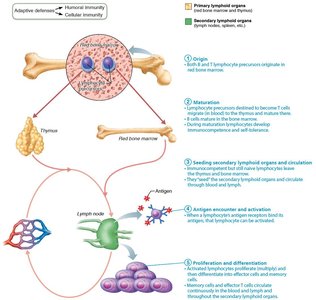
Origin: All lymphocytes originate from hematopoietic stem cells in red bone marrow.
Maturation:
B cells mature in the bone marrow.
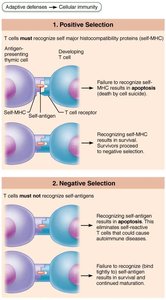
T cells mature in the thymus, undergoing positive and negative selection to ensure self-tolerance and immunocompetence.
Seeding Secondary Lymphoid Organs: Immunocompetent but naive lymphocytes circulate to secondary lymphoid organs (e.g., lymph nodes, spleen).
Antigen Encounter and Activation: First encounter with antigen leads to clonal selection and proliferation of specific lymphocytes.
Differentiation: Most cells become effector cells; some become memory cells for rapid future responses.
Humoral Immune Response
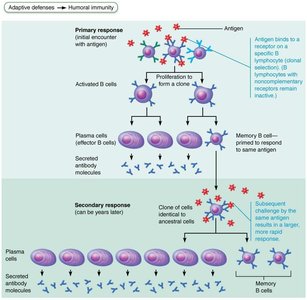
Activation of B Cells: Binding of antigen to B cell receptor triggers clonal selection and proliferation.
Plasma Cells: Most activated B cells become plasma cells, which secrete antibodies.
Memory B Cells: Provide immunological memory for faster, stronger secondary responses.
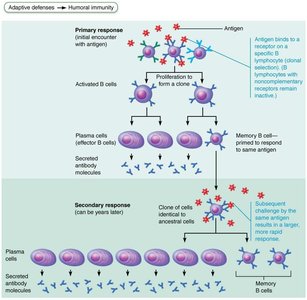
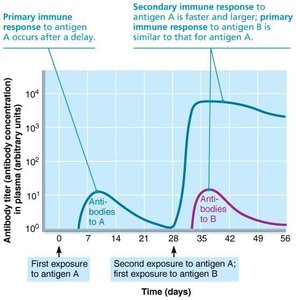
Primary Immune Response: Occurs after first exposure to antigen; slower and less robust.
Secondary Immune Response: Faster, stronger, and longer-lasting due to memory cells.
Active and Passive Humoral Immunity
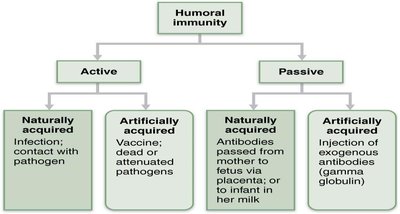
Active Immunity: Body produces its own antibodies (natural: infection; artificial: vaccination).
Passive Immunity: Antibodies are transferred from another source (natural: mother to fetus; artificial: injection of antibodies).
Antibody Structure and Function
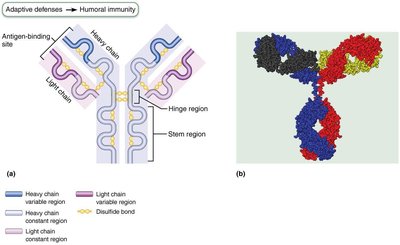
Structure: Y-shaped molecules with two heavy and two light chains, each with variable (antigen-binding) and constant regions.
Classes: IgM, IgA, IgD, IgG, IgE—each with distinct roles in immunity.
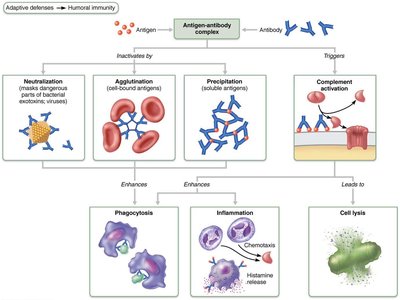
Functions: Neutralization, agglutination, precipitation, and complement activation.
Cellular Immune Response
T Cell Types and Functions
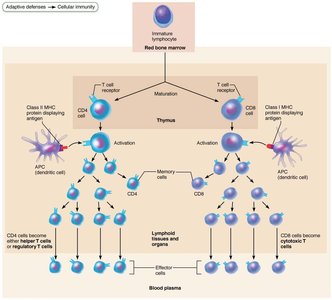
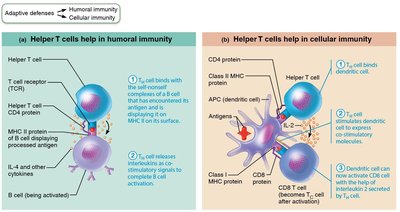
CD4 T Cells (Helper T Cells): Activate B cells, other T cells, and macrophages; regulate immune response.
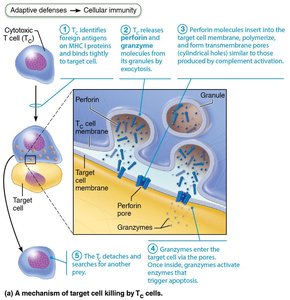
CD8 T Cells (Cytotoxic T Cells): Directly attack and kill infected or abnormal cells.
Regulatory T Cells: Suppress immune response to prevent overactivity and autoimmunity.
Antigen Presentation and MHC Proteins
Class I MHC: Present on all nucleated cells; display endogenous antigens to CD8 T cells.
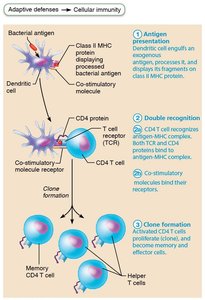
Class II MHC: Present on antigen-presenting cells; display exogenous antigens to CD4 T cells.
Activation and Differentiation of T Cells
Double Recognition: T cells must recognize both MHC and antigen.
Co-stimulation: Additional signals required for full activation.
Clonal Expansion: Activated T cells proliferate and differentiate into effector and memory cells.
Cytokines: Chemical messengers that regulate immune responses.
Immune System Disorders
Immunodeficiencies
Primary (Congenital): Genetic defects (e.g., SCID) impair immune cell function.
Acquired: HIV/AIDS destroys helper T cells, crippling immunity.
Autoimmune Diseases
Immune system attacks self-antigens due to failure of self-tolerance.
Treatment involves immunosuppression and targeting cytokines or co-stimulatory factors.
Hypersensitivities (Allergies)
Immediate (Type I): Rapid allergic reactions (e.g., anaphylaxis).
Subacute (Type II, III): Antibody-mediated, slower onset.
Delayed (Type IV): T cell-mediated, occurs days after exposure (e.g., contact dermatitis).
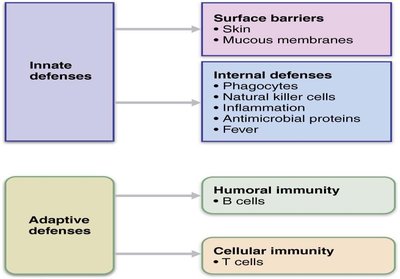
Summary Table: Innate vs. Adaptive Immunity
Innate Immunity | Adaptive Immunity |
|---|---|
Surface barriers (skin, mucosa) Phagocytes NK cells Inflammation Antimicrobial proteins Fever | B cells (antibodies) T cells (cytotoxic, helper, regulatory) Memory cells Highly specific Slower to respond initially |
Key Equations and Concepts
Clonal Selection:
Antibody Structure:
