 Back
The Immune System: Innate and Adaptive Body Defenses
Study Guide - Smart Notes
 Tailored notes based on your materials, expanded with key definitions, examples, and context.
Immune System: Innate and Adaptive Defenses
Lines of Defense
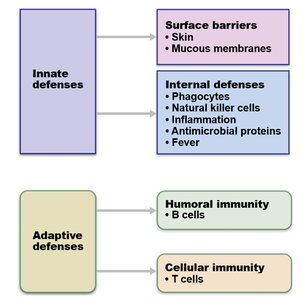
The human immune system protects the body from pathogens through multiple lines of defense, which are categorized as innate (nonspecific) and adaptive (specific) mechanisms.
Physical Barriers: The first line of defense includes the skin and mucous membranes, which act as barriers to prevent entry of pathogens.
Internal Defenses: The second line involves proteins and phagocytes that respond when pathogens breach physical barriers.
Adaptive Defenses: The third line is specific and involves lymphocytes that target particular pathogens.
Innate Immunity
Innate immunity provides immediate, nonspecific protection against pathogens.
Surface Barriers: Skin and mucous membranes physically block pathogens.
Internal Defenses:
Phagocytes: Cells that engulf and digest pathogens. The first phagocyte to arrive is usually the neutrophil, followed by macrophages.
Natural Killer Cells: Destroy infected or abnormal cells.
Inflammation: Characterized by four signs: redness, heat, swelling, and pain. Histamine is a key chemical mediator. Stages include vasodilation, increased permeability, and phagocyte migration.
Antimicrobial Proteins: Includes interferons (which inhibit viral replication) and complement proteins (which enhance phagocytosis and lyse pathogens).
Fever: Elevated body temperature inhibits pathogen growth.
Adaptive Immunity
Adaptive immunity is specific and involves lymphocytes that recognize and respond to particular antigens.
Humoral Immunity: Mediated by B cells, which target extracellular pathogens.
Cellular Immunity: Mediated by T cells, which target infected or abnormal cells.
4 Signs of Inflammation:
Redness (rubor) 🟥
Heat (calor) 🔥
Swelling (tumor) 💧
Pain (dolor) 😣
Histamine is a key chemical mediator released during inflammation, contributing to these signs.
Released by:
Mast cells
Basophils
Functions:
Vasodilation
Increases capillary permeability
Starts inflammation
Stages of Inflammation:
Vasodilation: Blood vessels widen, increasing blood flow to the area (causes redness and heat).
Increased Permeability: Blood vessel walls become more permeable, allowing fluid and immune cells to enter the tissue (causes swelling).
Phagocyte Migration: Phagocytes (like neutrophils and macrophages) move to the site to engulf pathogens and debris.
Antigens and Epitopes
Antigens are substances that provoke an immune response. An epitope is the specific part of an antigen recognized by immune cells.
MHC Molecules
Major Histocompatibility Complex (MHC) molecules display antigens on cell surfaces:
MHC I: Found on all nucleated cells; displays endogenous antigens (from within the cell).
MHC II: Found on antigen-presenting cells; displays exogenous antigens (from outside the cell).
Lymphocytes: Types, Surface Proteins, and Maturation
Lymphocytes are central to adaptive immunity. They express unique surface proteins and undergo maturation:
B cells: Mature in bone marrow; responsible for humoral immunity.
T cells: Mature in thymus; responsible for cellular immunity.
Activation leads to clonal selection and proliferation, producing effector and memory cells.
B Cells and Humoral Immunity
B cells target extracellular pathogens. After clonal selection:
Most clones become plasma cells that secrete antibodies.
A few become memory B cells for long-term immunity.
Antibodies neutralize pathogens, enhance phagocytosis, and activate complement.
T Cells and Cellular Immunity
T cells target infected or abnormal cells. Types include:
Cytotoxic T cells (Tc): Kill infected cells by releasing perforin and granzymes.
Helper T cells (Th): Activate Tc cells and B cells.
Regulatory T cells: Suppress immune responses to prevent autoimmunity.
Tc cell activation depends on Th cells for cytokine signals. Tc cells target cells displaying abnormal antigens and induce apoptosis.
Memory Cells
Memory cells provide rapid and robust responses upon re-exposure to the same antigen.
Active vs Passive Humoral Immunity
Humoral immunity can be acquired actively or passively:
Active Immunity: Results from exposure to antigen (infection or vaccination).
Passive Immunity: Results from transfer of antibodies (maternal antibodies or antibody therapy).
Vaccines stimulate active immunity by exposing the body to harmless forms of antigens.
AIDS and Autoimmune Diseases
AIDS: Caused by HIV, which destroys helper T cells, leading to immunodeficiency.
Autoimmune Disease: Occurs when the immune system attacks self-tissues. Treatment includes immunosuppressive drugs.
Immune Function and Aging
Immune function declines with age, increasing susceptibility to infections and reducing vaccine efficacy.
