 Back
The Integumentary System: Structure and Function of the Skin
Study Guide - Smart Notes
 Tailored notes based on your materials, expanded with key definitions, examples, and context.
The Integumentary System
Overview of Skin Structure
The integumentary system is composed of the skin and its associated structures, serving as the body's primary barrier against the external environment. The skin is organized into three main layers: the epidermis, dermis, and hypodermis (subcutaneous layer, not technically part of the skin). Each layer contains specialized cells and structures that contribute to the skin's protective, sensory, and regulatory functions.
Epidermis: The outermost layer, composed mainly of keratinized stratified squamous epithelium. It provides a waterproof barrier and creates our skin tone.
Dermis: The middle layer, containing connective tissue, blood vessels, nerve endings, hair follicles, and glands. It supports and nourishes the epidermis.
Hypodermis (Subcutaneous Layer): A layer of adipose (fat) and connective tissue that insulates the body and anchors the skin to underlying structures. Note: Not considered part of the skin proper.
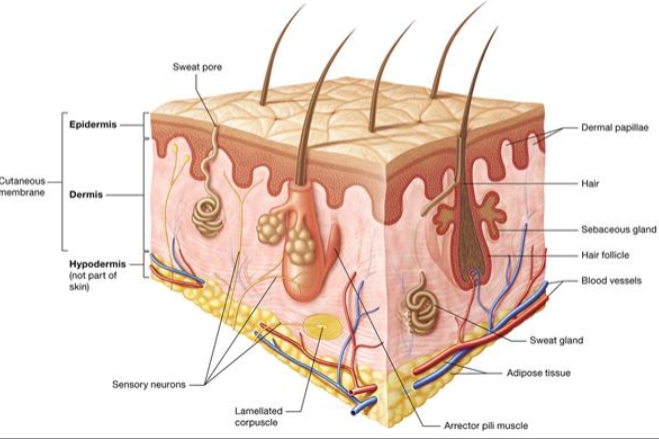
Key Structures and Their Functions
Sweat Pore: Opening on the skin surface through which sweat is released, aiding in thermoregulation.
Dermal Papillae: Projections of the dermis that increase surface area for exchange of gases, nutrients, and waste products between the dermis and epidermis; responsible for fingerprints.
Hair Follicle: Structure from which hair grows; extends from the epidermis into the dermis.
Sebaceous Gland: Produces sebum (oil) that lubricates hair and skin.
Sweat Gland: Produces sweat for cooling the body and excreting waste products.
Arrector Pili Muscle: Small muscle attached to hair follicles; contraction causes "goosebumps."
Blood Vessels: Supply nutrients and oxygen, remove waste, and help regulate temperature.
Sensory Neurons: Detect stimuli such as touch, pressure, pain, and temperature.
Laminated (Pacinian) Corpuscle: Specialized nerve ending that detects deep pressure and vibration.
Adipose Tissue: Stores fat, provides insulation, and cushions underlying tissues.
Functions of the Integumentary System
Protection: Acts as a physical barrier against mechanical injury, pathogens, and harmful substances.
Sensation: Contains sensory receptors for touch, pain, temperature, and pressure.
Thermoregulation: Regulates body temperature through sweat production and blood flow adjustments.
Excretion: Removes waste products via sweat glands.
Vitamin D Synthesis: Initiates the production of vitamin D when exposed to UV light.
Table: Comparison of Skin Layers
Layer | Main Components | Functions |
|---|---|---|
Epidermis | Keratinocytes, melanocytes | Protection, waterproofing, UV defense |
Dermis | Connective tissue, blood vessels, nerves, glands, hair follicles | Support, nourishment, sensation, thermoregulation |
Hypodermis | Adipose tissue, connective tissue | Insulation, energy storage, shock absorption |
Example: Thermoregulation
When body temperature rises, sweat glands produce sweat that evaporates from the skin surface, cooling the body. Blood vessels in the dermis dilate (vasodilation) to increase heat loss. Conversely, when cold, blood vessels constrict (vasoconstriction) and the arrector pili muscles contract, causing hair to stand up and trap heat.
