Back
Chap 5 - The Integumentary System: Structure and Function
Study Guide - Smart Notes
 Tailored notes based on your materials, expanded with key definitions, examples, and context.
The Integumentary System - Chapter 5
Overview
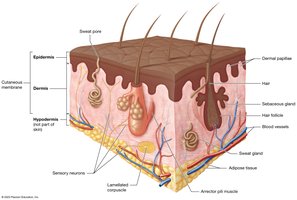
The integumentary system consists of the skin and its accessory structures, including hair, nails, and glands. The skin is the largest organ in the body, accounting for 10-15% of total body weight. It is composed of two main layers: the superficial epidermis and the deeper dermis. Below the dermis lies the hypodermis (subcutaneous tissue), which is not considered part of the skin but plays a supportive role.
Skin Structure
Main Components
Epidermis: Keratinized stratified squamous epithelium resting on a basement membrane; avascular.
Dermis: Loose connective tissue (superficial) and dense irregular connective tissue (deep); vascularized.
Accessory Structures: Hair, nails, sweat glands, sebaceous (oil) glands, sensory neurons, and arrector pili muscles.
Hypodermis: Loose connective and adipose tissue; highly vascularized; not part of the skin.
Cellulite
Cellulite refers to the dimpled appearance of the skin caused by collagen bands surrounding adipose tissue in the hypodermis. It is most common in the thighs, hips, and gluteal area and is influenced by genetics, sex, adipose tissue distribution, and age. Cellulite is considered normal, and while diet and exercise may minimize its appearance, there is little evidence that topical products are effective.
Functions of the Integumentary System
Overview
Protection
Sensation
Thermoregulation
Excretion
Synthesis of Vitamin D
Protection
Mechanical Trauma: The keratinized, stratified squamous epithelium provides a durable, flexible barrier against stretching, pressure, and abrasion.
Pathogens: The continuous structure of the skin, immune cells, and antimicrobial secretions (acid mantle) protect against microorganisms.
Environmental Threats: The skin absorbs UV radiation and secretes lipid-based chemicals to repel water and salts, maintaining internal homeostasis.
Sensation
Sensory receptors in the skin detect stimuli such as touch, pressure, pain, and temperature, which are crucial for homeostasis and protection.
Thermoregulation
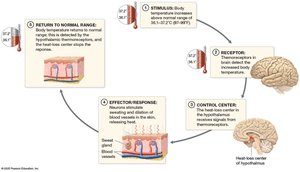
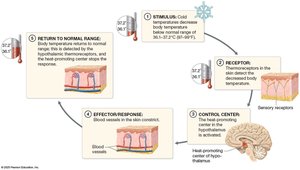
The skin helps maintain a stable internal temperature through negative feedback loops:
When body temperature rises: Thermoreceptors signal the hypothalamus, which stimulates sweating and vasodilation to release heat.
When body temperature falls: Thermoreceptors signal the hypothalamus, which stimulates vasoconstriction to conserve heat.
Excretion
The skin excretes small amounts of metabolic waste products, such as lactic acid and urea, through sweat.
Synthesis of Vitamin D
Exposure to UV radiation converts a precursor in the epidermis to cholecalciferol (vitamin D3), which is then modified by the liver and kidneys to form calcitriol, essential for calcium absorption and bone health.
The Epidermis
Structure and Cell Types
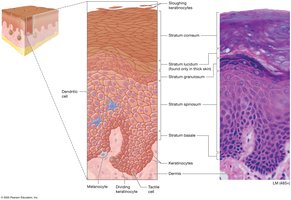
The epidermis is composed of several cell types and up to five layers (strata):
Keratinocytes: 95% of epidermal cells; produce keratin for strength and resistance to stress; connected by desmosomes.
Dendritic (Langerhans) Cells: Immune cells in the stratum spinosum.
Tactile (Merkel) Cells: Sensory receptors in the stratum basale for light touch.
Melanocytes: Produce melanin pigment in the stratum basale.
Layers (Strata) of the Epidermis
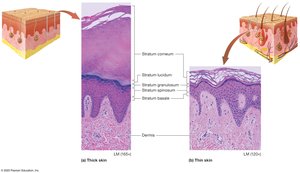
Stratum Basale (Germinativum): Deepest layer; single row of stem cells; mitotically active; produces keratin and vitamin D precursors.
Stratum Spinosum: Thickest layer; spiny-shaped cells; active in keratin and vitamin D production; mitotically active.
Stratum Granulosum: 3-5 rows of cells with granules; forms water barrier; keratin bundles present.
Stratum Lucidum: Clear layer of dead keratinocytes; found only in thick skin.
Stratum Corneum: Multiple layers of dead, flattened keratinocytes; cells are shed (sloughed) off.
Mnemonic for Epidermal Strata
Brilliant – Stratum Basale
Studying – Stratum Spinosum
Gives – Stratum Granulosum
Loads of – Stratum Lucidum
Confidence – Stratum Corneum
Note: Stratum Lucidum is only present in thick skin.
Topical Medications and the Epidermis
The lipid-based coating of the epidermis affects drug absorption. Polar compounds generally cannot cross the epidermis, making them safe for topical use. Nonpolar (hydrophobic) substances can cross, allowing for transdermal drug delivery (e.g., hormone patches), but also increasing risk for absorption of toxins.

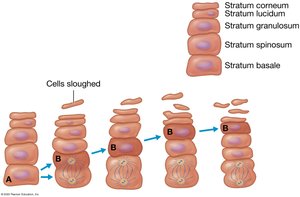
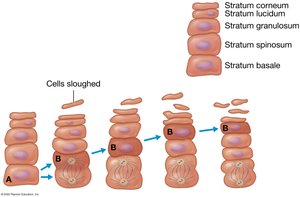
Keratinocyte Life Cycle
Keratinocytes originate in the stratum basale and stratum spinosum, undergo mitosis, and are pushed upward through the strata, eventually being shed from the stratum corneum. This process takes 40-50 days.
Thick and Thin Skin
Thick Skin: Palms, soles, and palmar/plantar surfaces; all five strata; thick stratum corneum; no hair follicles; many sweat glands.
Thin Skin: Covers most of the body; lacks stratum lucidum; thinner stratum corneum; contains hair follicles, sweat, and sebaceous glands.
Callus: Localized thickening of the stratum corneum due to repeated pressure.
The Dermis
Structure and Layers
The dermis is the deep layer of the skin, providing blood supply, sensory receptors, and anchoring the epidermis. It is divided into two layers:
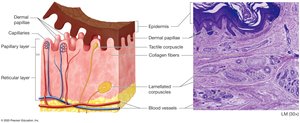
Papillary Layer: Superficial; loose connective tissue; contains dermal papillae that supply blood and house tactile corpuscles for light touch.
Reticular Layer: Deep; dense irregular connective tissue; contains blood vessels, sweat and sebaceous glands, hair follicles, and lamellated corpuscles for deep pressure and vibration.
Skin Markings
Types and Significance
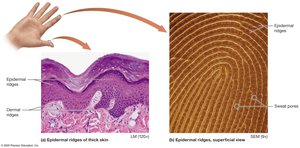
Dermal Ridges: Prominent in thick skin; form epidermal ridges (fingerprints) unique to each individual; sweat pores open along these ridges.
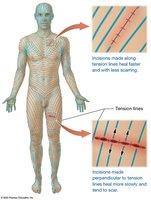
Tension (Cleavage) Lines: Gaps between collagen bundles in the reticular layer; important for surgical incisions as they affect healing and scarring.
Flexure Lines: Deep creases in areas such as the palms due to tightly anchored skin.
Skin Wrinkles
Causes and Treatments
Wrinkles result from age-related decreases in collagen, elastic fibers, proteoglycans, and adipose tissue in the dermis. UV exposure and smoking accelerate wrinkle formation. Treatments include:
Botox®: Paralyzes facial muscles to smooth skin temporarily.
Fillers: Injected substances (adipose, collagen, proteoglycans) to fill wrinkles.
Peels: Removal of superficial skin layers to stimulate new skin formation.
Topical Creams: May reduce appearance, but most nonprescription products have limited effect.