 Back
The Integumentary System: Structure, Function, and Clinical Aspects
Study Guide - Smart Notes
 Tailored notes based on your materials, expanded with key definitions, examples, and context.
The Integumentary System
Overview
The integumentary system is composed of the skin and its derivatives, including sweat glands, oil glands, hairs, nails, and subcutaneous tissue. It serves as the body's primary barrier against environmental hazards and plays essential roles in protection, sensation, thermoregulation, and metabolic functions.
Skin: The largest organ, consisting of two main layers (epidermis and dermis) and an underlying subcutaneous layer.
Sudoriferous (sweat) glands: Regulate temperature and excrete wastes.
Sebaceous (oil) glands: Lubricate and protect the skin and hair.
Hairs and Nails: Provide protection and sensory input.
Subcutaneous tissue: Anchors skin, provides insulation and shock absorption.
Skin Structure
Layers of the Skin
The skin consists of two primary layers: the epidermis and the dermis. Beneath these lies the subcutaneous tissue (hypodermis), which is not technically part of the skin but is functionally related.
Epidermis: Outermost, avascular, composed of keratinized stratified squamous epithelium.
Dermis: Underlies the epidermis, composed mainly of dense connective tissue, vascularized.
Subcutaneous tissue (Hypodermis): Mostly adipose tissue, provides insulation and anchors skin to underlying structures.
Epidermis
Cell Types
Keratinocytes: Produce keratin, the protein that gives skin its protective properties; major cell type of the epidermis.
Melanocytes: Produce melanin pigment, which protects against UV radiation.
Dendritic (Langerhans) cells: Immune cells that patrol the epidermis and activate immune responses.
Tactile epithelial (Merkel) cells: Sensory receptors for touch.
Layers (Strata) of the Epidermis
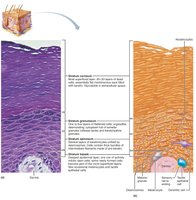
Stratum basale: Deepest, single row of mitotic stem cells; contains melanocytes.
Stratum spinosum: Several layers thick, contains pre-keratin filaments and dendritic cells.
Stratum granulosum: 4–6 layers, keratinization begins, cells flatten and organelles disintegrate.
Stratum lucidum: Only in thick skin (palms, soles), thin, translucent band of dead keratinocytes.
Stratum corneum: 20–30 layers of dead, keratinized cells; provides protection and prevents water loss.
Dermis
Structure and Layers
The dermis is a strong, flexible connective tissue layer containing fibroblasts, macrophages, and other immune cells. It houses nerves, blood vessels, lymphatics, hair follicles, and glands.
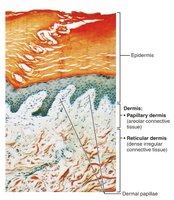
Papillary dermis: Superficial, areolar connective tissue with dermal papillae (capillary loops, nerve endings, touch receptors).
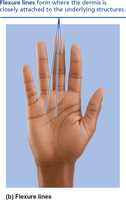
Reticular dermis: Deeper, dense irregular connective tissue; provides strength, elasticity, and houses cleavage (tension) lines and flexure lines.
Dermal Modifications
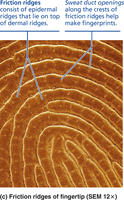
Friction ridges: Enhance grip and tactile sensation; form fingerprints.
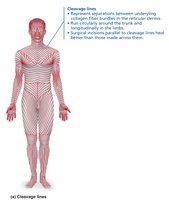
Cleavage lines: Orientation of collagen fibers; important for surgical incisions.
Flexure lines: Dermal folds at joints, allow skin to accommodate movement.
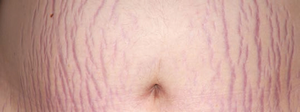
Striae (stretch marks): Result from extreme stretching, causing dermal tears.
Skin Color
Pigments
Melanin: Only pigment produced in the skin; protects DNA from UV damage. Varies in amount and form, causing different skin colors.
Carotene: Yellow to orange pigment, most visible in palms and soles; can be converted to vitamin A.
Hemoglobin: Pinkish hue in fair skin due to low melanin and visible blood flow.
Alterations in skin color can indicate disease (e.g., cyanosis, jaundice, pallor, erythema, bruising).
Hair
Structure and Function
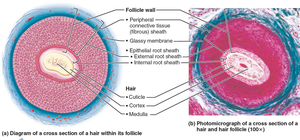
Hair consists of dead, keratinized cells and is found everywhere except palms, soles, lips, nipples, and parts of external genitalia. Functions include protection, sensation, and filtration.
Regions: Root (within scalp), Shaft (above scalp).
Layers of hair shaft: Medulla (core), Cortex (middle), Cuticle (outer).
Pigmentation: Determined by melanins; red hair has pheomelanin, gray/white hair results from decreased melanin.
Hair Follicle Structure
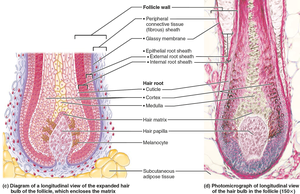
Hair follicle: Extends from epidermis to dermis; contains hair bulb, root hair plexus (sensory), and various sheaths.
Hair papilla: Supplies nutrients; essential for hair growth.
Hair matrix: Actively dividing cells producing hair.
Arrector pili: Smooth muscle causing "goose bumps."
Types and Growth
Vellus hair: Fine, pale body hair.
Terminal hair: Coarse, long hair (scalp, eyebrows, pubic, axillary regions).
Growth cycles alternate between active and resting phases; affected by nutrition and hormones.
Conditions: Hirsutism (excess hair in females), alopecia (hair thinning), male pattern baldness (genetic, androgen-influenced).
Nails
Structure and Function
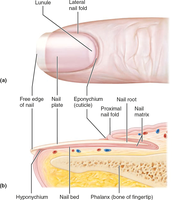
Nails are scale-like modifications of the epidermis, containing hard keratin. They protect the distal phalanges and aid in manipulation.
Root: Embedded in skin.
Nail plate/body: Visible attached portion.
Free edge: Extends beyond finger/toe.
Nail bed: Epidermis beneath nail plate.
Nail matrix: Responsible for nail growth.
Nail folds: Overlap nail borders; eponychium (cuticle), hyponychium (under free edge).
Lunule: White crescent at base, thickened matrix.
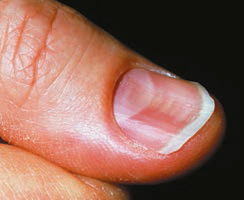
Abnormalities (e.g., yellow nails, koilonychia, Beau's lines) can indicate systemic disease.
Glands of the Skin
Sudoriferous (Sweat) Glands
Eccrine (merocrine) glands: Most numerous, abundant on palms, soles, forehead; function in thermoregulation; secrete watery sweat (99% water, salts, wastes).
Apocrine glands: Axillary and anogenital areas; secrete viscous, milky sweat; begin at puberty; may act as scent glands.
Modified apocrine glands: Ceruminous (earwax) and mammary (milk) glands.
Sebaceous (Oil) Glands
Widely distributed except on palms and soles; secrete sebum (oily, bactericidal, softens hair/skin).
Most develop from hair follicles; become active at puberty (stimulated by androgens).
Disorders: Acne (inflammation of sebaceous glands), seborrhea (cradle cap in infants).
Functions of the Skin
Protection
Chemical barriers: Sweat, sebum, acid mantle, melanin.
Physical barriers: Keratinized cells, glycolipids prevent water loss and entry of harmful substances.
Biological barriers: Dendritic cells (epidermis), macrophages (dermis) activate immune responses.
Body Temperature Regulation
Insensible perspiration (500 mL/day at rest).
Sensible perspiration (up to 12 L/day during heat).
Vasoconstriction in cold to reduce heat loss.
Cutaneous Sensations
Touch: Meissner's corpuscles, Merkel cells.
Pressure: Pacinian corpuscles.
Pain: Free nerve endings.
Hair movement: Hair follicle receptors.
Metabolic Functions
Synthesizes vitamin D for calcium absorption.
Disarms carcinogens, activates hormones, produces collagenase.
Blood Reservoir and Excretion
Holds up to 5% of blood volume; can constrict to redirect blood.
Excretes nitrogenous wastes, salt, and water via sweat.
Skin Disorders: Cancer and Burns
Skin Cancer
Basal cell carcinoma: Most common, least malignant; arises from stratum basale.
Squamous cell carcinoma: Second most common; arises from keratinocytes of stratum spinosum; can metastasize.
Melanoma: Cancer of melanocytes; most dangerous, highly metastatic, resistant to chemotherapy.
ABCDE Rule for early detection: Asymmetry, Border irregularity, Color variation, Diameter >6mm, Evolution.
Burns
First-degree: Epidermal damage only; redness, pain.
Second-degree: Epidermal and upper dermal damage; blisters.
Third-degree: Full-thickness; gray-white, cherry red, or blackened; not painful (nerve endings destroyed); requires grafting.
Rule of Nines: Used to estimate burn area for fluid replacement.
Developmental Aspects of the Integumentary System
Embryonic Development
Epidermis from ectoderm; dermis and subcutaneous tissue from mesoderm.
By 4th month, skin is well developed; lanugo coat (fine hair) appears in 5th–6th months, replaced by vellus hair before birth.
Infancy to Adulthood
Vernix caseosa (protective, cheesy coating) covers newborns.
Skin thickens, glands become active, acne may develop in adolescence.
Optimal appearance in 20s–30s; aging leads to thinning, dryness, decreased elasticity, increased cancer risk, and hair thinning.
Prevention of aging: UV protection is essential; UVA rays cause aging, UVB rays cause burning.
