 Back
The Language of Anatomy: Anatomical Positions, Body Planes, Cavities, and Homeostasis
Study Guide - Smart Notes
 Tailored notes based on your materials, expanded with key definitions, examples, and context.
The Language of Anatomy
Introduction to Anatomical Terminology
Understanding anatomy and physiology requires precise terminology to describe body positions, directions, regions, and structures. This standardized language prevents confusion and ensures clear communication among healthcare professionals.
Anatomical Position: The standard reference position for the body, standing erect, feet parallel, arms at the sides with palms facing forward and thumbs pointing away from the body.
Purpose: All anatomical terminology refers to this position, regardless of the actual position of the body.
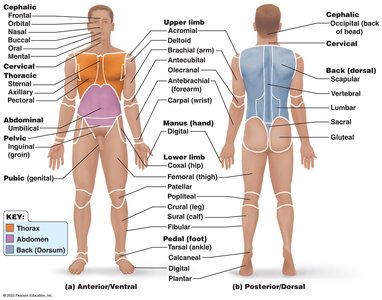
Anatomical Positions and Directional Terms
Directional Terms
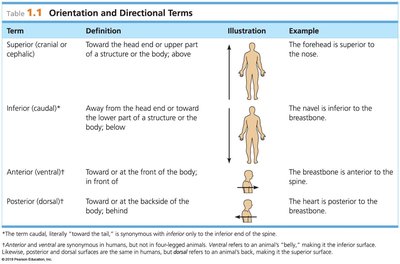
Directional terms are used to describe the locations of structures or the movement of the body relative to the anatomical position. These terms are essential for accurately describing injuries, procedures, and anatomical relationships.
Term | Definition | Example |
|---|---|---|
Superior (cranial/cephalic) | Toward the head end or upper part of a structure or the body; above | The forehead is superior to the nose. |
Inferior (caudal) | Away from the head end or toward the lower part of a structure or the body; below | The navel is inferior to the breastbone. |
Anterior (ventral) | Toward or at the front of the body; in front of | The breastbone is anterior to the spine. |
Posterior (dorsal) | Toward or at the backside of the body; behind | The heart is posterior to the breastbone. |
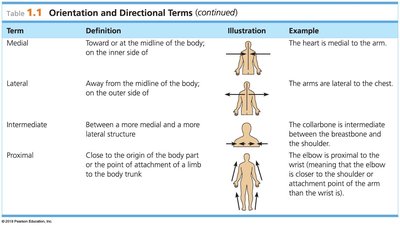
Medial | Toward or at the midline of the body; on the inner side of | The heart is medial to the arm. |
Lateral | Away from the midline of the body; on the outer side of | The arms are lateral to the chest. |
Intermediate | Between a more medial and a more lateral structure | The collarbone is intermediate between the breastbone and the shoulder. |
Proximal | Close to the origin of the body part or the point of attachment of a limb to the body trunk | The elbow is proximal to the wrist. |
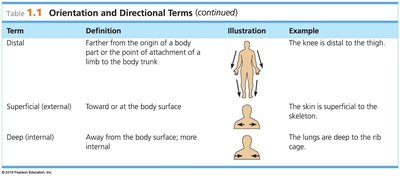
Distal | Farther from the origin of a body part or the point of attachment of a limb to the body trunk | The knee is distal to the thigh. |
Superficial (external) | Toward or at the body surface | The skin is superficial to the skeleton. |
Deep (internal) | Away from the body surface; more internal | The lungs are deep to the rib cage. |
Regional Terms
Body Regions
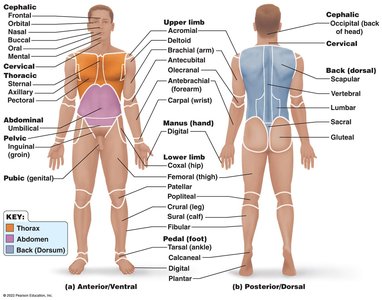
Regional terms specify distinct areas within major body divisions. These terms are used to pinpoint locations for examination, diagnosis, and treatment.
Axial Region: Includes the head, neck, and trunk.
Appendicular Region: Includes the limbs (arms and legs).
Specific regions are further divided, such as cephalic (head), thoracic (chest), abdominal (abdomen), and pelvic (pelvis).
Body Planes and Sections
Major Body Planes
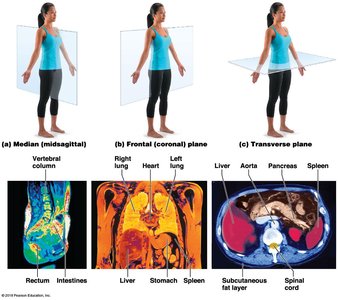
Body planes are imaginary lines used to divide the body into sections for anatomical study and medical imaging. Understanding these planes is crucial for interpreting scans and describing locations of injuries or pathologies.
Median (Midsagittal) Plane: Divides the body into equal right and left halves.
Frontal (Coronal) Plane: Divides the body into anterior (front) and posterior (back) parts.
Transverse (Horizontal) Plane: Divides the body into superior (upper) and inferior (lower) parts.
Body Cavities
Major Body Cavities
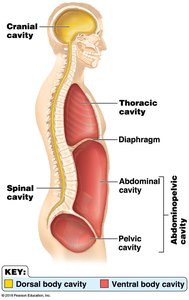
The human body contains several major cavities that house and protect vital organs. These cavities are separated by structures such as the diaphragm and are important for understanding organ location and function.
Dorsal Body Cavity: Includes the cranial cavity (brain) and spinal cavity (spinal cord).
Ventral Body Cavity: Includes the thoracic cavity (heart and lungs) and abdominopelvic cavity (digestive, urinary, and reproductive organs).
Abdominopelvic Regions and Quadrants
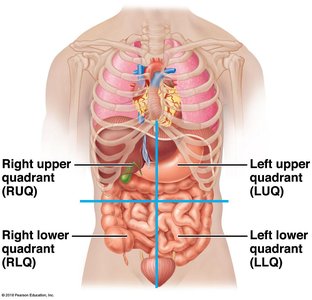
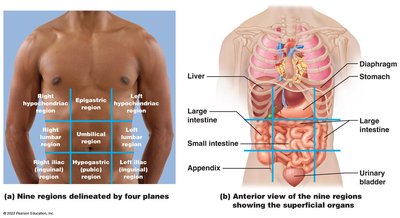
The abdominopelvic cavity is further divided for clinical and anatomical reference. Two common methods are used: quadrants and nine regions.
Quadrants: Right upper (RUQ), left upper (LUQ), right lower (RLQ), left lower (LLQ).
Nine Regions: Right/left hypochondriac, epigastric, right/left lumbar, umbilical, right/left iliac (inguinal), hypogastric (pubic).
Homeostasis
Definition and Importance
Homeostasis is the maintenance of a stable internal environment despite changes in external conditions. It is essential for the survival and proper functioning of living organisms.
Examples include sweating to cool the body, shivering to generate heat, and the release of insulin to regulate blood sugar.
Homeostasis ensures that metabolic activities proceed efficiently.
Control Mechanisms: Feedback Loops
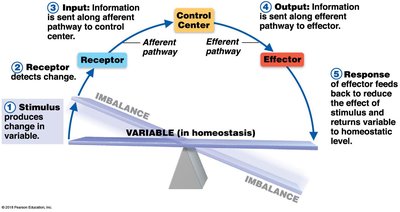
Homeostasis is maintained through feedback mechanisms that detect changes and initiate responses to restore balance. There are two main types of feedback loops: negative and positive.
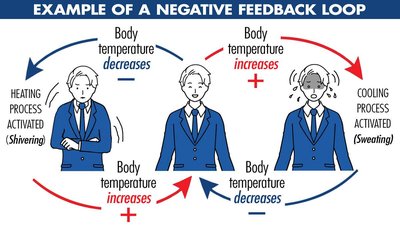
Negative Feedback Loops: Counteract changes in a variable, bringing it back to a set point. Most homeostatic control mechanisms are negative feedback loops (e.g., regulation of body temperature).
Positive Feedback Loops: Amplify the response to a stimulus, moving the variable further from the set point (e.g., blood clotting, childbirth).
Examples of Feedback Loops
Negative Feedback Example: Body temperature regulation. When body temperature rises, mechanisms such as sweating are activated to cool the body; when it falls, shivering generates heat.
Positive Feedback Example: Blood clotting. When a vessel is damaged, platelets adhere to the site and release chemicals that attract more platelets, accelerating the process until the break is sealed.
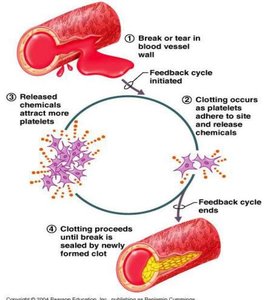
Additional info: Positive feedback loops are less common than negative feedback loops and are typically involved in processes that need to be pushed to completion rather than maintained at equilibrium.
