 Back
BackThe Lymphatic System and Immune System: Structure, Function, and Body Defenses
Study Guide - Smart Notes
 Tailored notes based on your materials, expanded with key definitions, examples, and context.
The Lymphatic System and Lymphoid Organs and Tissues
Overview of the Lymphatic System
The lymphatic system is a network of vessels, tissues, and organs that returns leaked fluid to the blood and provides the anatomical basis for the body's immune defenses. It includes lymphatic vessels, lymph, and lymphoid organs such as lymph nodes, spleen, MALT (mucosa-associated lymphoid tissue), and thymus.
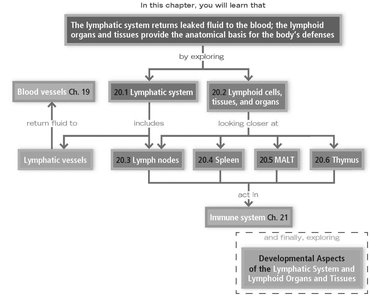
Lymphatic vessels collect excess interstitial fluid (lymph) and return it to the bloodstream.
Lymph nodes filter lymph and house lymphocytes for immune surveillance.
Spleen removes old blood cells and pathogens from the blood.
MALT protects mucosal surfaces throughout the body.
Thymus is the site of T lymphocyte maturation.
Lymphatic Vessels
Lymphatic vessels form a one-way system that transports lymph toward the heart. They begin as highly permeable lymphatic capillaries in tissues, which collect large molecules and excess fluid not reabsorbed by blood capillaries.
Lymphatic capillaries → collecting lymphatic vessels → lymphatic trunks → lymphatic ducts (thoracic duct or right lymphatic duct).
Mechanisms of lymph transport include skeletal muscle contraction, respiratory pressure changes, and valves to prevent backflow.
Lymphoid Cells and Tissues
Lymphoid tissues are found in lymphoid organs and connective tissues throughout the body. They house lymphocytes and provide sites for immune cell proliferation and surveillance.
Lymphocytes: Arise in red bone marrow and differentiate into T cells (thymus) or B cells (bone marrow).
Macrophages: Phagocytic cells that activate T lymphocytes.
Dendritic cells: Present antigens to T cells.
Reticular cells: Produce the stroma supporting lymphoid tissues.
Lymphoid tissue types: Diffuse (scattered in most organs) and follicular (nodules, e.g., Peyer's patches).
Lymph Nodes
Lymph nodes are the principal lymphoid organs, acting as filters to remove microorganisms and debris from lymph before it returns to the blood. Each node is encapsulated and contains a stroma of reticular fibers supporting lymphocytes.
Lymph enters via multiple afferent vessels and exits through fewer efferent vessels, slowing flow for immune surveillance.
Spleen
The spleen is the largest lymphoid organ, located in the left upper abdomen. It removes old red blood cells, platelets, and foreign matter from the blood, and provides a site for lymphocyte proliferation and immune surveillance.
Contains white pulp (lymphocytes) and red pulp (macrophages).
MALT (Mucosa-Associated Lymphoid Tissue)
MALT consists of lymphoid tissues in mucous membranes throughout the body, guarding entryways against pathogens.
Tonsils: Form a ring around the pharynx to trap pathogens from food and air.
Peyer's patches: Aggregated lymphoid nodules in the small intestine.
Appendix: Contains lymphoid follicles off the large intestine.
Thymus
The thymus is the site of T lymphocyte maturation and secretes hormones that promote immunocompetence. It is unique among lymphoid organs as it contains no B cells, is not directly involved in antigen response, and its stroma is made of epithelial cells.
Composed of lobules with an outer cortex and inner medulla.
Developmental Aspects
Lymphatic vessels and lymph nodes develop from lymph sacs budding from veins by the fifth week of embryonic development. The thymus is derived from endoderm, while other lymphoid organs arise from mesenchyme.
The Immune System: Innate and Adaptive Body Defenses
Overview of the Immune System
The immune system protects the body from disease-causing organisms and cancerous cells through innate (nonspecific) and adaptive (specific) defenses.
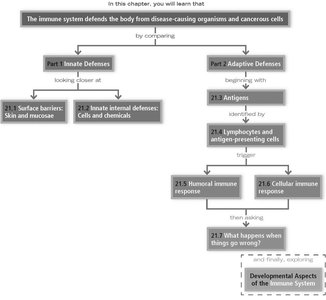
Innate defenses: Surface barriers (skin, mucosa) and internal defenses (cells and chemicals).
Adaptive defenses: Humoral (antibody-mediated) and cellular (T cell-mediated) immunity.
Innate Defenses
Surface Barriers
Skin and mucous membranes act as the first line of defense, providing a physical barrier and producing protective chemicals (acid, enzymes, mucin, defensins).
Internal Defenses
Phagocytes (neutrophils, macrophages): Engulf and destroy pathogens.
Natural killer (NK) cells: Lyse infected or cancerous cells.
Inflammation: Local response to injury or infection, characterized by redness, heat, swelling, and pain.
Antimicrobial proteins: Interferons (inhibit viral replication) and complement (lyse pathogens).
Fever: Systemic response to infection, raising body temperature to inhibit pathogens.
Adaptive Defenses
Specificity: Targets specific antigens.
Systemic response: Not limited to infection site.
Memory: Faster, stronger response upon re-exposure.
Antigens
Antigens are substances that trigger adaptive immune responses. Complete antigens have immunogenicity and reactivity; haptens are incomplete antigens. Antigenic determinants are specific sites recognized by lymphocytes. Self-antigens are recognized by MHC proteins.
B and T Lymphocytes and Antigen-Presenting Cells
B cells: Mature in bone marrow; produce antibodies (humoral immunity).
T cells: Mature in thymus; mediate cellular immunity.
Immunocompetence: Ability to recognize specific antigens.
Self-tolerance: Ability to avoid attacking self-antigens.
Antigen-presenting cells (APCs): Dendritic cells, macrophages, and B cells present antigens to T cells.
Humoral Immunity
B cells are activated by antigen binding, undergo clonal selection, and differentiate into plasma cells (antibody-secreting) and memory cells.
Primary response: Slow, initial antibody production.
Secondary response: Rapid, robust antibody production upon re-exposure.
Active immunity: Body produces its own antibodies (infection or vaccination).
Passive immunity: Antibodies are transferred from another source (maternal, injection).
Antibody classes: IgM, IgG, IgA, IgD, IgE.
Antibody actions: Neutralization, agglutination, precipitation, complement activation.
Cellular Immunity
T cells recognize antigens presented by MHC proteins.
CD4 cells become helper T cells (activate B/T cells, macrophages) or regulatory T cells (suppress immune response).
CD8 cells become cytotoxic T cells (destroy infected/cancerous cells).
Activation requires antigen recognition and co-stimulatory signals.
Cytokines amplify immune responses.
Immune Disorders
Immunodeficiencies: SCID (congenital), AIDS (acquired).
Autoimmune diseases: Immune system attacks self-antigens.
Hypersensitivities: Overactive immune responses (allergies, cytotoxic, immune complex, delayed).
Developmental Aspects of the Immune System
Immune cells originate in liver/spleen (embryo), then bone marrow.
Lymphocytes develop immunocompetence in thymus and bone marrow.
Immune function declines with age.
