 Back
The Lymphatic System and Lymphoid Organs and Tissues: Study Notes
Study Guide - Smart Notes
 Tailored notes based on your materials, expanded with key definitions, examples, and context.
Introduction to the Lymphatic System
Why Do We Need It?
The lymphatic system is essential for maintaining fluid balance, supporting immune function, and absorbing dietary fats. The cardiovascular system alone has limitations, such as high pressure causing fluid loss from capillaries and limited ability to filter pathogens and large molecules. The lymphatic system addresses these limitations by returning excess fluid to the bloodstream, filtering pathogens, and absorbing macromolecules.
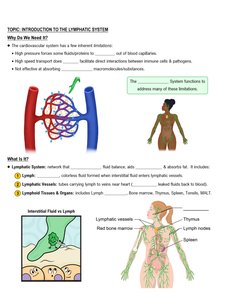
What Is the Lymphatic System?
Lymphatic System: Network that helps maintain fluid balance, aids immunity, and absorbs fats. It includes lymph, lymphatic vessels, lymphoid tissues, and organs.
Lymph: Fluid similar to plasma that forms when interstitial fluid enters lymphatic vessels.
Lymphatic Vessels: Tubes that transport lymph throughout the body.
Lymphoid Tissues & Organs: Sites of immune cell production and activation (e.g., lymph nodes, spleen, thymus, tonsils).
Functions of the Lymphatic System
Primary Functions
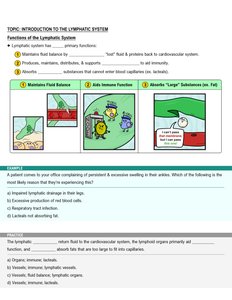
The lymphatic system has three main functions:
Maintains Fluid Balance: Returns excess interstitial fluid to the bloodstream, preventing edema.
Aids Immune Function: Filters lymph and provides sites for immune cell activation.
Absorbs Large Substances: Such as dietary fats (chyle) from the digestive tract that are too large to enter blood capillaries.
Lymphatic Vasculature
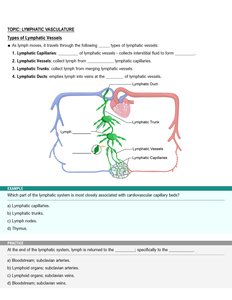
Types of Lymphatic Vessels
Lymph flows through a series of vessels:
Lymphatic Capillaries: Smallest vessels, collect interstitial fluid to form lymph.
Lymphatic Vessels: Larger vessels that transport lymph toward lymph nodes.
Lymphatic Trunks: Drain lymph from large regions of the body.
Lymphatic Ducts: Largest vessels, empty lymph into the venous system at the subclavian veins.
Cardiovascular System vs. Lymphatic System
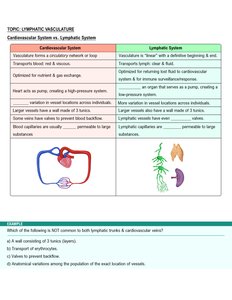
The cardiovascular and lymphatic systems differ in structure and function:
Cardiovascular System | Lymphatic System |
|---|---|
Closed circuit; blood circulates in a loop | One-way system; lymph flows toward the heart |
Heart acts as a pump | No pump; relies on muscle contractions and valves |
Transports nutrients, gases, and wastes | Returns excess fluid, absorbs fats, and supports immunity |
Lymphatic Capillaries
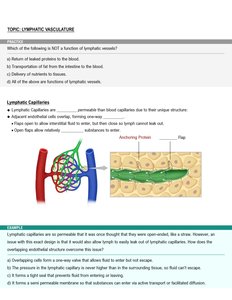
Lymphatic capillaries are highly permeable due to their unique structure:
Endothelial cells overlap, forming one-way mini-valves.
Anchoring filaments attach capillaries to surrounding tissue, preventing collapse.
Allow entry of proteins, pathogens, and large particles that cannot enter blood capillaries.
Lymphatic Ducts
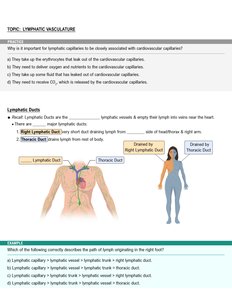
The two major lymphatic ducts are:
Right Lymphatic Duct: Drains lymph from the right upper limb, right side of thorax, and right side of head and neck.
Thoracic Duct: Drains lymph from the rest of the body.
Transport of Lymph
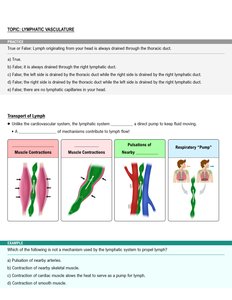
Lymph is transported by:
Muscle contractions
Pulsations of nearby arteries
Respiratory movements ("respiratory pump")
Valves that prevent backflow
Lymphoid Cells & Tissues
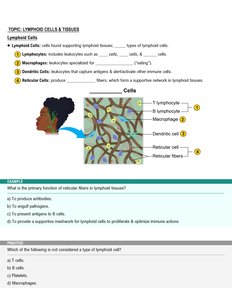
Lymphoid Cells
Lymphocytes: Main immune cells (T cells and B cells) that recognize and respond to antigens.
Macrophages: Phagocytic cells that engulf pathogens and present antigens to lymphocytes.
Dendritic Cells: Capture antigens and deliver them to lymph nodes.
Reticular Cells: Produce reticular fibers that form the structural framework of lymphoid tissues.
Lymphoid Tissue
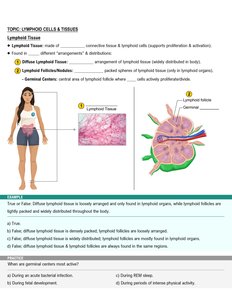
Diffuse Lymphoid Tissue: Loosely arranged lymphoid cells found in most organs.
Lymphoid Follicles (Nodules): Densely packed, spherical bodies of lymphoid cells, often with germinal centers for B cell proliferation.
Overview of Lymphoid Organs
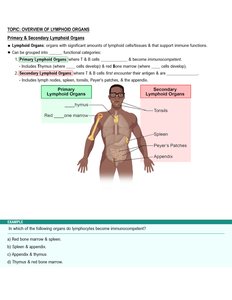
Primary & Secondary Lymphoid Organs
Primary Lymphoid Organs: Sites where lymphocytes mature (red bone marrow for B cells, thymus for T cells).
Secondary Lymphoid Organs: Sites where mature lymphocytes encounter antigens (lymph nodes, spleen, tonsils, Peyer's patches, appendix).
Primary Lymphoid Organs
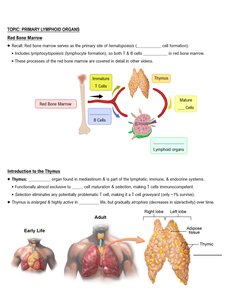
Red Bone Marrow
Red bone marrow is the site of hematopoiesis (formation of blood cells) and B cell maturation.

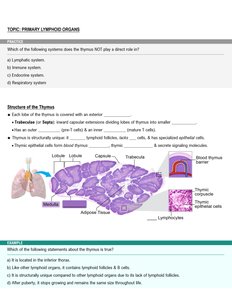
Thymus
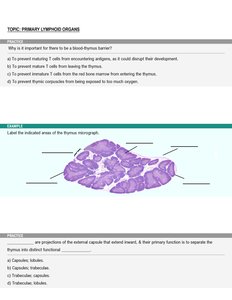
The thymus is located in the mediastinum and is the site of T cell maturation. It is most active during childhood and decreases in size with age. The thymus is divided into lobules by trabeculae and contains a cortex and medulla.
Secondary Lymphoid Organs
Lymph Nodes
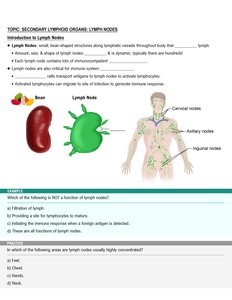
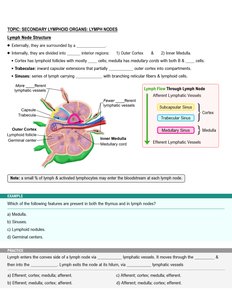
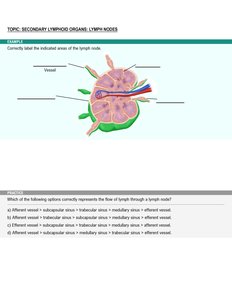
Lymph nodes are small, bean-shaped structures that filter lymph and house lymphocytes. They are concentrated in the cervical, axillary, and inguinal regions. Lymph enters via afferent vessels, is filtered in the cortex and medulla, and exits via efferent vessels.
Spleen
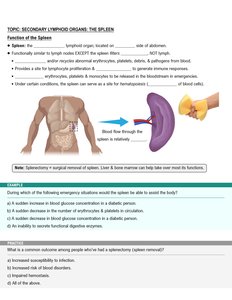
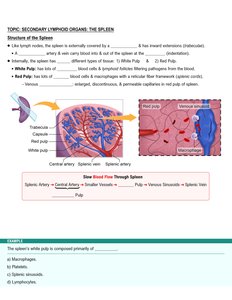
The spleen filters blood, removes old erythrocytes, and supports immune responses. It contains white pulp (lymphocytes) and red pulp (erythrocyte removal and blood filtration).
Mucosa-Associated Lymphoid Tissue (MALT)
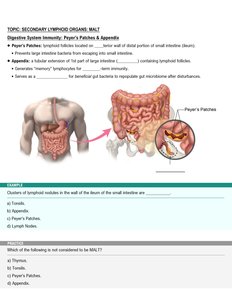
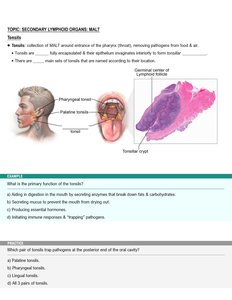
MALT consists of lymphoid tissues in mucous membranes throughout the body, including the digestive, respiratory, urinary, and reproductive tracts. Major collections include the tonsils, Peyer's patches, and appendix.
Introduction to Immunity
Innate and Adaptive Immunity
Immunity refers to the body's ability to eliminate disease-causing microbes and protect against environmental substances. There are two main types:
Innate (Non-Specific) Immunity: Present at birth, provides general protection against a wide range of pathogens.
Adaptive (Specific) Immunity: Develops over time, targets specific pathogens, and involves memory cells for faster future responses.
Antigens & Antibodies
Antigens are foreign substances that induce an immune response. Antibodies are Y-shaped proteins produced by B cells that specifically recognize and bind to antigens, marking them for destruction by immune cells.
Additional info: The lymphatic system is closely integrated with the immune system, providing both structural and functional support for immune responses. Disorders of the lymphatic system can lead to lymphedema, immunodeficiency, or autoimmune diseases.
