 Back
BackThe Lymphatic System: Structure, Function, and Clinical Relevance
Study Guide - Smart Notes
 Tailored notes based on your materials, expanded with key definitions, examples, and context.
The Lymphatic System
Overview of the Lymphatic System
The lymphatic system is a crucial component of the human body, responsible for maintaining fluid balance, supporting immune function, and facilitating the absorption of dietary fats. Disruption in its function can lead to severe clinical conditions, such as edema and elephantiasis. The system works by returning excess interstitial fluid to the bloodstream, thus preventing blood thickening and hypovolemia.
Homeostasis: Maintains fluid balance by returning interstitial fluid to the circulatory system.
Edema: Swelling caused by fluid accumulation due to impaired lymphatic drainage or altered capillary dynamics.
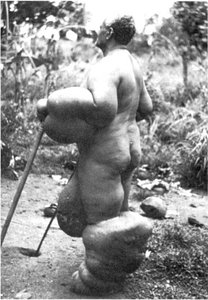
Elephantiasis: Severe swelling (often of the limbs) caused by parasitic blockage of lymphatic vessels, commonly due to filariasis.
Clinical Example: Blockage of lymphatic vessels by roundworms (filariasis) leads to gross enlargement of extremities, a condition known as elephantiasis, affecting over 120 million people worldwide.
Composition of Lymph
Lymph is a clear fluid composed primarily of water, with dissolved proteins, lipids, carbohydrates, electrolytes, and cellular elements. Its composition reflects its role in transporting nutrients, waste, and immune cells.
Water: 96% of lymph
Proteins: 2-6% of solids (albumin, globulin, clotting factors, antibodies, enzymes)
Lipids: 5-15% (mainly chylomicrons and lipoproteins)
Carbohydrates: Primarily glucose
Electrolytes: Sodium, potassium, calcium, chloride, etc.
Cellular content: Mainly lymphocytes
Additional info: Lymph is found in all vertebrates and consists of plasma-like fluid and, in some species, nucleated red blood cells (not in mammals).
Components of the Lymphatic System
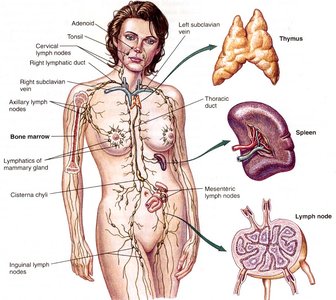
The lymphatic system is composed of lymph, lymphatic vessels, and lymphatic tissues and organs. Each component plays a specific role in fluid transport and immune defense.
Lymph: Formed when high arterial pressure forces fluid out of capillaries into tissues.
Lymphatic vessels: Begin as blind-ended capillaries in most tissues, forming plexuses that pass through lymphatic tissue and organs to deliver lymph to the venous system.
Lymphatic tissues and organs:
Primary structures:
Thymus: Most active in childhood; site of T cell maturation.
Bone marrow: Site of lymphocyte differentiation into T, B, and NK cells.
Secondary structures: Frontline defense (lymph nodes, spleen, tonsils, Peyer's patches).
Primary Functions of the Lymphatic System
Fluid Balance: Maintains normal blood volume and interstitial fluid composition by returning excess fluid to the bloodstream.
Immunity: T cell lymphocytes provide cellular immunity; B cell lymphocytes provide humoral immunity (antibody production).
Absorption: End products of fat digestion are absorbed mainly by lymphatic channels (lacteals) in the small intestine.
Transport: Carries proteins and large particulate matter away from tissue spaces.
Capillary Dynamics and Lymph Formation
Capillary Exchange and Net Pressures
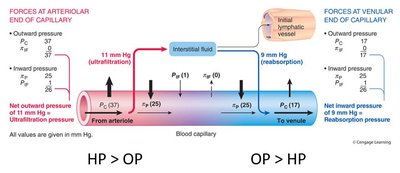
Fluid movement across capillary walls is governed by the balance between hydrostatic and osmotic pressures. This process determines the filtration and reabsorption of fluid, with excess interstitial fluid entering lymphatic capillaries.
Hydrostatic Pressure (HP): The force exerted by fluid against the capillary wall, pushing fluid out of the capillary.
Osmotic Pressure (OP): The force exerted by plasma proteins drawing water into the capillary.
Net Filtration Pressure (NFP): The difference between outward and inward pressures across the capillary wall.
Equation for Net Filtration Pressure:
= Capillary hydrostatic pressure
= Interstitial fluid osmotic pressure
= Interstitial fluid hydrostatic pressure
= Capillary osmotic pressure
At the arterial end of the capillary, net outward pressure (ultrafiltration) is about 11 mm Hg, while at the venous end, net inward pressure (reabsorption) is about -9 mm Hg. The difference results in the filtration of approximately 3 liters of fluid per day, which is returned to the blood via the lymphatic system.
Lymphatic Vessels and Capillaries
Structure and Function
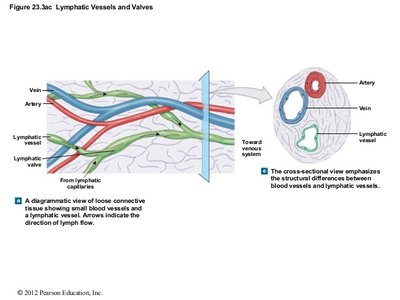
Lymphatic vessels are thin-walled, have valves to prevent backflow, and lack clear boundaries between layers. Unlike veins, they are more permeable and can absorb larger molecules and particles from the interstitial space. Lymphatic capillaries are lined by a single layer of endothelial cells, allowing easy entry of fluid and proteins.
Valves: Ensure unidirectional flow of lymph toward the venous system.
Permeability: Lymphatic capillaries are more permeable than blood capillaries, allowing uptake of proteins, lipids, and immune cells.
Relationship to Other Body Systems
The lymphatic system interacts with the cardiovascular, digestive, and immune systems to maintain homeostasis. It returns excess interstitial fluid to the blood, absorbs dietary fats, and provides immune surveillance and response.
Cardiovascular system: Returns filtered fluid to maintain blood volume and pressure.
Digestive system: Absorbs and transports fats via lacteals.
Immune system: Houses and transports immune cells, filters pathogens through lymph nodes.
