 Back
BackThe Muscular System: Functional Organization and Terminology
Study Guide - Smart Notes
 Tailored notes based on your materials, expanded with key definitions, examples, and context.
The Muscular System
Functional Organization of the Muscular System
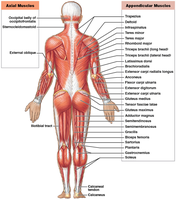
The muscular system is responsible for movement, posture, and support throughout the body. It is divided into two main divisions: axial and appendicular muscles, each with distinct roles and anatomical locations.
Axial muscles support and position the axial skeleton, including the head, neck, and trunk.
Appendicular muscles support, move, and brace the limbs.
Muscles vary widely in size, shape, and function, and their performance depends on fiber organization and skeletal attachments.
Divisions of the Muscular System
Axial Division: Muscles that arise from and act on the axial skeleton. They position the head and spinal column and move the rib cage to assist in breathing.
Appendicular Division: Muscles that stabilize or move the appendicular skeleton (limbs and girdles).
Fascicle Organization and Muscle Efficiency
Fascicle Arrangements
Fascicles are bundles of muscle fibers within a skeletal muscle. The arrangement of fascicles affects both the power and range of motion of a muscle.
Parallel muscles: Fascicles are parallel to the long axis of the muscle. These muscles typically have a central body (belly) and shorten effectively. Example: Biceps brachii.
Convergent muscles: Fascicles extend over a broad area and converge on a common attachment site. These muscles are versatile but do not pull as hard as parallel muscles. Example: Pectoralis major.
Pennate muscles: Fascicles form an angle with the tendon, allowing more fibers in a given area and producing more tension. Types include:
Unipennate: All fibers on one side of the tendon (e.g., extensor digitorum).
Bipennate: Fibers insert on both sides of the tendon (e.g., rectus femoris).
Multipennate: Tendon branches within the muscle (e.g., deltoid).
Circular muscles (sphincters): Fascicles are arranged in concentric circles, encircling an opening. Contraction decreases the diameter of the opening. Example: Orbicularis oris.
Levers and Muscle Efficiency
Muscles act on bones as levers, and the arrangement of the lever system influences the efficiency and range of motion of the muscle. The position of the muscle attachment relative to the joint determines the mechanical advantage.
Muscle Origins, Insertions, and Actions
Definitions
Origin: The fixed attachment point of a muscle, usually proximal in anatomical position.
Insertion: The movable attachment point of a muscle, usually distal.
Action: The specific movement produced by muscle contraction.
Muscle Group Roles
Agonist (Prime Mover): The main muscle responsible for a specific movement. Example: Biceps brachii for elbow flexion.
Synergist: Assists the agonist by providing additional force or stabilizing the origin. Example: Brachioradialis for elbow flexion.
Fixator: A synergist that prevents movement at another joint, stabilizing the origin of the agonist.
Antagonist: A muscle whose action opposes that of the agonist. Example: Triceps brachii is the antagonist to biceps brachii during elbow flexion.
Muscle Terminology
Terms Indicating Specific Regions
Abdominis: Abdomen
Brachial: Arm (brachium)
Femoris: Thigh (femur)
Oris: Mouth
Carpi: Wrist
Other examples: Cervicis (neck), Nasalis (nose), Ocular (eye), Tibial (shin), etc.
Terms Indicating Position, Direction, or Fascicle Organization
Anterior: Front
Posterior: Back
Lateral: Side
Medial: Middle
Superficial: Toward the surface
Deep (Profundus): Away from the surface
Rectus: Straight
Transverse: Crosswise
Oblique: Slanting
Terms Indicating Structural Characteristics
Biceps: Two heads
Triceps: Three heads
Quadriceps: Four heads
Deltoid: Triangle-shaped
Orbicularis: Circular
Rhomboid: Parallelogram-shaped
Serratus: Serrated
Major/Minor: Larger/Smaller
Maximus/Minimus: Largest/Smallest
Longus/Brevis: Long/Short
Terms Indicating Actions
Abductor: Moves a limb away from the midline
Adductor: Moves a limb toward the midline
Extensor: Straightens a joint
Flexor: Bends a joint
Levator: Raises a body part
Depressor: Lowers a body part
Pronator: Turns palm downward
Supinator: Turns palm upward
Tensor: Tenses a body part
Classification of Skeletal Muscles
Skeletal muscles are classified as axial or appendicular based on their origins and functions.
Axial muscles: Arise from the axial skeleton and are involved in positioning the head, vertebral column, and rib cage.
Appendicular muscles: Stabilize or move the appendicular skeleton (limbs and girdles).
Summary Table: Muscle Classification and Examples
Division | Location | Main Functions | Examples |
|---|---|---|---|
Axial | Head, neck, trunk | Support and move axial skeleton, assist in breathing | External oblique, masseter, intercostals |
Appendicular | Limbs and girdles | Stabilize and move appendicular skeleton | Deltoid, biceps brachii, quadriceps femoris |
Additional info: Understanding muscle terminology and classification is essential for identifying muscle location, function, and structure, which is foundational for further study in anatomy and physiology.
