 Back
BackThe Muscular System: Structure, Function, and Major Muscles
Study Guide - Smart Notes
 Tailored notes based on your materials, expanded with key definitions, examples, and context.
The Muscular System
Introduction to the Muscular System
The muscular system is responsible for movement, posture, and heat production in the human body. It consists of skeletal, cardiac, and smooth muscles, but this chapter focuses on skeletal muscles, which are under voluntary control and attach to bones to facilitate movement.
Naming Muscles
Principles of Muscle Naming
Muscles are named based on several criteria, including size, location, shape, appearance, position, number of origins, and function. Understanding these conventions helps in identifying and learning the muscles of the body.
Size: Terms such as major, minor, longus (long), brevis (short), and vastus (broad) are used.
Location: Directional and regional terms (e.g., pectoralis minor, superior, inferior, medial, lateral).
Attachment: Named for bones or structures to which they attach (e.g., sternocleidomastoid).
Function: Named for their action (e.g., flexor, extensor, adductor, abductor).
Functional Groups of Muscles
Agonists, Antagonists, Synergists, and Fixators
Muscles work in groups to produce coordinated movements. Each group has a specific role:
Agonist (Prime Mover): The main muscle responsible for a specific movement.
Antagonist: Opposes the action of the agonist, usually located on the opposite side of the joint.
Synergist: Assists the agonist in performing its action.
Fixator: Stabilizes the origin of the agonist to allow efficient movement.
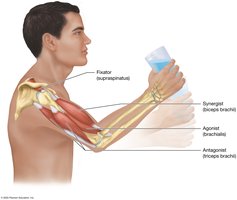
Overview of Major Muscle Groups
Regional Organization
Skeletal muscles are organized into regional groups for study:
Muscles of the head, neck, and vertebral column
Muscles of the trunk and pelvic floor
Muscles of the pectoral girdle and upper limb
Muscles of the hip and lower limb
Muscles of Facial Expression
Key Muscles and Their Actions
Muscles of facial expression are responsible for movements such as smiling, frowning, and blinking. They are unique in that they insert into the skin rather than bone.
Frontalis: Elevates the eyebrows.
Occipitalis: Pulls the scalp posteriorly.
Orbicularis oculi: Closes the eyelids.
Zygomaticus major and minor: Elevate the corners of the mouth (smiling).
Orbicularis oris: Controls the lips for eating, drinking, and puckering.
Buccinator: Pulls the cheek inward (sucking).
Muscle | Origin/Insertion/Nerve | Action |
|---|---|---|
Frontalis | Epicranial aponeurosis/skin of eyebrows; Facial nerve | Raises eyebrows, wrinkles forehead |
Orbicularis oculi | Frontal and maxillary bones/skin around eyelids; Facial nerve | Closes eye |
Zygomaticus major | Zygomatic bone/skin at corner of mouth; Facial nerve | Elevates lateral corners of mouth |
Orbicularis oris | Maxilla and mandible/skin around mouth; Facial nerve | Closes and protrudes lips |
Buccinator | Maxilla and mandible/orbicularis oris; Facial nerve | Compresses cheek |
Muscles of Mastication
Major Muscles Involved in Chewing
Muscles of mastication move the mandible for chewing and speaking.
Masseter: Elevates the mandible (primary chewing muscle).
Temporalis: Elevates and retracts the mandible.
Medial and Lateral Pterygoids: Move the mandible side to side and assist in grinding movements.
Muscle | Origin/Insertion/Nerve | Action |
|---|---|---|
Masseter | Zygomatic arch/mandible; Mandibular nerve | Elevates mandible |
Temporalis | Temporal fossa/coronoid process of mandible; Mandibular nerve | Elevates and retracts mandible |
Medial pterygoid | Pterygoid plate/mandible; Mandibular nerve | Elevates and protracts mandible, side-to-side movement |
Lateral pterygoid | Pterygoid plate/mandible; Mandibular nerve | Protracts and depresses mandible, side-to-side movement |
Muscles of Swallowing
Key Muscles and Their Functions
Swallowing involves coordinated action of several muscles in the neck and pharynx.
Omohyoid and Sternohyoid: Depress the hyoid bone during swallowing.
Mylohyoid, Geniohyoid, Stylohyoid: Elevate the hyoid and floor of the mouth.
Muscle | Origin/Insertion/Nerve | Action |
|---|---|---|
Omohyoid | Scapula/hyoid bone; Cervical nerves | Depresses hyoid |
Sternohyoid | Sternum/hyoid bone; Cervical nerves | Depresses hyoid |
Mylohyoid | Mandible/hyoid bone; Trigeminal nerve | Elevates hyoid and floor of mouth |
Muscles That Move the Head and Neck
Major Muscles and Their Actions
These muscles are responsible for head rotation, flexion, and extension.
Sternocleidomastoid: Rotates and flexes the head.
Trapezius: Extends the head and neck.
Splenius capitis: Rotates and extends the head and neck.
Muscle | Origin/Insertion/Nerve | Action |
|---|---|---|
Sternocleidomastoid | Sternum and clavicle/mastoid process; Accessory nerve | Flexes and rotates head |
Trapezius | Occipital bone, vertebrae/scapula, clavicle; Accessory nerve | Extends head and neck |
Splenius capitis | Vertebrae/mastoid process; Cervical nerves | Extends, rotates head |
Muscles of the Vertebral Column
Erector Spinae and Associated Muscles
The muscles of the vertebral column maintain posture and allow for extension, flexion, and rotation of the spine.
Erector spinae group: Includes longissimus, spinalis, and iliocostalis muscles; extends and laterally flexes the vertebral column.
Longissimus thoracis: Assists in extending or rotating the head and neck.
Muscle | Origin/Insertion/Nerve | Action |
|---|---|---|
Erector spinae | Vertebrae/ribs, vertebrae, skull; Spinal nerves | Extends and laterally flexes spine |
Longissimus thoracis | Vertebrae/ribs; Spinal nerves | Extends, rotates head and neck |
Muscles of Ventilation
Diaphragm and Intercostal Muscles
Muscles of ventilation are essential for breathing by changing the volume of the thoracic cavity.
Diaphragm: Contracts to increase thoracic volume during inspiration.
External intercostals: Elevate the ribs during inspiration.
Internal intercostals: Depress the ribs during forced exhalation.
Muscle | Origin/Insertion/Nerve | Action |
|---|---|---|
Diaphragm | Sternum, ribs, vertebrae/central tendon; Phrenic nerve | Increases thoracic cavity volume (inhalation) |
External intercostals | Ribs/ribs; Intercostal nerves | Elevate ribs (inspiration) |
Internal intercostals | Ribs/ribs; Intercostal nerves | Depress ribs (forced expiration) |
Abdominal Muscles
Major Muscles and Their Functions
Abdominal muscles support the trunk, allow movement, and hold organs in place by regulating internal abdominal pressure.
Rectus abdominis: Compresses the abdomen and flexes the trunk.
External and internal obliques: Rotate and laterally flex the trunk.
Transversus abdominis: Compresses the abdominal cavity.
Muscle | Origin/Insertion/Nerve | Action |
|---|---|---|
Rectus abdominis | Pubic bone/ribs, sternum; Intercostal nerves | Flexes trunk, compresses abdomen |
External oblique | Ribs/iliac crest; Intercostal nerves | Flexes, rotates trunk |
Internal oblique | Iliac crest/ribs; Intercostal nerves | Flexes, rotates trunk |
Transversus abdominis | Ribs, iliac crest/linea alba; Intercostal nerves | Compresses abdomen |
Muscles That Move the Scapula at the Pectoral Girdle
Key Muscles and Their Actions
These muscles stabilize and move the scapula, allowing for a wide range of shoulder movements.
Serratus anterior: Protracts the scapula.
Pectoralis minor: Depresses the scapula.
Trapezius: Extends the head and neck, elevates, retracts, and depresses the scapula.
Rhomboid major and minor: Retract the scapula.
Muscle | Origin/Insertion/Nerve | Action |
|---|---|---|
Serratus anterior | Ribs/scapula; Long thoracic nerve | Protracts scapula |
Pectoralis minor | Ribs/coracoid process; Medial pectoral nerve | Depresses scapula |
Trapezius | Occipital bone, vertebrae/scapula, clavicle; Accessory nerve | Elevates, retracts, depresses scapula |
Rhomboid major/minor | Vertebrae/scapula; Dorsal scapular nerve | Retracts scapula |
Muscles That Move the Arm at the Shoulder Joint
Major Muscles and Rotator Cuff
These muscles are responsible for the wide range of motion at the shoulder joint.
Pectoralis major: Adducts the arm.
Coracobrachialis: Assists with flexion of the humerus.
Deltoid: Abducts the arm.
Latissimus dorsi: Extends the arm.
Teres major: Extends and adducts the arm.
Rotator cuff muscles: Supraspinatus (abducts), infraspinatus (rotates), teres minor (extends, adducts), subscapularis (rotates).
Muscle | Origin/Insertion/Nerve | Action |
|---|---|---|
Pectoralis major | Sternum, clavicle/humerus; Pectoral nerves | Adducts, flexes arm |
Deltoid | Clavicle, scapula/humerus; Axillary nerve | Abducts arm |
Latissimus dorsi | Vertebrae, iliac crest/humerus; Thoracodorsal nerve | Extends, adducts arm |
Rotator cuff | Scapula/humerus; Suprascapular, axillary, subscapular nerves | Stabilizes, moves shoulder |
Muscles That Move the Forearm and Hand
Flexors, Extensors, and Pronators
These muscles control movements at the elbow, wrist, and fingers.
Biceps brachii, brachialis, brachioradialis: Flex the forearm.
Triceps brachii: Extends the forearm.
Flexor carpi radialis, palmaris longus, flexor carpi ulnaris: Flex the hand.
Pronator teres: Pronates the forearm.
Extensor carpi radialis longus/brevis, extensor carpi ulnaris: Extend the hand and wrist.
Extensor digitorum: Extends the fingers.
Muscles of the Hip, Thigh, Knee, and Leg
Anterior, Medial, and Posterior Muscle Groups
These muscles are responsible for movements of the hip, thigh, knee, and leg, including walking, running, and maintaining posture.
Iliopsoas (iliacus and psoas major): Flex the thigh.
Adductor group (magnus, longus, brevis), gracilis: Adduct the thigh.
Sartorius: Flexes and laterally rotates the thigh.
Quadriceps femoris group (rectus femoris, vastus lateralis/intermedius/medialis): Extend the leg at the knee.
Gluteal group (maximus, medius, minimus): Extend and abduct the thigh.
Piriformis: Laterally rotates the thigh.
Hamstring group (semitendinosus, semimembranosus, biceps femoris): Extend the thigh and flex the leg.
Muscles of the Ankle, Foot, and Toes
Key Muscles and Their Actions
These muscles control movements such as dorsiflexion, plantarflexion, inversion, eversion, and toe flexion/extension.
Tibialis anterior, extensor digitorum longus: Dorsiflex the foot.
Fibularis longus: Plantarflexes and everts the foot.
Gastrocnemius, soleus: Plantarflex the foot.
Flexor digitorum longus: Flexes the toes.
Additional info: For each muscle group, understanding the origin, insertion, innervation, and action is essential for clinical and academic applications. Muscle tables provide a concise summary for review and exam preparation.
