 Back
BackThe Muscular System: Structure, Function, and Organization
Study Guide - Smart Notes
 Tailored notes based on your materials, expanded with key definitions, examples, and context.
The Muscular System
Introduction to the Muscular System
The muscular system is responsible for producing movement, maintaining posture, stabilizing joints, and generating heat. Muscles are classified and named based on several criteria, including their shape, function, attachments, region, alignment, number of origins, and size.
Criteria for Naming Muscles
Shape: Muscles may be named for their distinctive shapes (e.g., deltoid – triangular).
Function: Some muscles are named for their primary action (e.g., flexor, extensor).
Attachment: Names may reflect the bones or structures to which the muscle attaches (e.g., sternocleidomastoid).
Region: Muscles may be named for the region of the body they occupy (e.g., brachialis – arm).
Alignment: The direction of muscle fibers (e.g., rectus – straight, oblique – angled).
Number of Origins: Prefixes such as bi-, tri-, or quad- indicate two, three, or four origins (e.g., biceps, triceps).
Size: Terms like maximus, minimus, longus, and brevis describe muscle size.
Fascicle Arrangements
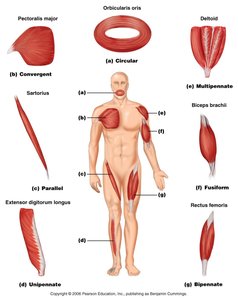
Muscle fascicles are bundles of muscle fibers, and their arrangement affects muscle function and range of motion. There are seven main types of fascicle arrangements:
Circular: Fascicles arranged in concentric rings (e.g., orbicularis oris).
Convergent: Fascicles converge toward a single tendon (e.g., pectoralis major).
Parallel: Fascicles run parallel to the long axis of the muscle (e.g., sartorius).
Unipennate: Fascicles insert into only one side of the tendon (e.g., extensor digitorum longus).
Bipennate: Fascicles insert into the tendon from both sides (e.g., rectus femoris).
Multipennate: Fascicles attach obliquely from many directions to several tendons (e.g., deltoid).
Fusiform: Spindle-shaped muscles with a central belly (e.g., biceps brachii).
Functional Roles of Muscles in Movement
Muscles that span the same joint and act on the same movement can have different functional roles:
Prime Mover (Agonist): The muscle that provides the primary force for a movement.
Antagonist: The muscle that opposes or reverses a particular movement.
Synergist: A muscle that assists the prime mover by adding extra force or reducing undesirable movements.
Fixator: A type of synergist that immobilizes the origin of a prime mover, stabilizing the joint.
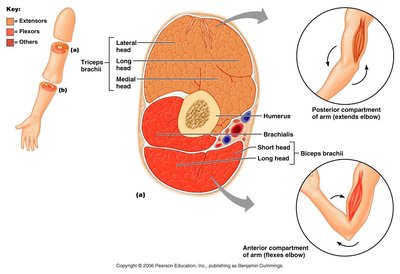
Example: During elbow flexion, the biceps brachii is the prime mover, the triceps brachii is the antagonist, the brachialis acts as a synergist, and the muscles of the shoulder girdle serve as fixators.
Major Muscles of the Human Body
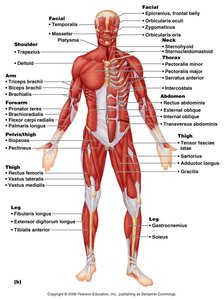
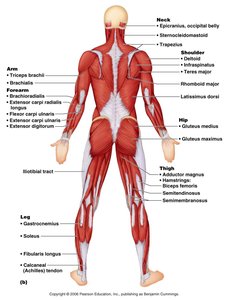
The human body contains over 600 skeletal muscles, each with specific locations and functions. The following images illustrate the major muscles from anterior and posterior views, as well as regional groupings.
Muscles of the Head and Neck
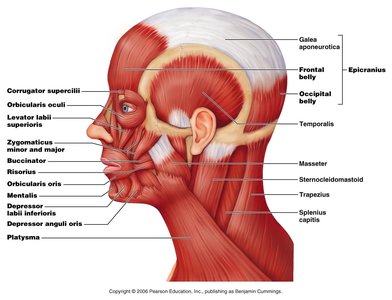
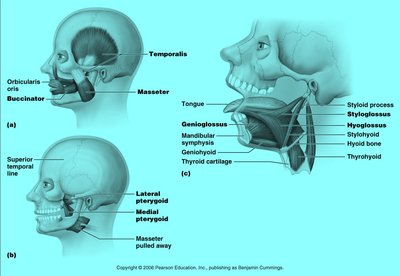
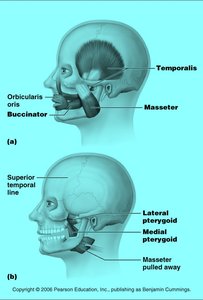
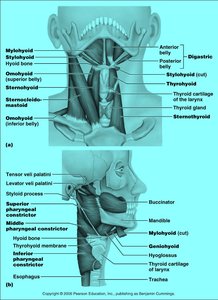
Muscles in the head and neck are responsible for facial expression, mastication (chewing), and movements of the head and neck. Key muscles include the orbicularis oris, masseter, temporalis, sternocleidomastoid, and platysma.
Muscles of the Trunk
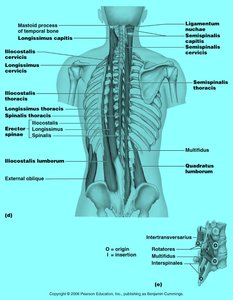
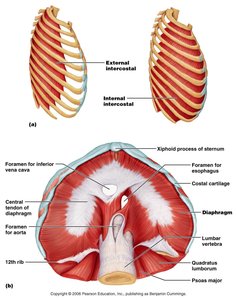
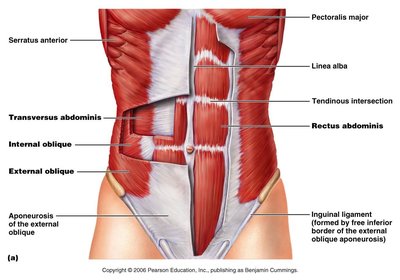
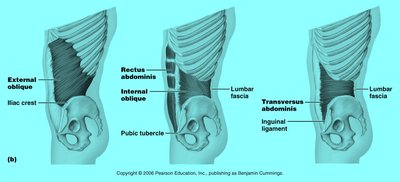
The trunk muscles include those of the back, thorax, and abdomen. They are essential for posture, respiration, and movements of the vertebral column and ribs.
Back Muscles: Include the erector spinae group (iliocostalis, longissimus, spinalis), quadratus lumborum, and multifidus.
Thoracic Muscles: Include the intercostal muscles (external and internal) and the diaphragm, which is the primary muscle of respiration.
Abdominal Muscles: Include the rectus abdominis, external oblique, internal oblique, and transversus abdominis.
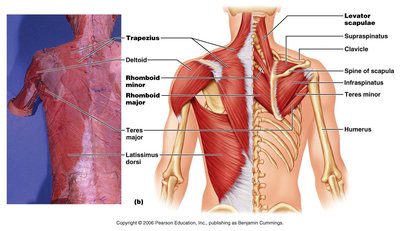
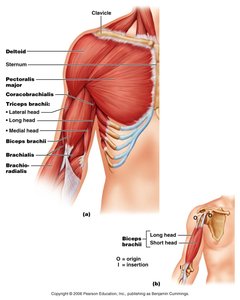
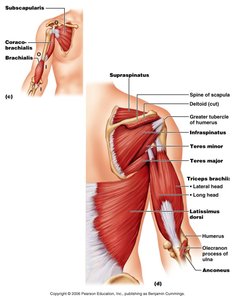
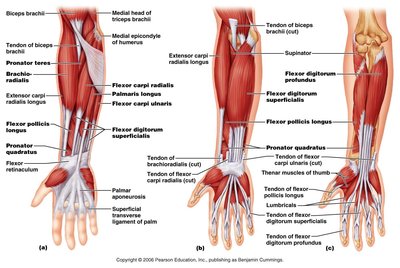
Muscles of the Shoulder and Upper Limb
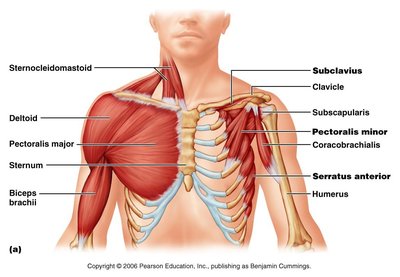
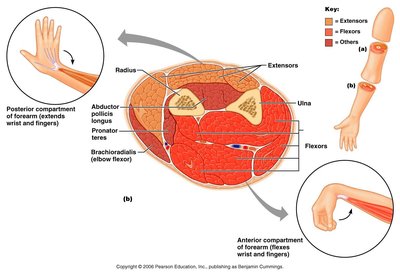
These muscles are responsible for movements of the shoulder, arm, forearm, and hand. Major muscles include the deltoid, pectoralis major, biceps brachii, triceps brachii, and the muscles of the rotator cuff.
Muscles of the Hip and Lower Limb
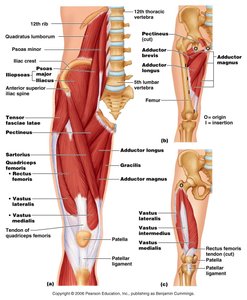
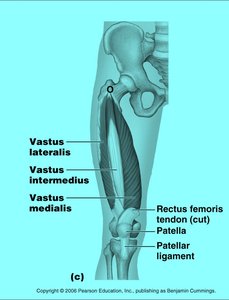
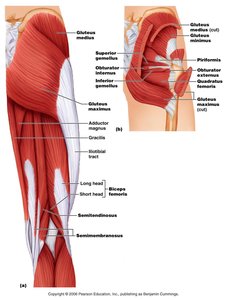
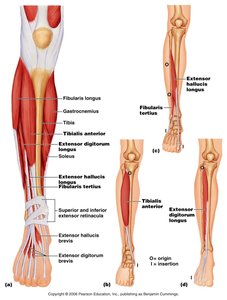
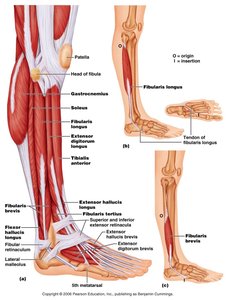
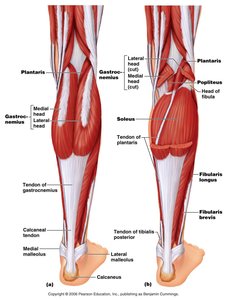
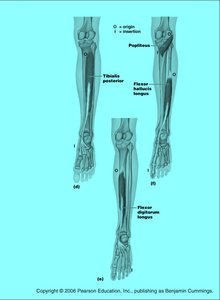
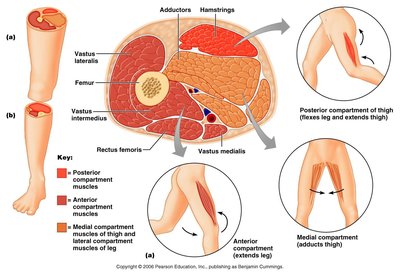
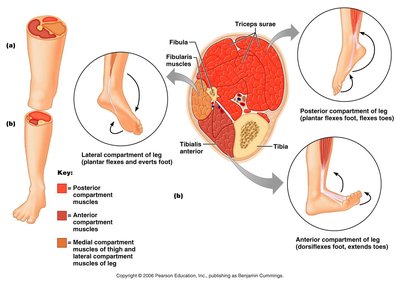
These muscles control movements of the hip, thigh, leg, and foot. They are crucial for locomotion, balance, and posture. Major groups include the gluteal muscles, quadriceps femoris, hamstrings, adductors, and muscles of the leg and foot.
Summary Table: Functional Roles of Muscles
Role | Description | Example |
|---|---|---|
Prime Mover (Agonist) | Main muscle responsible for movement | Biceps brachii in elbow flexion |
Antagonist | Opposes the prime mover | Triceps brachii in elbow flexion |
Synergist | Assists the prime mover | Brachialis in elbow flexion |
Fixator | Stabilizes the origin of the prime mover | Shoulder muscles during elbow flexion |
Additional info: The arrangement of fascicles not only determines the muscle's range of motion but also its power. Parallel muscles have greater range but less power, while pennate muscles are more powerful but have less range of motion.
