 Back
BackChapter 10:The Muscular System: Structure, Function, and Major Muscles
Study Guide - Smart Notes
 Tailored notes based on your materials, expanded with key definitions, examples, and context.
Chapter 10: The Muscular System
10-1 Actions of the Muscular System
The muscular system is responsible for producing movement through the contraction of muscle tissue. There are three types of muscle tissue: skeletal, cardiac, and smooth muscle. This chapter focuses on skeletal muscle, which is under voluntary control and is essential for body movement, posture, and heat production.
Principles of Leverage: Skeletal muscles use bones as levers to produce movement. The arrangement of muscles relative to joints determines the type and range of movement possible.
Muscle Action: Muscles can only pull; they never push. For every movement produced by one muscle group, another group produces the opposite movement (antagonistic pairs).
General Rules for Muscle Action:
A muscle crossing on the anterior side of a joint usually produces flexion.
A muscle crossing on the posterior side of a joint usually produces extension.
A muscle crossing on the lateral side of a joint produces abduction.
A muscle crossing on the medial side of a joint produces adduction.
Exceptions: These generalities do not apply to the knee and ankle due to developmental rotation of the lower limb.
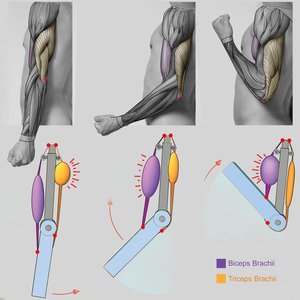
10-2 Muscle Interactions and Functional Groups
Muscles rarely act alone; instead, they work in groups to produce smooth and coordinated movements. The main functional groups are:
Prime Mover (Agonist): The muscle primarily responsible for a specific movement.
Antagonist: The muscle that opposes or reverses the action of the prime mover.
Synergist: A muscle that assists the prime mover by adding extra force or reducing unnecessary movement.
Fixator: A type of synergist that stabilizes the origin of the prime mover, providing a stable base for movement.
Note: The same muscle may act as a prime mover, antagonist, or synergist depending on the movement.

10-3 Naming Skeletal Muscles
Skeletal muscles are named according to several criteria, which often describe their structure, location, or function. The seven main ways muscles are named include:
Direction of Muscle Fibers: e.g., rectus (straight)
Relative Size: e.g., maximus (largest)
Location: e.g., temporalis (over the temporal bone)
Number of Origins: e.g., triceps (three heads)
Location of Origin and Insertion: e.g., sternocleidomastoid (originates on sternum and clavicle, inserts on mastoid process)
Shape: e.g., deltoid (triangular)
Action: e.g., flexor (flexes a bone), extensor (extends a bone)
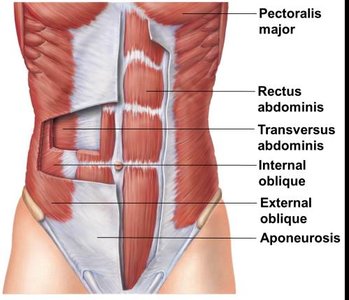
10-4 Major Skeletal Muscles of the Body
There are over 600 skeletal muscles in the human body, which are grouped by function and location. Understanding the names, locations, and primary actions of major muscles is essential for the study of anatomy and physiology.
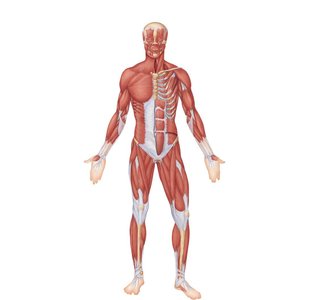
Anterior Muscles: Include muscles of the head, neck, thorax, abdomen, thigh, leg, forearm, and arm.
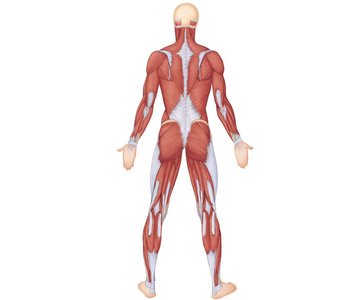
Posterior Muscles: Include muscles of the neck, shoulder, back, hip, thigh, leg, and arm.
Below are examples of major muscles and their primary actions:
Muscle | Location | Primary Action |
|---|---|---|
Pectoralis major | Chest (anterior thorax) | Adducts and medially rotates arm |
Deltoid | Shoulder | Abducts arm |
Biceps brachii | Anterior arm | Flexes elbow and supinates forearm |
Triceps brachii | Posterior arm | Extends elbow |
Rectus abdominis | Abdomen | Flexes vertebral column |
Quadriceps femoris | Anterior thigh | Extends knee |
Hamstrings | Posterior thigh | Flex knee and extend hip |
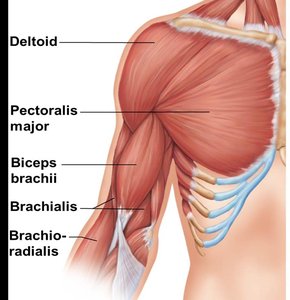
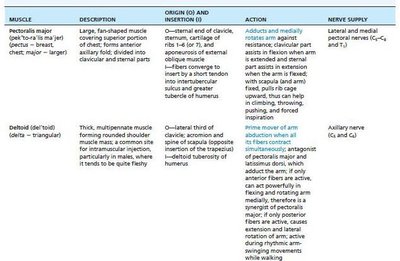
Learning Objectives
Understand the principles of leverage in muscle actions.
Know how muscle actions can be determined by position, interactions, and functional groups.
List the seven ways that muscles can be named and give examples of each.
Identify anterior and posterior muscles and know the primary function of each muscle.
