 Back
BackThe Muscular System: Structure, Function, and Mechanics
Study Guide - Smart Notes
 Tailored notes based on your materials, expanded with key definitions, examples, and context.
The Muscular System
Introduction
The muscular system is essential for movement, posture, and stability in the human body. This chapter focuses on skeletal muscles, their actions, naming conventions, fascicle arrangements, lever systems, and an overview of major muscles. Understanding these concepts is crucial for students of anatomy and physiology, as well as for those entering health-related professions.
Muscle Actions and Interactions
Functional Groups of Skeletal Muscles
Prime Mover (Agonist): The muscle primarily responsible for a specific movement. Example: The biceps brachii during elbow flexion.
Antagonist: The muscle that opposes or reverses a movement. Example: The triceps brachii during elbow flexion.
Synergist: Assists the prime mover by adding extra force or reducing unnecessary movement. Example: The brachialis assists the biceps brachii.
Fixator: A type of synergist that stabilizes the origin of the prime mover, providing a stable base for movement.
Muscles can only pull, not push. The coordinated action of agonists, antagonists, and synergists allows for smooth and controlled movements.
Inferring Muscle Action by Position Relative to Joints
The action of a muscle can often be predicted by its position relative to the joint it crosses:
Anterior side: Produces flexion (e.g., pectoralis major at the shoulder joint).
Posterior side: Produces extension (e.g., latissimus dorsi at the shoulder joint).
Lateral side: Produces abduction (e.g., deltoid middle fibers at the shoulder joint).
Medial side: Produces adduction (e.g., teres major at the shoulder joint).
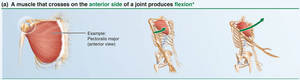
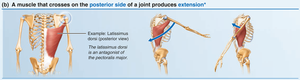
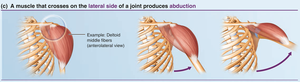
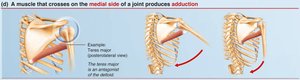
Note: These generalities do not apply to the knee and ankle due to developmental rotation of the lower limb.
Origin and Insertion
Origin: The attachment site on the bone that moves the least, usually proximal or medial.
Insertion: The attachment site on the bone that moves the most, usually distal or lateral.
During contraction, the insertion moves toward the origin.
Naming Skeletal Muscles
Criteria for Naming Muscles
Location: Named for the bone or region (e.g., temporalis over the temporal bone).
Shape: Named for distinctive shapes (e.g., deltoid = triangle).
Size: Terms like maximus (largest), minimus (smallest), longus (long).
Direction of fibers: Rectus (straight), transversus (right angles), oblique (angles).
Number of origins: Biceps (two), triceps (three).
Location of attachments: Origin named first (e.g., sternocleidomastoid attaches to sternum and clavicle, inserts on mastoid process).
Action: Named for the movement produced (e.g., flexor, extensor).
Combined criteria: Example: extensor carpi radialis longus (extends wrist, near radius, long muscle).
Fascicle Arrangements
Patterns of Fascicle Arrangement
Fascicles are bundles of muscle fibers. Their arrangement affects muscle shape and function:
Circular: Fascicles arranged in concentric rings (e.g., orbicularis oris).
Convergent: Broad origin, fascicles converge toward a single tendon (e.g., pectoralis major).
Parallel: Fascicles parallel to the long axis (e.g., sartorius).
Fusiform: Spindle-shaped with parallel fibers (e.g., biceps brachii).
Pennate: Short fascicles attach obliquely to a central tendon. Types:
Unipennate: Fascicles on one side (e.g., extensor digitorum longus).
Bipennate: Fascicles on both sides (e.g., rectus femoris).
Multipennate: Multiple feather-like fascicles (e.g., deltoid).
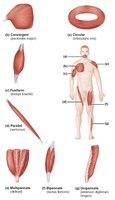
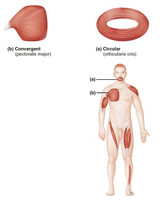
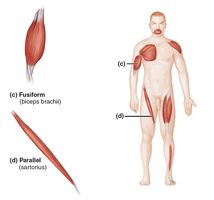
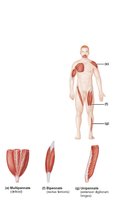
Functional Implications: Fascicle arrangement determines a muscle’s range of motion and power. Long, parallel fibers allow greater movement but less power. Pennate muscles are more powerful but have less range of motion.
Lever Systems
Basic Components of a Lever System
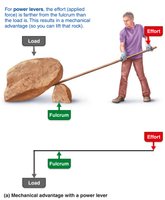
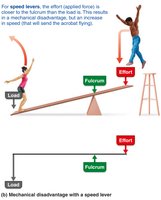
Lever: Rigid bar (bone) that moves on a fixed point (fulcrum, usually a joint).
Effort: Force applied by muscle contraction.
Load: Resistance moved by the effort (bone, tissues, added weight).
Mechanical Advantage vs. Disadvantage
Mechanical Advantage (Power Lever): Load is close to fulcrum, effort is far. Small effort moves large load. Used for strength.
Mechanical Disadvantage (Speed Lever): Load is far from fulcrum, effort is close. Load moves rapidly over a large distance. Used for speed and range of motion.


Classes of Lever Systems
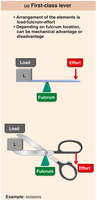
Class | Arrangement | Example |
|---|---|---|
First-class | Fulcrum between load and effort | Seesaw, scissors, raising head off chest |
Second-class | Load between fulcrum and effort | Wheelbarrow, standing on toes |
Third-class | Effort between fulcrum and load | Tweezers, most skeletal muscles (e.g., biceps curl) |
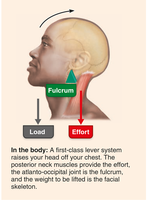
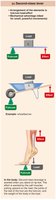
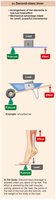
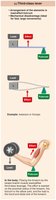
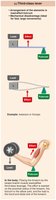
Summary: Speed levers (mechanical disadvantage) favor speed and range of motion, while power levers (mechanical advantage) favor strength and stability.
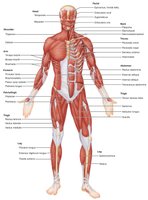
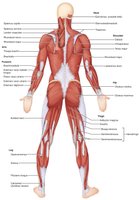
Major Skeletal Muscles of the Body
Overview and Study Tips
There are over 600 skeletal muscles, grouped by function and location.
Muscle tables typically include: description, origin and insertion, actions, and innervation.
Tips for learning muscles:
Use the muscle’s name to infer location and action.
Relate muscle attachments to their actions.
Practice identifying muscles on diagrams and your own body.
Key Equations
Lever Law:
Additional info: Understanding muscle mechanics and anatomy is foundational for clinical practice, injury prevention, and effective movement analysis.
