 Back
BackThe Muscular System: Structure, Function, and Major Muscles
Study Guide - Smart Notes
 Tailored notes based on your materials, expanded with key definitions, examples, and context.
The Muscular System
Introduction
The muscular system is essential for movement, posture, and many physiological processes. This chapter focuses on the structure, classification, and function of skeletal muscles, as well as the major muscle groups of the human body.
Structure of Skeletal Muscles
Gross Anatomy of Skeletal Muscle
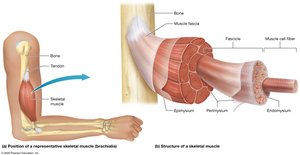
Skeletal Muscle Fibers: Long, thin cells surrounded by a thin layer of extracellular matrix called the endomysium.
Fascicle: A bundle of 10–100 muscle fibers, surrounded by perimysium.
Epimysium: Connective tissue that surrounds all fascicles in a muscle.
Fascia: The most superficial connective tissue sheath, continuous with the epimysium.
Tendons: Attach muscle to bone or other structures.
Rich Blood and Nerve Supply: Necessary for muscle function.
Voluntary Control: Skeletal muscle contraction is under conscious control and requires nervous stimulation.
Fascicle Patterns and Muscle Shapes
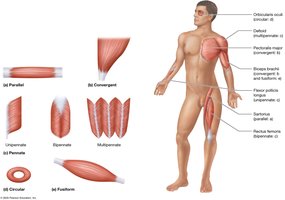
Parallel: Evenly spaced fascicles; e.g., Sartorius.
Convergent: Broad at one end, tapers to a single tendon; e.g., Pectoralis Major.
Circular (Sphincters): Encircle openings; e.g., Orbicularis Oculi.
Fusiform: Thick in the middle, tapered at ends; e.g., Biceps Brachii.
Pennate: Fascicles attach at an angle to the tendon.
Unipennate: One side; e.g., Flexor Pollicis Longus.
Bipennate: Both sides; e.g., Rectus Femoris.
Multipennate: Multiple tendons; e.g., Deltoid.
Naming Muscles
Principles of Muscle Naming
Size: Major, Minor, Longus, Brevis, Vastus.
Location: Directional (Superior, Inferior, Medial, Lateral) or regional terms.
Attachment: Named for bones or structures attached (e.g., Sternocleidomastoid).
Function: Flexor, Extensor, Levator, Adductor, Abductor.
Depth: Profundus (deep), Superficialis (superficial).
Functions of Skeletal Muscles
Muscle Tension and Movement
Muscle Tension: Force generated by contraction.
Body Movements: Actions produced by muscle tension.
Heat Generation: Conversion of ATP chemical energy to mechanical energy produces heat (e.g., shivering).
Functional Groups of Muscles
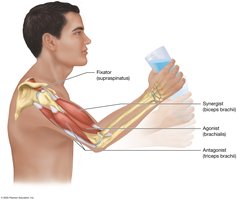
Agonist (Prime Mover): Main muscle producing movement.
Antagonist: Opposes or slows movement; located opposite the agonist.
Synergist: Assists the agonist, stabilizes movement.
Fixator: Stabilizes the origin of the agonist for efficient movement.
Muscle Origin and Insertion
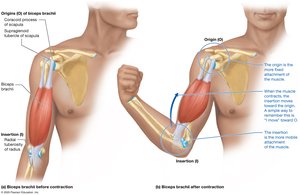
Origin (O): More fixed attachment point.
Insertion (I): More moveable attachment point.
Muscle contraction typically moves the insertion toward the origin.
Origin and insertion can switch depending on movement context.
Lever Systems in Body Movements
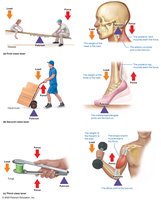
Lever: Bone that moves on a fixed point (fulcrum).
Load: Object or body part being moved.
Force: Muscle tension applied to the lever.
Fulcrum: Joint acting as the pivot point.
First-Class Lever: Fulcrum between load and force (e.g., atlanto-occipital joint).
Second-Class Lever: Load between fulcrum and force (e.g., metatarsophalangeal joints).
Third-Class Lever: Force between load and fulcrum (e.g., elbow joint with biceps brachii); most common in the body.
Mechanical Advantage and Disadvantage
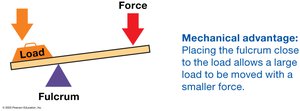
Mechanical Advantage: Small force moves a large load (fulcrum close to load).
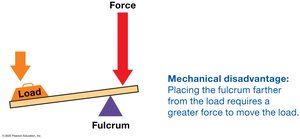
Mechanical Disadvantage: Greater force required to move the load (fulcrum farther from load).
Muscle Injuries and Clinical Applications
Muscle Knots (Myofascial Trigger Points)
Localized, irritable spots in muscle fascia causing pain and sustained contraction.
Caused by repetitive exercise, trauma, stress, disease, or trapped nerves.
Treatment: Massage, anti-inflammatory medications, muscle relaxants, passive stretching.
Muscle Strains
Occurs when muscle is overstretched or overloaded, causing tears.
Symptoms: Pain, limited movement, swelling, bruising.
Treatment: PRICE method (Protect, Rest, Ice, Compression, Elevation), medications, physical therapy, or surgery.
Studying Muscles: Overview of Major Muscle Groups
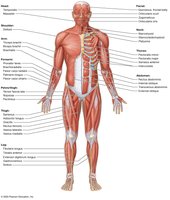
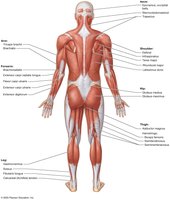
Major Muscle Groups
Muscles of the head, neck, and vertebral column
Muscles of the trunk and pelvic floor
Muscles of the pectoral girdle and upper limb
Muscles of the hip and lower limb
Summary Table: Common Terms in Muscle Anatomy
Term | Meaning |
|---|---|
Major | Large |
Minor | Small |
Longus | Long |
Brevis | Short |
Vastus | Broad |
Profundus | Deep |
Superficialis | Superficial |
Flexor | Decreases angle at a joint |
Extensor | Increases angle at a joint |
Adductor | Moves limb toward midline |
Abductor | Moves limb away from midline |
Key Equations
Mechanical Advantage:
Conclusion
The muscular system is highly organized, with muscles classified by structure, function, and location. Understanding muscle anatomy and physiology is essential for comprehending movement, injury mechanisms, and clinical treatments.
