 Back
The Muscular System: Structure, Function, and Mechanics
Study Guide - Smart Notes
 Tailored notes based on your materials, expanded with key definitions, examples, and context.
The Muscular System
Muscle Mechanics: Leverage and Fascicle Arrangement
The muscular system relies on principles of biomechanics to produce movement. Muscles act on bones, which serve as levers, and joints function as fulcrums. The arrangement of muscle fascicles determines both the range of motion and the power of muscle contractions.
Lever: A rigid bar (usually a bone) that moves about a fixed point.
Fulcrum: The fixed point (joint) around which the lever moves.
Effort: The force applied by muscle contraction to move the lever.
Load: The resistance or weight that opposes the effort.
Power Levers vs. Speed Levers
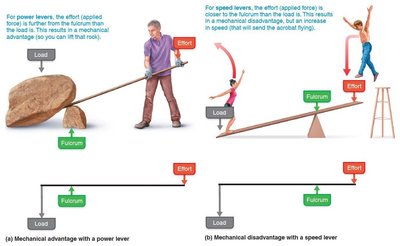
Levers in the body can be classified based on their mechanical advantage. Power levers allow movement of heavy loads with less effort, while speed levers favor rapid movement but require more effort.
Power Lever: Load is close to the fulcrum, effort is applied farther away. Example: using a jack to lift a car.
Speed Lever: Load is farther from the fulcrum, effort is applied closer. Example: lifting a load with a shovel.
Classes of Levers in the Human Body
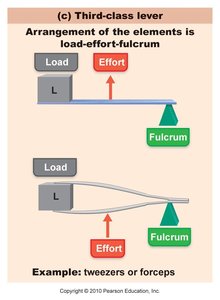
Levers are categorized into three classes based on the relative positions of the fulcrum, load, and effort.
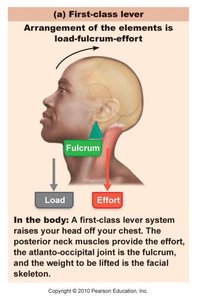
First Class Lever: Fulcrum is between load and effort. Example: raising the head off the chest.
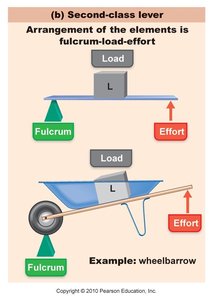
Second Class Lever: Load is between fulcrum and effort. Example: standing on toes.
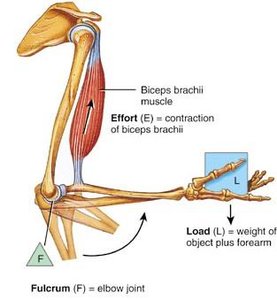
Third Class Lever: Effort is between load and fulcrum. Example: flexing the forearm with the biceps brachii.
Arrangement of Fascicles
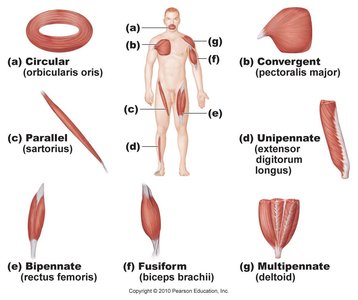
The arrangement of muscle fascicles affects both the range of motion and the power of a muscle. Fascicle patterns include circular, convergent, parallel, unipennate, bipennate, fusiform, and multipennate.
Circular: Fascicles arranged in concentric rings (e.g., sphincters).
Convergent: Fascicles converge toward a single tendon (e.g., pectoralis major).
Parallel: Fascicles run parallel to the long axis (e.g., sartorius).
Unipennate: Fascicles attach obliquely to one side of the tendon (e.g., extensor digitorum longus).
Bipennate: Fascicles attach to both sides of the tendon (e.g., rectus femoris).
Fusiform: Spindle-shaped with expanded belly (e.g., biceps brachii).
Multipennate: Multiple fascicles converge to a single tendon (e.g., deltoid).
Muscle Function: Origin, Insertion, and Roles
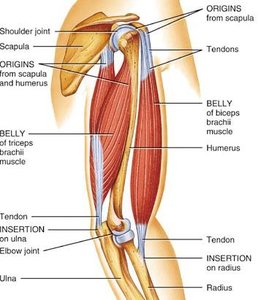
Muscles are attached to bones at two points: the origin (immobile) and the insertion (moves toward the origin during contraction). Muscles work in groups to produce movement, with specific roles:
Agonist (Prime Mover): The muscle responsible for the main movement (e.g., biceps brachii in forearm flexion).
Antagonist: Opposes the agonist, stretches during contraction (e.g., triceps during forearm flexion).
Synergist: Assists the agonist or stabilizes a joint.
Fixator: Synergist that immobilizes a bone or muscle origin, stabilizing the movement (e.g., muscles stabilizing the scapula).
Muscle Naming Terminology
Muscles are named based on several criteria, including location, number of origins, action, size, shape, and direction of fibers.
Location: Named for the region they cover (e.g., temporalis overlies the temporal bone).
Number of Origins: Indicates the number of attachment points (e.g., biceps brachii has two origins).
Action: Describes the movement produced (e.g., flexors, extensors, adductors).
Size: Relative size (e.g., maximus, minimus, longus, brevis).
Shape: Describes the muscle's form (e.g., deltoid is triangular, trapezius is trapezoid).
Direction of Fibers: Orientation of muscle fibers (e.g., rectus means straight).
Origin and Insertion: Named for their attachment points (e.g., sternocleidomastoid attaches to sternum, clavicle, and mastoid process).
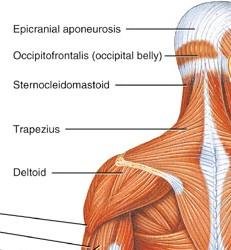
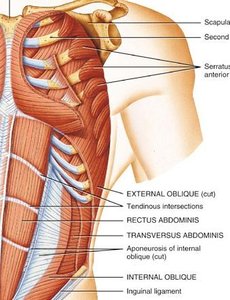
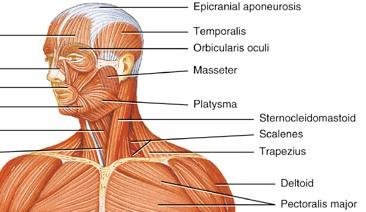
Main Muscle Groups: Anterior and Posterior
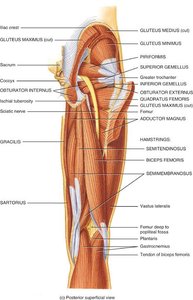
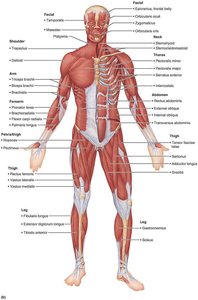
The human body contains several major muscle groups, each with specific functions and anatomical locations. Understanding these groups is essential for identifying muscle actions and their contributions to movement.
Anterior Muscle Groups: Quadriceps (rectus femoris, vastus lateralis, vastus medialis, vastus intermedius), Hamstrings (biceps femoris, semimembranosus, semitendinosus), Abdominals (rectus abdominis, external & internal obliques, transverse abdominis).
Posterior Muscle Groups: Latissimus dorsi, rhomboids, rotator cuff (infraspinatus, supraspinatus, teres minor, subscapularis), gluteal muscles (gluteus maximus, medius, minimus, iliotibial band).
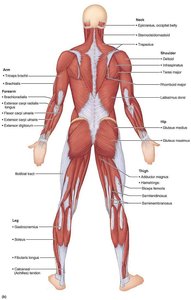
Summary Table: Lever Classes
The following table summarizes the three classes of levers found in the human body:
Class | Arrangement | Anatomical Example |
|---|---|---|
First Class | Fulcrum between load and effort | Neck muscles raising head |
Second Class | Load between fulcrum and effort | Standing on toes |
Third Class | Effort between load and fulcrum | Biceps brachii flexing forearm |
Summary Table: Fascicle Arrangements
The following table summarizes the main types of fascicle arrangements:
Arrangement | Example | Function |
|---|---|---|
Circular | Orbicularis oris | Closes openings |
Convergent | Pectoralis major | Versatile movement |
Parallel | Sartorius | Greater contraction |
Unipennate | Extensor digitorum longus | Increased power |
Bipennate | Rectus femoris | Increased power |
Fusiform | Biceps brachii | Flexion |
Multipennate | Deltoid | Greatest power |
Key Equations
Mechanical advantage of a lever can be calculated as:
Muscle force and torque:
Additional info:
Links to interactive resources for further study: GetBodySmart Muscular System, LUMEN Gross Anatomy Muscles
