 Back
BackThe Muscular System: Structure, Function, and Physiology
Study Guide - Smart Notes
 Tailored notes based on your materials, expanded with key definitions, examples, and context.
The Muscular System
Overview and Functions
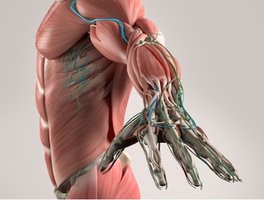
The muscular system is essential for movement, posture, and heat production in the human body. Muscles work closely with the nervous and skeletal systems to produce voluntary and involuntary movements, maintain body position, and regulate temperature through heat generation.
Motion / Movement: Muscles contract to move bones and body parts.
Heat Production: Muscle contractions generate heat, helping maintain body temperature.
Posture / Body Support: Muscles stabilize joints and maintain posture.
Basic Characteristics of Muscles
Muscle Properties
Muscle tissue exhibits several key physiological properties that enable its function:
Irritability / Responsiveness: Ability to respond to stimuli, though not all stimuli elicit a response; the stimulus must reach a threshold.
Contractility: Ability to shorten and generate force upon stimulation.
Extensibility: Ability to be stretched or extended.
Elasticity: Ability to return to original shape after contraction or extension.
Muscle Structure and Nomenclature
Muscle Organization
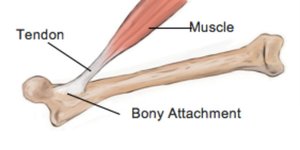
Muscles are named based on size, shape, location, function, relative position, orientation of fibers, and attachment points. Tendons connect muscles to bones, transmitting the force of contraction to the skeleton.
Fascia: Connective tissue that supports and separates muscles and organs. Superficial fascia connects the hypodermis to muscle, while deep fascia connects muscle to muscle.
Muscle Cell Structure
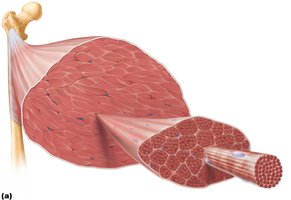
Muscle cells, or muscle fibers, are multinucleated and surrounded by connective tissue layers:
Endomysium: Surrounds individual muscle fibers.
Perimysium: Surrounds bundles of fibers (fascicles).
Epimysium: Surrounds the entire muscle.
Muscle Fiber Structure
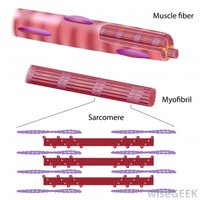
Each muscle fiber contains many myofibrils, which are composed of myofilaments (actin and myosin). These proteins are responsible for muscle contraction.
Types of Muscle Tissue
Classification of Muscle Types
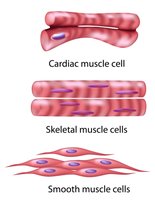
There are three main types of muscle tissue, each with distinct structure and function:
Type | Structure | Control | Location |
|---|---|---|---|
Skeletal Muscle | Striated, multinucleated | Voluntary | Attached to bones |
Cardiac Muscle | Striated, branched, intercalated discs | Involuntary | Heart |
Smooth Muscle | Non-striated, spindle-shaped | Involuntary | Walls of hollow organs |
Muscle Contraction: The Sliding Filament Model
Sarcomere Structure
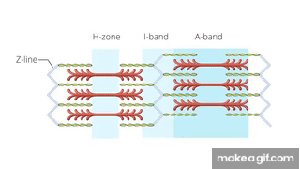
The sarcomere is the functional unit of muscle contraction, defined as the region between two Z-lines. It contains thick (myosin) and thin (actin) filaments whose interaction produces contraction.
M-line: Anchors myosin filaments.
I-band: Contains only actin; shrinks during contraction.
A-band: Contains myosin; remains constant during contraction.
H-zone: Region with only myosin; disappears during contraction as actin slides inward.

Actin and Myosin Interaction
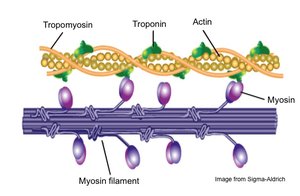
Muscle contraction occurs when myosin heads bind to actin, forming cross-bridges. This process is regulated by the proteins tropomyosin and troponin, and is powered by ATP.
Actin: Contains myosin binding sites, covered by tropomyosin in resting state.
Troponin: Binds calcium, causing tropomyosin to move and expose binding sites.
Myosin: Has heads with actin binding sites and ATPase activity.
Cross-Bridge Cycle
The cross-bridge cycle describes the sequence of events during muscle contraction:
Calcium binds to troponin, moving tropomyosin and exposing actin binding sites.
Myosin heads (cocked by ATP hydrolysis) bind to actin, forming cross-bridges.
Power stroke: Myosin head pivots, pulling actin filament inward; ADP and Pi are released.
ATP binds to myosin, causing it to detach from actin and reset for another cycle.
Neuromuscular Junction and Excitation-Contraction Coupling
Neuromuscular Junction
The neuromuscular junction is the synapse between a motor neuron and a muscle fiber. Acetylcholine (ACh) is released from the neuron, binds to receptors on the muscle, and initiates an action potential in the muscle fiber.
Acetylcholinesterase: Enzyme that breaks down ACh, preventing continuous stimulation.
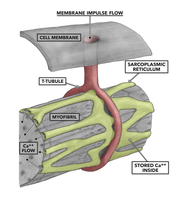
T-tubules: Invaginations of the sarcolemma that transmit action potentials into the muscle fiber.
Sarcoplasmic Reticulum (SR): Stores and releases calcium ions in response to action potentials.
Excitation-Contraction Coupling
Excitation-contraction coupling links the action potential to muscle contraction:
Action potential travels along sarcolemma and down T-tubules.
SR releases Ca2+ into sarcoplasm.
Ca2+ binds to troponin, initiating the cross-bridge cycle.
Muscle Relaxation
Mechanisms of Relaxation
Muscle relaxation requires the cessation of neural stimulation and removal of Ca2+ from the sarcoplasm:
Stop ACh release and degrade remaining ACh with acetylcholinesterase.
Ca2+ is actively transported back into the SR (requires ATP).
Cross-bridges detach, and muscle returns to resting state.
Muscle Metabolism and Exercise
ATP Production and Muscle Fatigue
ATP is required for both contraction and relaxation. During exercise, increased ATP demand is met by cellular respiration in mitochondria. Lack of oxygen leads to lactic acid production, causing muscle soreness. Weight loss during exercise is primarily due to the exhalation of CO2, a product of cellular respiration.
Fatigue: Occurs when ATP levels are low, reducing muscle performance.
Rigor Mortis: Post-mortem muscle stiffness due to lack of ATP, preventing myosin detachment from actin.
Muscle Strength and Growth
Factors Affecting Strength
Muscle strength depends on the number of cross-bridges formed. Exercise increases muscle size and strength by promoting the formation of more cross-bridges and stimulating growth hormone pathways.
Muscle Disorders
Spasms and Toxins
Muscle spasms are involuntary contractions caused by failure to relax. Acetylcholinesterase inhibitors and toxins (e.g., tetanus toxin) can cause persistent contractions by interfering with normal neural signaling.
Acetylcholinesterase Inhibitors: Drugs or toxins that prevent breakdown of ACh, leading to prolonged contraction.
Tetanus Toxin: Blocks inhibitory neurotransmitters, causing continuous muscle contraction.
Summary Table: Muscle Types
Muscle Type | Striations | Nuclei | Control | Location |
|---|---|---|---|---|
Skeletal | Yes | Multinucleated | Voluntary | Attached to bones |
Cardiac | Yes | Single (sometimes two) | Involuntary | Heart |
Smooth | No | Single | Involuntary | Walls of hollow organs |
