 Back
The Muscular System: Structure, Function, and Naming of Skeletal Muscles
Study Guide - Smart Notes
 Tailored notes based on your materials, expanded with key definitions, examples, and context.
The Muscular System
Overview of the Muscular System
The muscular system is responsible for movement, posture, and heat production in the human body. Muscles work together to produce voluntary and involuntary movements, and their structure and function are essential for understanding human anatomy and physiology.
Functional Groups of Skeletal Muscles
Classification of Muscle Roles
Skeletal muscles are organized into functional groups based on their actions during movement. Understanding these groups helps clarify how muscles interact to produce coordinated motion.
Prime Movers (Agonists): Provide the major force for producing a specific movement. Example: The biceps brachii is the prime mover for elbow flexion.
Antagonists: Oppose or reverse a particular movement. Example: The triceps brachii acts as the antagonist during elbow flexion.
Synergists: Add force to a movement and reduce undesirable or unnecessary movement. Example: The brachialis assists the biceps brachii in elbow flexion.
Fixators: Synergists that immobilize a bone or muscle’s origin, providing stability during movement. Example: Muscles that stabilize the scapula during arm movements.
Example: Elbow Movement
During elbow flexion, the biceps contracts (prime mover), while the triceps relaxes (antagonist). During elbow extension, the triceps contracts (prime mover), and the biceps relaxes (antagonist). 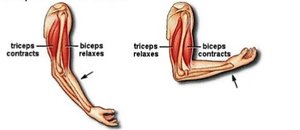
Naming Skeletal Muscles
Principles of Muscle Naming
Skeletal muscles are named according to several criteria, which often reflect their structure, location, or function. Understanding these principles aids in identifying and learning muscle names.
Direction of Muscle Fibers: Terms like rectus (straight), oblique (angled), and transverse (horizontal) describe fiber orientation.
Location: Muscles are often named for the region of the body they are found in, such as femoris (thigh) or brachii (arm).
Location of Attachments: Names may indicate points of origin and insertion, such as sternocleidomastoid (originates at sternum and clavicle, inserts at mastoid process).
Shape: Terms like deltoid (triangle-shaped) or orbicularis (circular) describe muscle shape.
Size: Descriptors such as maximus (largest), minimus (smallest), longus (long), and brevis (short) indicate muscle size.
Number of Origins: Prefixes like biceps (two origins), triceps (three origins), and quadriceps (four origins) denote the number of muscle heads.
Action: Names may reflect the muscle’s action, such as flexor, extensor, adductor, or abductor.
Examples:
Rectus Femoris: Named for the direction of fibers (rectus = straight) and location (femoris = thigh).
Sternocleidomastoid: Named for its attachments: sterno (sternum), cleido (clavicle), mastoid (mastoid process).
Muscle Actions and Joint Movements
How Muscles Produce Movement at Joints
Muscles produce movement by contracting and pulling on bones, which act as levers. The action depends on the muscle’s position relative to the joint.
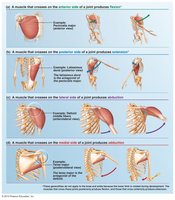
Flexion: Decreases the angle between two bones (e.g., bending the elbow).
Extension: Increases the angle between two bones (e.g., straightening the elbow).
Abduction: Moves a limb away from the midline of the body.
Adduction: Moves a limb toward the midline of the body.
Muscle Fiber Arrangement
Types of Muscle Fiber Patterns
The arrangement of muscle fibers affects the muscle’s range of motion and force production.
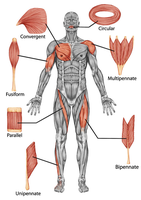
Parallel: Fibers run parallel to the long axis; allows greater range of motion.
Fusiform: Spindle-shaped with a central belly.
Circular: Fibers arranged in concentric rings; found in sphincters.
Convergent: Fibers converge toward a single tendon.
Unipennate: Fibers attach to one side of a tendon.
Bipennate: Fibers attach to both sides of a tendon.
Multipennate: Multiple tendons with fibers arranged at multiple angles.
Comparison Table: Muscle Fiber Arrangements
Arrangement | Example | Function |
|---|---|---|
Parallel | Sartorius | Greater range of motion |
Fusiform | Biceps brachii | Combination of force and range |
Circular | Orbicularis oris | Closes openings |
Convergent | Pectoralis major | Versatile movement |
Unipennate | Extensor digitorum longus | Greater force |
Bipennate | Rectus femoris | Greater force |
Multipennate | Deltoid | Maximum force |
Summary
The muscular system is essential for movement and stability. Muscles are classified by their function, naming conventions, and fiber arrangement, all of which contribute to their role in the body. Understanding these principles is fundamental for students of anatomy and physiology.
