 Back
The Nervous System: Structure and Function
Study Guide - Smart Notes
 Tailored notes based on your materials, expanded with key definitions, examples, and context.
The Nervous System
Overview and Function
The nervous system is the master integrating and coordinating system of the body, responsible for monitoring and processing sensory information from both the external environment and within the body. It produces responses to stimuli, enabling thought, action, and sensation.
Integration: Processes and integrates new inputs with previously stored information to produce responses.
Divisions: The nervous system is divided into the central nervous system (CNS) and the peripheral nervous system (PNS).
CNS: Consists of the brain and spinal cord.
PNS: Includes all nervous elements outside the CNS, such as nerves, sensory receptors, and clusters of neuron cell bodies.
Principal Cell Types
Despite its complexity, nervous tissue is composed of two main cell types: neurons and neuroglia.
Neuroglia
Types and Functions
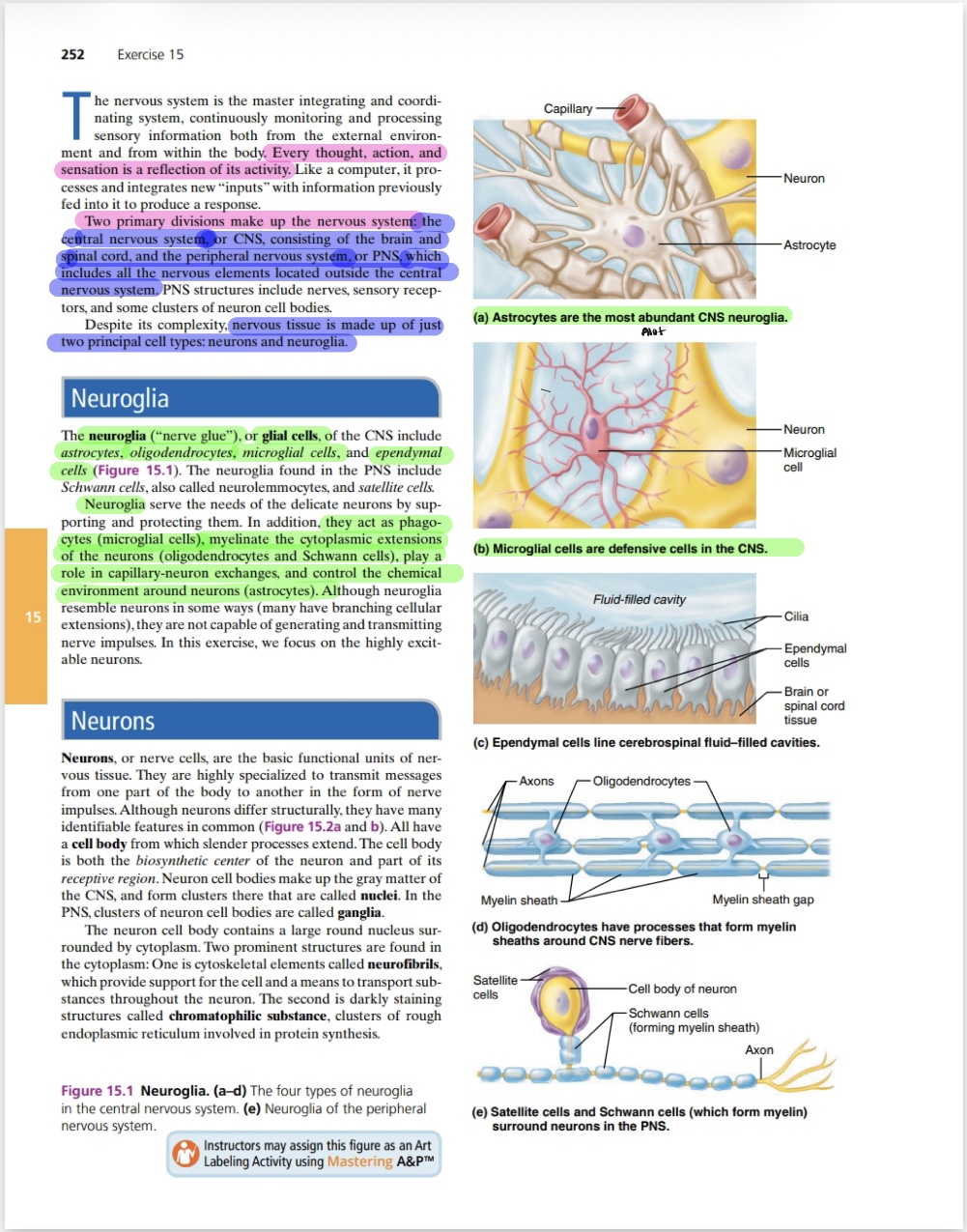
Neuroglia ("nerve glue" or glial cells) serve the needs of neurons by supporting and protecting them. They are not capable of generating or transmitting nerve impulses. Neuroglia are classified based on their location and function:
CNS Neuroglia: Astrocytes, oligodendrocytes, microglial cells, and ependymal cells.
PNS Neuroglia: Schwann cells and satellite cells.
Type | Location | Main Function |
|---|---|---|
Astrocytes | CNS | Most abundant; control chemical environment, capillary-neuron exchanges |
Microglial cells | CNS | Act as phagocytes; defensive cells |
Ependymal cells | CNS | Line cerebrospinal fluid-filled cavities |
Oligodendrocytes | CNS | Form myelin sheaths around CNS nerve fibers |
Schwann cells | PNS | Form myelin sheaths around PNS nerve fibers |
Satellite cells | PNS | Surround neuron cell bodies in PNS |
Astrocytes: Most abundant CNS neuroglia; regulate the chemical environment and capillary-neuron exchanges.
Microglial cells: Defensive cells that act as phagocytes.
Ependymal cells: Line cerebrospinal fluid-filled cavities and help circulate fluid.
Oligodendrocytes: Form myelin sheaths around CNS nerve fibers.
Schwann cells: Form myelin sheaths around PNS nerve fibers.
Satellite cells: Surround neuron cell bodies in the PNS.
Neurons
Structure and Function
Neurons are the basic functional units of nervous tissue, specialized to transmit messages in the form of nerve impulses. They share several structural features:
Cell Body: The biosynthetic center and part of the receptive region. Contains a large, round nucleus surrounded by cytoplasm.
Processes: Slender extensions from the cell body, including dendrites (receptive) and axons (transmitting).
Gray Matter: Composed of neuron cell bodies in the CNS, forming clusters called nuclei.
Ganglia: Clusters of neuron cell bodies in the PNS.
Cell Body Components
Neurofibrils: Cytoskeletal elements providing support and transport within the neuron.
Chromatophilic Substance: Clusters of rough endoplasmic reticulum involved in protein synthesis.
Myelin Sheath
The myelin sheath is a protective covering formed by oligodendrocytes in the CNS and Schwann cells in the PNS. It insulates nerve fibers and increases the speed of nerve impulse transmission.
Myelin Sheath Gap: Also known as the node of Ranvier, it is a gap in the myelin sheath that facilitates rapid conduction of nerve impulses.
Summary Table: Neuron and Neuroglia Features
Feature | Description |
|---|---|
Cell Body | Biosynthetic center, contains nucleus |
Neurofibrils | Support and transport within neuron |
Chromatophilic Substance | Protein synthesis (rough ER) |
Myelin Sheath | Insulation and increased impulse speed |
Myelin Sheath Gap | Node of Ranvier; rapid impulse conduction |
Example
Astrocytes regulate the chemical environment around neurons, while microglial cells act as the immune defense in the CNS. Oligodendrocytes and Schwann cells form myelin sheaths, which are essential for fast nerve impulse transmission.
Additional info: The notes expand on the brief points in the original material, providing definitions, examples, and context for each cell type and structure.
