 Back
The Penis and Male Perineum: Structure and Function
Study Guide - Smart Notes
 Tailored notes based on your materials, expanded with key definitions, examples, and context.
The Penis: Structure and Function
Overview of the Penis
The penis is the primary male copulatory organ, responsible for delivering sperm into the female reproductive tract. Along with the scrotum, it forms the external genitalia of the male. The penis consists of an attached root and a free body, which ends in the enlarged tip known as the glans penis.
Prepuce (Foreskin): The loose skin covering the penis extends distally around the glans to form a cuff called the prepuce or foreskin. Circumcision is the surgical removal of the foreskin, which is not medically necessary but can reduce the risk of certain infections.
Penile Anatomy: The penis contains the spongy urethra and three cylindrical bodies of erectile tissue, each covered by dense fibrous connective tissue.
Erectile Tissue and Erection
Internally, the penis is composed of erectile tissue—a spongy network of connective tissue and smooth muscle filled with vascular spaces. During sexual excitement, these spaces fill with blood, causing the penis to enlarge and become rigid, a process known as erection.
Corpus Spongiosum: The midventral erectile body surrounds the urethra, expands distally to form the glans, and proximally to form the bulb of the penis. The bulbospongiosus muscle covers the bulb externally.
Corpora Cavernosa: The paired dorsal erectile bodies make up most of the penis and are bound by the tunica albuginea. Their proximal ends form the crura, which anchor to the pubic arch.
Example: During sexual arousal, increased blood flow to the erectile tissues results in erection, enabling the penis to function as a copulatory organ.
Function of the Corpora Cavernosa
The corpora cavernosa are responsible for most of the rigidity during erection. They fill with blood, allowing the penis to become firm and suitable for copulation.
Key Point: The corpora cavernosa are essential for penile erection and sexual function.
The Male Perineum
Definition and Boundaries
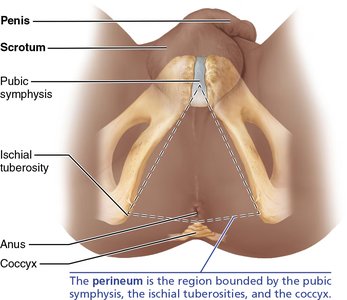
The male perineum is a diamond-shaped region that suspends the scrotum and contains the root of the penis and the anus. It is bounded by the pubic symphysis anteriorly, the coccyx posteriorly, and the ischial tuberosities laterally.
Key Point: The perineum serves as the anatomical region for the external genitalia and the anus.
Muscular Floor: The floor of the perineum is formed by muscles described in muscular system chapters.
Example: The perineum is important in both reproductive and excretory functions, providing support and anchorage for the external genitalia.
Check Your Understanding
What is the function of the corpora cavernosa? The corpora cavernosa are responsible for penile rigidity during erection.
What name is given to the external region where the penis and scrotum are suspended? The perineum.
