 Back
The Reproductive System: Homologous Structures, Hormonal Regulation, and Meiosis
Study Guide - Smart Notes
 Tailored notes based on your materials, expanded with key definitions, examples, and context.
The Male and Female Reproductive Systems: Common Features
Homologous Reproductive Structures
The male and female reproductive systems share several homologous structures, meaning they originate from the same embryonic tissues and often serve similar functions.
Gonads: The testes in males and ovaries in females are homologous organs responsible for producing gametes and sex hormones.
External Genitalia: The penis in males and clitoris in females are homologous structures.
Accessory Organs: Ducts and glands in both sexes facilitate gamete transport and support reproductive function.
Function: Both systems produce gametes (sperm or ova) and secrete sex hormones (testosterone, estrogens, progesterone).
Example: Both testes and ovaries are essential for gamete production and hormone secretion, influencing sexual development and behavior.
Reproductive Hormone Regulation: The HPG Axis
The Hypothalamic-Pituitary-Gonadal (HPG) Axis
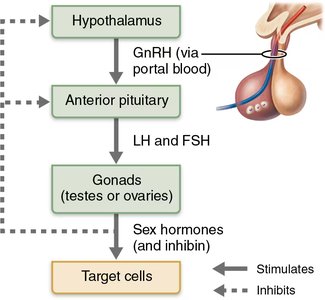
The HPG axis is a hormonal regulatory system that controls gamete production and sex hormone secretion in both males and females.
Hypothalamus: Releases gonadotropin-releasing hormone (GnRH) in a pulsatile manner.
Anterior Pituitary: Responds to GnRH by releasing follicle-stimulating hormone (FSH) and luteinizing hormone (LH).
Gonads: FSH and LH stimulate the gonads to produce gametes and sex hormones.
Sex Hormones: Testosterone, estrogens, and progesterone act on target tissues and exert negative feedback on the hypothalamus and pituitary.
Inhibin: Released by gonads in response to FSH, inhibits FSH release from the pituitary.
Example: The HPG axis ensures proper timing and regulation of puberty and reproductive function.
Activation of the HPG Axis at Puberty
Puberty marks the onset of reproductive capability, driven by increased activity of the HPG axis.
Before puberty, low sex hormone levels suppress GnRH release.
As puberty approaches, hypothalamic sensitivity decreases, leading to rhythmic GnRH release.
FSH and LH levels rise, stimulating gonadal growth and sex hormone production.
High sex hormone levels trigger the physical and functional changes of puberty.
Meiosis: Gamete Formation
Definition and Purpose of Meiosis
Meiosis is a specialized type of nuclear division occurring only in the gonads, essential for sexual reproduction.
Reduces Chromosome Number: Halves the chromosome number in gametes, preventing doubling in offspring.
Increases Genetic Variability: Through crossing over and independent assortment, meiosis creates genetically unique gametes.
Example: Human gametes contain 23 chromosomes, while somatic cells contain 46.
Terminology of Meiosis
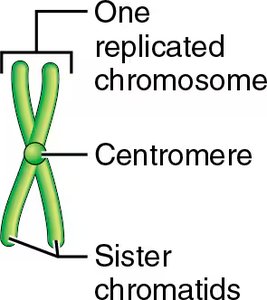
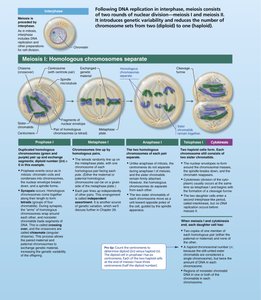
Sister Chromatids: Identical copies of a chromosome joined at the centromere, formed after DNA replication.
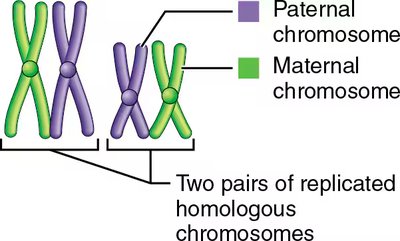
Homologous Chromosomes: Chromosome pairs (one paternal, one maternal) carrying genes for the same traits.
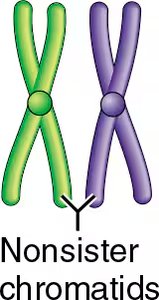
Nonsister Chromatids: Chromatids from different homologous chromosomes; exchange genetic material during crossing over.
Diploid (2n): Cells with two sets of chromosomes (somatic cells).
Haploid (n): Cells with one set of chromosomes (gametes).
Sequence of Events in Meiosis
Meiosis consists of two consecutive divisions: Meiosis I and Meiosis II, each with four phases (prophase, metaphase, anaphase, telophase).
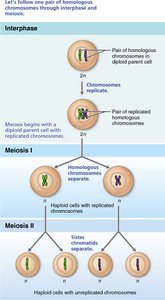
Interphase: Chromosomes replicate, forming sister chromatids.
Meiosis I: Homologous chromosomes separate, reducing chromosome number by half.
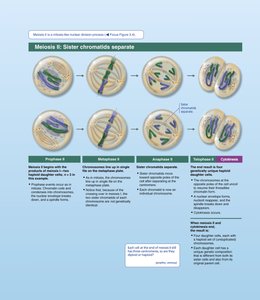
Meiosis II: Sister chromatids separate, resulting in four haploid cells.
Example: In humans, meiosis produces four sperm cells in males or one ovum and three polar bodies in females.
Detailed Steps of Meiosis
Each division of meiosis includes distinct stages:
Meiosis I: Homologous chromosomes pair, undergo crossing over, and separate.
Meiosis II: Sister chromatids separate, similar to mitosis.
Meiosis Compared with Mitosis
Meiosis and mitosis are both forms of cell division, but they serve different purposes and produce different outcomes.
Mitosis: Produces two genetically identical diploid cells for growth and repair.
Meiosis: Produces four genetically unique haploid gametes for sexual reproduction.
Genetic Variability: Meiosis introduces variability through independent assortment and crossing over.
Feature | Mitosis | Meiosis |
|---|---|---|
Number of Divisions | One | Two |
Number of Daughter Cells | Two | Four |
Chromosome Number | Diploid (2n) | Haploid (n) |
Genetic Identity | Identical | Unique |
Function | Growth, repair | Gamete production |
Example: Mitosis maintains genetic stability, while meiosis ensures genetic diversity in offspring.
Additional info: Independent assortment and crossing over during meiosis are key mechanisms for genetic variation, which is fundamental to evolution and adaptation.
