 Back
The Reproductive System: Meiosis, Gametogenesis, and the Ovarian & Menstrual Cycles
Study Guide - Smart Notes
 Tailored notes based on your materials, expanded with key definitions, examples, and context.
The Reproductive System
Overview and Function
The reproductive system is essential for the creation of life, involving the production of sex cells (gametes), secretion of sex hormones, and nurturing of developing offspring. In humans, the reproductive system is divided into male and female systems, each with specialized structures and functions.
Primary Functions: Production of gametes (sperm and oocytes), secretion of sex hormones (e.g., testosterone, estrogen, progesterone), and support of embryonic/fetal development (in females).
Sexual differentiation: Typical physiology of XX (female) and XY (male) individuals is discussed in this context.
Meiosis and Gametogenesis
Meiosis: Definition and Purpose
Meiosis is a specialized type of cell division that produces four genetically unique haploid gametes from a diploid parent cell. This process is fundamental for sexual reproduction and genetic diversity.
Gametes: Reproductive cells (sperm in males, oocytes in females) that contain half the number of chromosomes (haploid, n).
Genetic Diversity: Achieved through crossing over and independent assortment during meiosis.
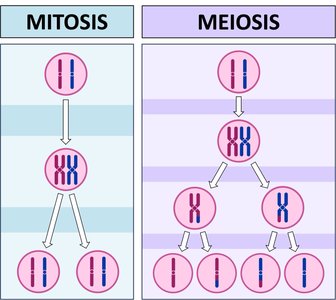
Meiosis vs. Mitosis
Mitosis: Produces two identical diploid cells (2n), used for growth and repair.
Meiosis: Produces four genetically unique haploid cells (n), used for sexual reproduction.
Chromosome Terminology
Diploid (2n): Two sets of chromosomes (one from each parent).
Haploid (n): One set of chromosomes (found in gametes).
Fertilization: Fusion of two haploid gametes restores diploid number in the zygote.
Phases of Meiosis
Meiosis consists of two sequential divisions: Meiosis I and Meiosis II.
Meiosis I: Homologous chromosomes separate, reducing chromosome number by half.
Meiosis II: Sister chromatids separate, similar to mitosis.
Key Events in Meiosis
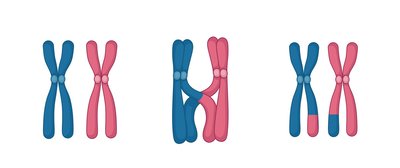
Prophase I: Homologous chromosomes pair (synapsis) and crossing over occurs, exchanging genetic material.
Metaphase I: Homologous pairs align randomly (independent assortment), increasing genetic variation.
Anaphase I: Homologous chromosomes are pulled apart; sister chromatids remain together.
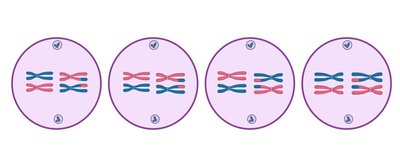
Telophase I & Cytokinesis: Two haploid cells form.
Meiosis II: Similar to mitosis; sister chromatids separate, resulting in four haploid cells.
Spermatogenesis
Process and Stages
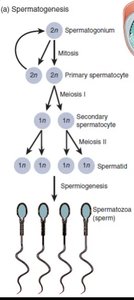
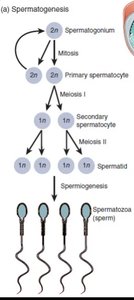
Spermatogenesis is the process by which diploid germ cells develop into mature haploid sperm cells in the testes.
Spermatogonial stem cells divide by mitosis; one remains a stem cell, the other becomes a primary spermatocyte.
Primary spermatocyte (2n): Undergoes Meiosis I to form two secondary spermatocytes (n).
Secondary spermatocytes: Undergo Meiosis II to form four spermatids (n).
Spermiogenesis: Spermatids mature into spermatozoa (sperm cells).
Oogenesis and the Ovarian Cycle
Oogenesis: Process and Regulation
Oogenesis is the process of gamete formation in the ovaries, producing oocytes and reproductive hormones. It is closely linked to the ovarian cycle, which includes folliculogenesis and hormonal regulation.
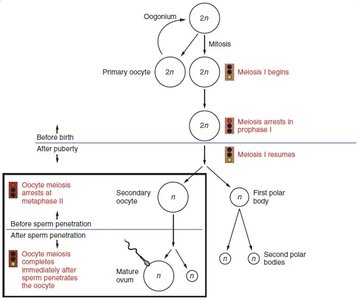
Oogonia: Stem cells formed during fetal development; divide by mitosis to form primary oocytes.
Primary oocytes: Arrested in prophase I until puberty.
At puberty: Hormonal changes stimulate a few primary oocytes to resume meiosis each month.
Ovulation: Release of a secondary oocyte (arrested in metaphase II) into the fallopian tube, triggered by a surge in luteinizing hormone (LH) and follicle-stimulating hormone (FSH).
Fertilization: Meiosis II completes only if a sperm penetrates the oocyte, forming a haploid ovum and polar bodies.
Folliculogenesis
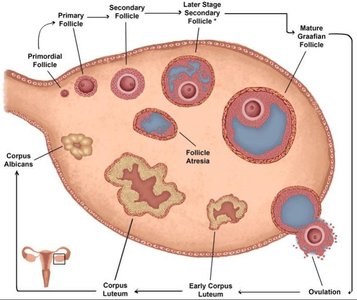
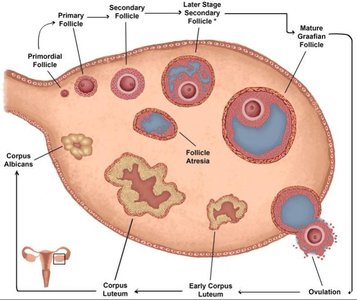
Folliculogenesis is the maturation of ovarian follicles, which house developing oocytes and secrete hormones.
Primordial follicle: Oocyte surrounded by a single layer of squamous granulosa cells.
Primary follicle: Granulosa cells become cuboidal and proliferate; oocyte grows.
Secondary follicle: Addition of theca cells and blood vessels; granulosa cells convert androgens to estrogen.
Tertiary (antral) follicle: Formation of the zona pellucida and antrum; FSH-dependent growth.
Graafian follicle: Large antrum; ready for ovulation.
Hormonal Regulation of the Ovarian Cycle
Estrogen: Secreted by the dominant follicle; high levels trigger LH and FSH surge.
LH surge: Stimulates completion of meiosis I and ovulation.
Corpus luteum: Formed from the ruptured follicle; secretes progesterone to maintain the uterine lining.
If pregnancy occurs: hCG from the embryo maintains the corpus luteum.
If no pregnancy: Corpus luteum degenerates to corpus albicans; progesterone drops, triggering menstruation.
The Menstrual Cycle
Phases and Hormonal Control
The menstrual cycle prepares the uterus for possible implantation of an embryo and is divided into three main phases:
Menses: Shedding of the uterine lining; triggered by a drop in progesterone.
Proliferative phase: Regrowth of the endometrium; stimulated by estrogen from developing follicles.
Secretory phase: Endometrial glands secrete nutrients; initiated by progesterone from the corpus luteum.
Summary Table: Comparison of Spermatogenesis and Oogenesis
Feature | Spermatogenesis | Oogenesis |
|---|---|---|
Location | Testes | Ovaries |
Timing | Puberty to old age | Begins before birth, resumes at puberty, ends at menopause |
Number of gametes per cycle | Millions per day | One per month |
Completion of meiosis | Continuous | Paused twice; completes only upon fertilization |
Practice Questions
How does meiosis differ from mitosis? How many haploid cells are produced by the end of meiosis?
What is the process of crossing over? How does it contribute to genetic variation?
What occurs during anaphase I of meiosis, and how does it differ from what occurs in anaphase II?
What is spermatogenesis? What is oogenesis?
What is the ovarian cycle?
What are the steps from an oogonia to a secondary oocyte?
Meiosis pauses 2 times during oogenesis. Which phases of meiosis are paused and at what point in the individual’s life will each phase resume? Which hormone stimulates the continuation of meiosis I, leading a primary oocyte to divide into a secondary oocyte and polar body?
What is folliculogenesis? Know what occurs at each of the 5 stages of the follicular phase.
What is atresia?
What role does the corpus luteum play during the luteal phase of folliculogenesis? What hormone does it secrete and what structure does it become if there is no pregnancy?
What are the 3 phases of the menstrual cycle? During which phase is the uterine lining shed?
