Back
BackLecture 9.2: The Respiratory System - Part 2
Study Guide - Smart Notes
 Tailored notes based on your materials, expanded with key definitions, examples, and context.
The Respiratory System
Overview of Respiration
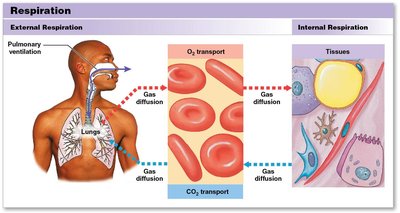
The process of respiration is essential for the exchange of oxygen (O2) and carbon dioxide (CO2) between the body and the environment. It involves two main phases: external respiration and internal respiration. These processes ensure that oxygen is delivered to tissues for cellular metabolism and that carbon dioxide, a metabolic waste product, is removed from the body.
External Respiration: The exchange of O2 and CO2 between the lungs and the external environment.
Internal Respiration: The exchange of O2 and CO2 between systemic blood and body tissues, driven by cellular respiration.
Pulmonary Ventilation
Mechanics of Breathing
Pulmonary ventilation refers to the movement of air into and out of the lungs, driven by pressure differences between the atmosphere and the alveoli. The respiratory cycle consists of two phases: inspiration (inhalation) and expiration (exhalation).
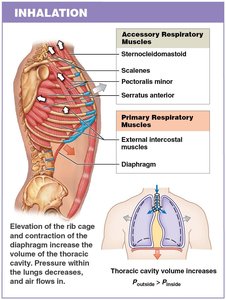
Inspiration: An active process involving the contraction of the diaphragm and external intercostal muscles, increasing thoracic cavity volume and decreasing intrapulmonary pressure.
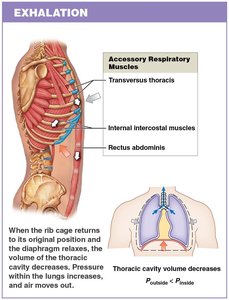
Expiration: Can be passive (during quiet breathing) or active (during forced breathing), involving relaxation or contraction of respiratory muscles, respectively.
Pressure and Volume Changes
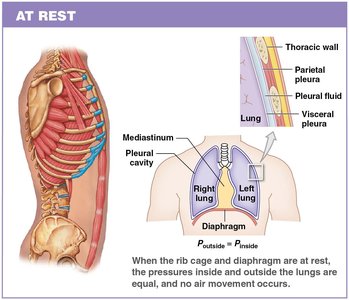
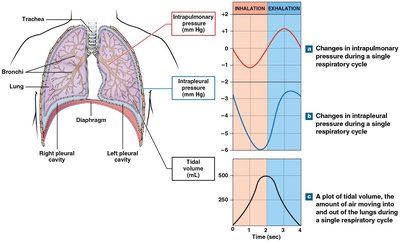
Air flows from areas of higher pressure to lower pressure. During inhalation, thoracic volume increases, causing intrapulmonary pressure to drop below atmospheric pressure, drawing air in. During exhalation, thoracic volume decreases, raising intrapulmonary pressure and expelling air.
At Rest: Pressures inside and outside the lungs are equal; no air movement occurs.
Inhalation: Thoracic cavity volume increases, pressure decreases, air flows in.
Exhalation: Thoracic cavity volume decreases, pressure increases, air flows out.
Respiratory Volumes and Capacities
Tidal Volume (VT): The amount of air moved in quiet breathing (about 500 mL).
Vital Capacity (VC): The maximum amount of air exhaled after a maximal inhalation (about 4.5 L).
Residual Volume: The air remaining in the lungs after maximal exhalation.
Respiratory Minute Volume (VE): The total volume of air moved per minute, calculated as:
Gas Exchange
Principles of Gas Diffusion
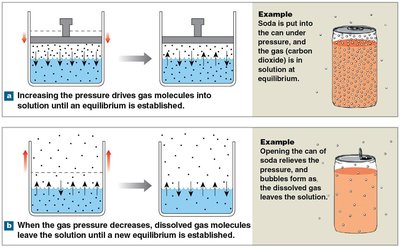
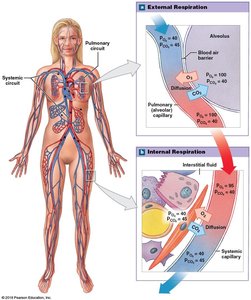
Gas exchange occurs across the blood-air barrier in the alveoli and is governed by the partial pressures of gases and their diffusion gradients. Gases move from areas of higher partial pressure to lower partial pressure.
Partial Pressure: The pressure exerted by a single gas in a mixture of gases.
Diffusion: Gases diffuse down their concentration gradients between alveolar air and blood, and between blood and tissues.
External and Internal Gas Exchange
Oxygen and carbon dioxide are exchanged in the lungs (external respiration) and in the tissues (internal respiration) according to their partial pressure gradients.
Gas Transport in Blood
Oxygen and Carbon Dioxide Transport
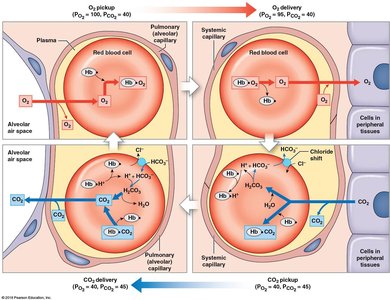
Blood plasma alone cannot transport sufficient O2 or CO2. Red blood cells (RBCs) play a critical role in transporting these gases:
Oxygen: Most O2 is carried bound to hemoglobin as oxyhemoglobin (HbO2).
Carbon Dioxide: Transported as dissolved CO2, bound to hemoglobin (carbaminohemoglobin), or as bicarbonate ions (HCO3-), following conversion to carbonic acid (H2CO3).
Control of Respiration
Neural Regulation and Chemoreceptors
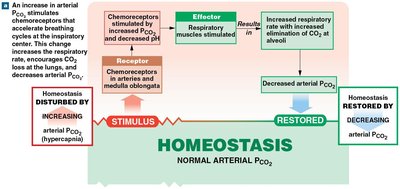
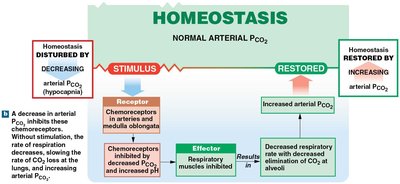
Respiratory centers in the brainstem regulate the rate and depth of breathing in response to changing levels of O2 and CO2. Chemoreceptors are sensitive to changes in arterial PCO2 (partial pressure of CO2), with CO2 being the primary driver of respiratory adjustments.
Hypercapnia: Elevated arterial PCO2 stimulates increased respiratory rate (hyperventilation).
Hypocapnia: Decreased arterial PCO2 suppresses respiratory drive (hypoventilation).
Age-Related Changes in the Respiratory System
Effects of Aging
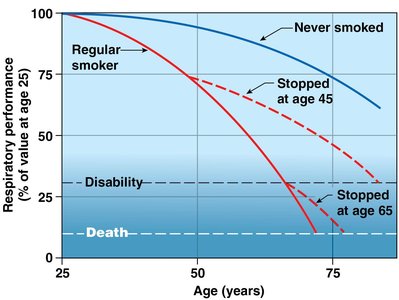
Aging leads to several changes in the respiratory system, including decreased elasticity of lung tissue, reduced vital capacity, and increased risk of respiratory diseases such as emphysema. Arthritic changes can further restrict chest movement and reduce respiratory efficiency. Smoking accelerates the decline in respiratory performance.
Integration with Other Body Systems
Systemic Interactions
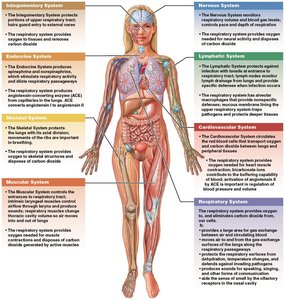
The respiratory system interacts closely with other organ systems, including the cardiovascular, nervous, muscular, and lymphatic systems, to maintain homeostasis and support cellular metabolism.