 Back
BackThe Skeletal System: Structure, Function, and Anatomy
Study Guide - Smart Notes
 Tailored notes based on your materials, expanded with key definitions, examples, and context.
The Skeletal System
Overview of the Skeleton
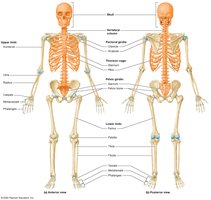
The human skeleton is a complex framework of approximately 206 bones and associated cartilages. It provides structural support, protection for internal organs, and facilitates movement through articulations (joints). The skeleton is divided into two main divisions: the axial skeleton and the appendicular skeleton.
Axial Skeleton: Forms the longitudinal axis of the body and is primarily structured for protection. It includes the skull, vertebral column, and thoracic cage.
Appendicular Skeleton: Structured for motion, it includes the bones of the girdles and the upper and lower limbs.
Major Components of the Skeleton
Skull: The most complex structure, consisting of 22 bones (8 cranial, 14 facial).
Vertebral Column: Composed of 33 vertebrae, including the sacrum and coccyx (fused vertebrae).
Thoracic Cage: Includes 12 pairs of ribs, the sternum, and part of the vertebral column, protecting thoracic organs.
Pectoral Girdle: Clavicle and scapula, supporting the upper limb.
Pelvic Girdle: Two pelvic bones and the sacrum, supporting the lower limb.
Upper and Lower Limbs: Arms, forearms, wrists, hands, thighs, legs, ankles, and feet, each with specific bones for movement and support.
Bone Markings
Types of Bone Markings
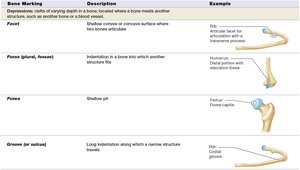
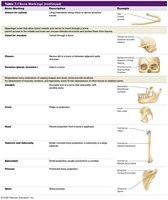
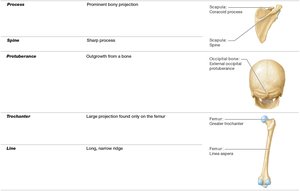
Bone markings are surface features that serve as sites for muscle, ligament, and tendon attachment, or as passages for nerves and blood vessels. They are classified as depressions, openings, or projections.
Depressions: Allow passage of blood vessels and nerves or articulation between bones.
Openings: Enclose delicate structures and allow passage through bones.
Projections: Sites for ligament and tendon attachment or articulation with other bones.
Skull Structure
Overview of Skull Bones
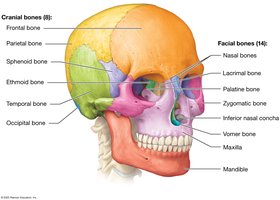
The skull is composed of cranial and facial bones, united by immovable joints called sutures (except the mandible). The cranial bones protect the brain, while the facial bones form the structure of the face.
Cranial Bones: Frontal, occipital, ethmoid, sphenoid (single); temporal, parietal (paired).
Facial Bones: Mandible, vomer (single); maxilla, zygomatic, nasal, lacrimal, palatine, inferior nasal concha (paired).
Major Cavities of the Skull
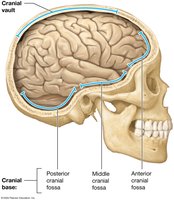
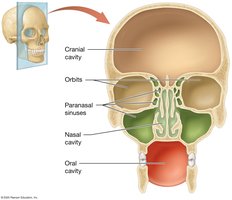
Cranial Cavity: Houses the brain, with the cranial vault (calvaria) and cranial base. The base contains anterior, middle, and posterior cranial fossae for brain support.
Orbits: Contain the eyeballs and associated structures.
Nasal Cavity: Houses olfactory receptors and forms the first part of the respiratory tract.
Oral Cavity: Contains the teeth and tongue, forming the entry to the digestive tract.
Paranasal Sinuses: Air-filled spaces that lighten the skull and enhance voice resonance.
Selected Skull Bones and Features
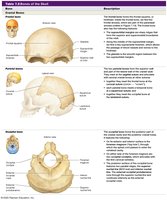
Frontal Bone: Forms the forehead and part of the cranial vault.
Parietal Bones: Form the superior and lateral aspects of the skull.
Occipital Bone: Forms the posterior part of the skull and contains the foramen magnum.
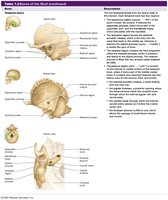
Temporal Bones: House the structures of the ears.
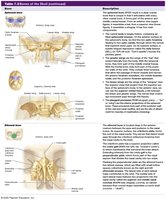
Sphenoid and Ethmoid Bones: Contribute to the cranial floor and orbits.
Facial Bones
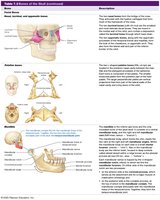
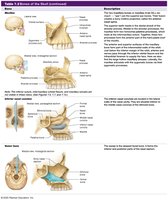
Maxillae: Form the upper jaw and part of the orbits.
Zygomatic Bones: Form the cheekbones.
Mandible: Lower jaw bone, only movable skull bone.
Nasal, Lacrimal, Palatine, Inferior Nasal Concha, Vomer: Contribute to the structure of the nasal cavity and orbits.
Special Features of the Skull
Fetal Skull and Fontanels
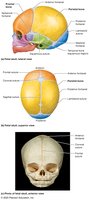
In infants, the skull contains membranous areas called fontanels, which allow for flexibility during birth and brain growth. These close by 18–24 months of age.
Forensic Skull Anatomy
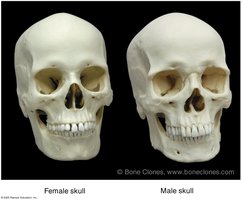
Skull features can help determine sex, age, and ethnic heritage. For example, males typically have a more prominent supraorbital ridge and a more acute mandibular angle.
Hyoid Bone
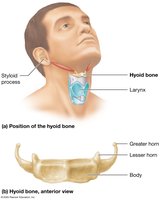
The hyoid bone is a small, C-shaped bone in the neck that does not articulate with other bones. It serves as an attachment for muscles involved in swallowing and speech.
The Vertebral Column
Structure and Regions
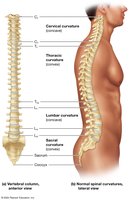
The vertebral column consists of 33 vertebrae, divided into cervical, thoracic, lumbar, sacral, and coccygeal regions. It supports the head, protects the spinal cord, and provides attachment points for ribs and muscles.
Cervical (7): Neck region
Thoracic (12): Articulate with ribs
Lumbar (5): Lower back
Sacral (5 fused): Articulate with pelvic bones
Coccygeal (3–5 fused): Tailbone
Spinal Curvatures
Primary Curvatures: Thoracic and sacral, present during fetal development.
Secondary Curvatures: Cervical and lumbar, develop after birth.
Abnormal Spinal Curvatures
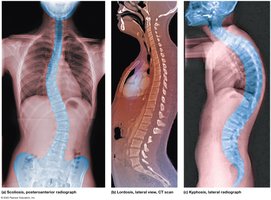
Scoliosis: Lateral curvature, C or S shaped.
Lordosis: Exaggerated cervical and lumbar curvatures ("swayback").
Kyphosis: Exaggerated thoracic curvature ("humpback").
Structure of a Typical Vertebra
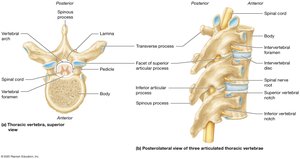
Body (Centrum): Weight-bearing region.
Vertebral Foramen: Passage for the spinal cord.
Pedicles and Laminae: Form the vertebral arch.
Processes: Spinous, transverse, and articular processes for muscle and ligament attachment.
Specialized Vertebrae
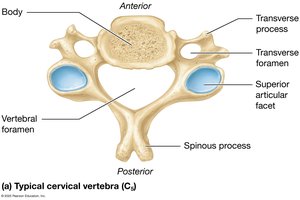
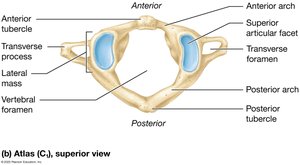
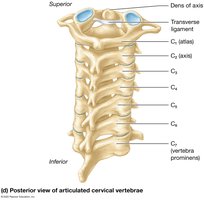
Atlas (C1): Supports the skull, allows nodding motion.
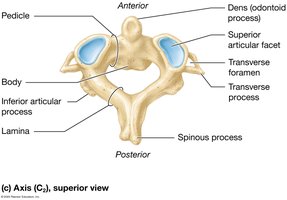
Axis (C2): Contains the dens (odontoid process), allows rotation of the head.
The Thoracic Cage
Structure and Function
The thoracic cage consists of the sternum, 12 pairs of ribs, and thoracic vertebrae. It protects the heart, lungs, and major blood vessels, and supports the shoulder girdles and upper limbs.
Sternum: Manubrium, body, and xiphoid process.
Ribs: True ribs (1–7), false ribs (8–12), and floating ribs (11–12).
The Pectoral Girdle and Upper Limb
Pectoral Girdle
The pectoral girdle consists of the clavicle and scapula, supporting the upper limb and providing attachment points for muscles.
Humerus
The humerus is the only bone of the arm, articulating proximally with the scapula and distally with the radius and ulna.
Radius and Ulna
The radius (lateral) and ulna (medial) are the bones of the forearm, articulating with each other and with the humerus and carpals.
Carpals, Metacarpals, and Phalanges
The wrist contains eight carpal bones, the hand contains five metacarpals, and the fingers contain 14 phalanges.
The Pelvic Girdle and Lower Limb
Pelvic Girdle
The pelvic girdle consists of two pelvic bones and the sacrum, forming the pelvis. Each pelvic bone is composed of the ilium, ischium, and pubis, which fuse during childhood.
Femur and Patella
The femur is the only bone of the thigh and the strongest bone in the body. The patella is a sesamoid bone within the quadriceps tendon.
Tibia and Fibula
The tibia (medial) and fibula (lateral) are the bones of the leg, connected by an interosseous membrane and forming the ankle joint with the tarsals.
Tarsals, Metatarsals, and Phalanges
The ankle contains seven tarsal bones, the foot contains five metatarsals, and the toes contain 14 phalanges. The foot also has three arches (medial longitudinal, lateral longitudinal, and transverse) for support and shock absorption.
Study Boost: Mnemonics and Visual Analogies
PEST OF 6: Parietal, Ethmoid, Sphenoid, Temporal, Occipital, Frontal (cranial bones)
Breakfast at 7, Lunch at 12, Dinner at 5: 7 cervical, 12 thoracic, 5 lumbar vertebrae
The trapezium is by the thumb (carpals)
TIBia = Thick, Inner Bone; FibuLA = Lateral bone
