 Back
5.3 The Special Senses and General Sensory Receptors: Structure and Function
Study Guide - Smart Notes
 Tailored notes based on your materials, expanded with key definitions, examples, and context.
The Special Senses and General Sensory Receptors
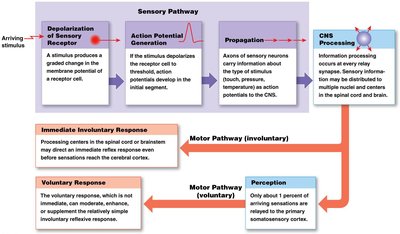
Overview of Sensory and Motor Pathways
The nervous system processes sensory information through specialized pathways that detect, transmit, and interpret stimuli from both the internal and external environment. These pathways are divided into afferent (sensory) and efferent (motor) divisions, with the somatic nervous system controlling voluntary muscle contractions.
Afferent Division: Transmits sensory information from receptors to the central nervous system (CNS).
Efferent Division: Carries motor commands from the CNS to peripheral effectors (muscles and glands).
Somatic Nervous System (SNS): Controls voluntary movements by innervating skeletal muscles.
Sensory Receptors: Types and Functions
Sensory receptors are specialized cells or cell processes that detect specific types of stimuli. Their structure and location determine their sensitivity and the type of information they convey to the CNS.
General Senses: Include temperature, pain, touch, pressure, vibration, and proprioception (body position).
Special Senses: Include olfaction (smell), gustation (taste), vision (sight), equilibrium (balance), and hearing. These are detected by specialized receptors located in sense organs.
Receptor Specificity and Receptive Fields
Each sensory receptor has a characteristic sensitivity, known as receptor specificity. The receptive field is the area monitored by a single receptor cell. The size of the receptive field affects the ability to localize a stimulus: smaller fields allow for more precise localization.
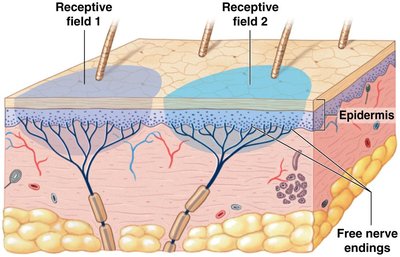
Transduction: The process by which a sensory receptor converts a stimulus into an action potential.
Adaptation in Sensory Receptors
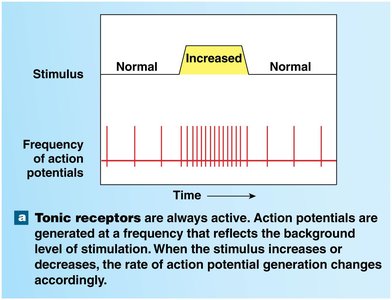
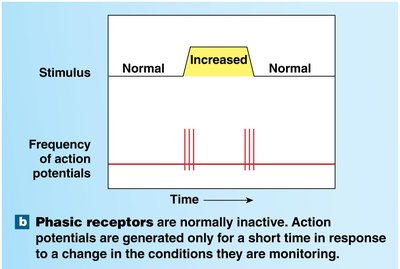
Adaptation refers to the reduction in sensitivity of a receptor in the presence of a constant stimulus. This can occur peripherally (in the PNS) or centrally (in the CNS).
Tonic Receptors: Always active and adapt slowly, if at all. They provide continuous information about the stimulus.
Phasic Receptors: Normally inactive but respond rapidly to changes in the stimulus, then quickly adapt.
Types of Sensory Receptors
Nociceptors: Pain receptors; free nerve endings that do not adapt, ensuring continued awareness of injury or inflammation.
Thermoreceptors: Detect temperature changes; adapt quickly to stable temperatures but are very active during temperature changes.
Chemoreceptors: Detect changes in chemical concentrations (e.g., pH, CO2, O2); important in respiratory regulation.
Mechanoreceptors: Respond to physical distortion of their plasma membranes (stretching, compression, twisting).
Mechanoreceptors: Classes and Functions
Mechanoreceptors are divided into three main classes based on the type of stimulus they detect:
Tactile Receptors: Detect touch, pressure, and vibration.
Baroreceptors: Detect pressure changes in blood vessels and internal organs.
Proprioceptors: Monitor the position of joints and muscles.
Tactile Receptors in the Skin
There are six main types of tactile receptors in the skin, each with distinct structures and functions:
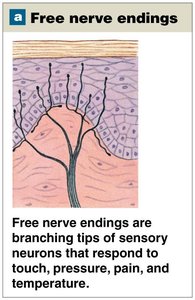
Free Nerve Endings: Sensitive to touch, pressure, pain, and temperature; found between epidermal cells; tonic receptors with small receptive fields.
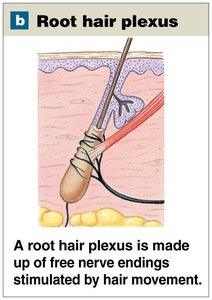
Root Hair Plexus Nerve Endings: Monitor hair movement; adapt rapidly and best detect initial contact and movement.
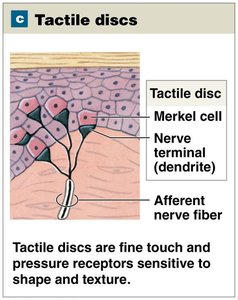
Tactile Discs (Merkel Discs): Fine-touch and pressure receptors; sensitive to shape and texture; extremely sensitive tonic receptors with very small receptive fields.
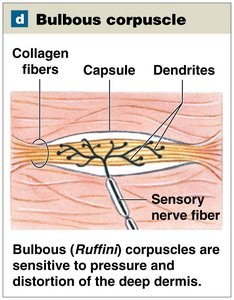
Bulbous Corpuscles (Ruffini Corpuscles): Sensitive to pressure and distortion of the skin; located in the deep dermis; tonic receptors with little adaptation.
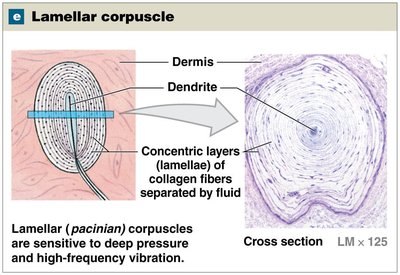
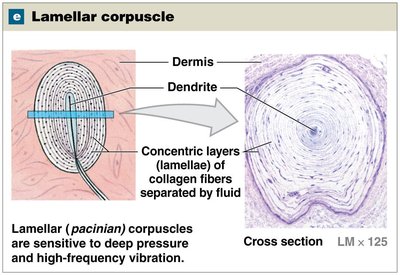
Lamellar Corpuscles (Pacinian Corpuscles): Detect deep pressure and high-frequency vibration; fast-adapting receptors; consist of a dendrite surrounded by concentric layers of collagen fibers.
Tactile Corpuscles (Meissner Corpuscles): Perceive fine touch, pressure, and low-frequency vibration; adapt quickly; most abundant in sensitive areas such as eyelids, lips, fingertips, nipples, and external genitalia.
Summary Table: Types of Tactile Receptors
Receptor Type | Stimulus Detected | Location | Adaptation |
|---|---|---|---|
Free Nerve Endings | Touch, pressure, pain, temperature | Epidermis | Slow (tonic) |
Root Hair Plexus | Hair movement | Dermis (around hair follicles) | Fast (phasic) |
Tactile Discs | Fine touch, pressure, shape, texture | Basal epidermis | Slow (tonic) |
Bulbous Corpuscles | Pressure, skin distortion | Deep dermis | Slow (tonic) |
Lamellar Corpuscles | Deep pressure, vibration | Dermis, subcutaneous tissue | Fast (phasic) |
Tactile Corpuscles | Fine touch, pressure, low-frequency vibration | Dermal papillae (sensitive areas) | Fast (phasic) |
Key Terms and Concepts
Action Potential: An electrical signal generated by a neuron in response to a stimulus.
Peripheral Adaptation: Decreased sensitivity of sensory receptors in the peripheral nervous system.
Central Adaptation: Decreased sensitivity at the level of the CNS, even if the stimulus persists.
Receptive Field: The area monitored by a single sensory receptor.
Example: Localization of Touch
When a small area of skin is touched, the ability to localize the stimulus depends on the size of the receptive field. Areas with small receptive fields, such as the fingertips, allow for precise localization, while areas with larger receptive fields, such as the back, provide less precise localization.
Additional info:
Mechanoreceptors play a critical role in proprioception, which is essential for coordinated movement and balance.
Adaptation allows the nervous system to focus on new or changing stimuli, preventing sensory overload.
