 Back
The Testes and Scrotum: Structure, Function, and Clinical Relevance
Study Guide - Smart Notes
 Tailored notes based on your materials, expanded with key definitions, examples, and context.
The Male Reproductive System: The Testes and Scrotum
The Scrotum
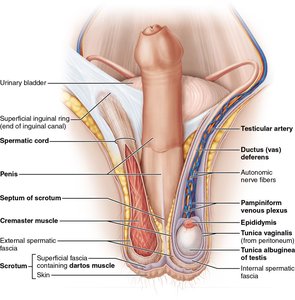
The scrotum is a sac of skin and superficial fascia that hangs outside the abdominopelvic cavity at the root of the penis. It serves as a protective enclosure for the paired oval testes and is divided by a midline septum, providing a compartment for each testis. The scrotum's location is essential for maintaining the optimal temperature required for sperm production, which is lower than core body temperature.
Structure: Covered with sparse hairs, contains two compartments for the testes.
Temperature Regulation: The scrotum adapts to temperature changes. In cold conditions, the testes are pulled closer to the body, and the scrotal skin wrinkles to reduce heat loss.
Muscles Involved:
Dartos muscle: A layer of smooth muscle in the superficial fascia that wrinkles the scrotal skin.
Cremaster muscle: Bands of mixed skeletal and smooth muscle that elevate the testes, derived from the internal oblique muscles.
The Testes
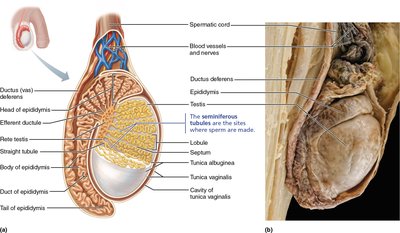
Each testis is approximately 4 cm long by 2.5 cm wide and is surrounded by two tunics. The outer tunica vaginalis is derived from the peritoneum, while the inner tunica albuginea is a fibrous capsule. Septa from the tunica albuginea divide the testis into lobules, each containing tightly coiled seminiferous tubules, which are the sites of sperm production.
Tunica Vaginalis: A two-layered serous membrane derived from the peritoneum.
Tunica Albuginea: The fibrous capsule of the testis, providing structural support.
Lobules: Each testis is divided into about 250 wedge-shaped lobules.
Seminiferous Tubules: One to four per lobule; these are the actual "sperm factories." Sperm produced here are conveyed into the rete testis, then through efferent ductules to the epididymis for storage and maturation.
Blood Supply and Temperature Regulation
The testes are supplied by the long testicular arteries, which branch from the abdominal aorta. Venous drainage occurs via the pampiniform venous plexus, a network that surrounds the testicular artery. This plexus absorbs heat from the arterial blood, cooling it before it enters the testes, thus helping maintain the optimal temperature for sperm production.
Testicular Arteries: Supply oxygenated blood to the testes.
Pampiniform Venous Plexus: Surrounds the testicular artery, absorbs heat, and cools arterial blood.
Homeostatic Mechanism: Both muscle activity and the venous plexus are crucial for temperature regulation.
Nervous and Lymphatic Supply
Both divisions of the autonomic nervous system serve the testes. Sensory nerves transmit impulses that can result in pain and nausea if the testes are hit forcefully. A connective tissue sheath encloses nerve fibers, blood vessels, and lymphatics, forming the spermatic cord, which passes through the inguinal canal.
Spermatic Cord: Contains ductus deferens, blood vessels, nerves, and lymphatics.
Autonomic Innervation: Regulates testicular function and pain response.
Clinical Relevance: Testicular Cancer
Testicular cancer is relatively rare but is the most common cancer in males aged 15 to 35. The most important risk factor is cryptorchidism (nondescent of the testes). The most common sign is a painless solid mass. Testicular cancer has a high cure rate, with over 90% of cases cured by surgical removal (orchiectomy) and/or radiation or chemotherapy.
Risk Factor: Cryptorchidism (nondescent of the testes).
Sign: Painless solid mass in the testis.
Treatment: Orchiectomy, radiation therapy, chemotherapy.
Cure Rate: Over 90%.
Summary Table: Key Structures and Functions
Structure | Function |
|---|---|
Scrotum | Protects and regulates temperature of testes |
Dartos muscle | Wrinkles scrotal skin to reduce heat loss |
Cremaster muscle | Elevates testes for temperature regulation |
Tunica vaginalis | Serous membrane covering testis |
Tunica albuginea | Fibrous capsule, divides testis into lobules |
Seminiferous tubules | Site of sperm production |
Pampiniform venous plexus | Cools arterial blood entering testes |
Spermatic cord | Contains vessels, nerves, lymphatics, ductus deferens |
Check Your Understanding
Q: Name the tubular structures in the testes that act as "sperm factories." A: Seminiferous tubules.
Q: Muscle activity and the pampiniform venous plexus help to keep the temperature of the testes at homeostatic levels. How do they do that? A: The dartos and cremaster muscles adjust the position and surface area of the scrotum to regulate heat loss, while the pampiniform venous plexus cools arterial blood before it enters the testes.
Example Application
If a male spends extended periods in environments that increase scrotal temperature (e.g., hot tubs, tight clothing), sperm production may decrease due to the inability to maintain the optimal temperature for spermatogenesis.
