 Back
Tissue Level of Organization: Epithelial, Connective, Muscle, and Nervous Tissues
Study Guide - Smart Notes
 Tailored notes based on your materials, expanded with key definitions, examples, and context.
Module 4.1: Types of Tissue
Overview of Body Tissues
The human body is composed of trillions of cells organized into tissues, each with specialized roles. Histology is the study of tissues. There are four basic types of tissues in the body:
Epithelial tissue: Covers surfaces, lines cavities, and forms glands.
Connective tissue: Supports, binds, and protects other tissues and organs.
Muscle tissue: Specialized for contraction and movement.
Neural tissue: Specialized for communication via electrical impulses.
Each tissue type contributes to the structure and function of organs and organ systems.
Section 1: Epithelial Tissue
General Characteristics of Epithelial Tissue
Epithelial tissues are sheets of cells that cover body surfaces, line internal cavities, and form glands. They are characterized by closely packed cells with minimal extracellular material, polarity (apical and basal surfaces), and the ability to regenerate rapidly.
Functions: Protection, absorption, filtration, excretion, secretion, and sensory reception.
Cell shapes: Squamous (flat), cuboidal (cube-shaped), columnar (tall and column-like).
Cell layers: Simple (one layer), stratified (multiple layers), pseudostratified (appears layered but all cells touch the basement membrane).
Squamous Epithelium
Squamous epithelial cells are flat and irregularly shaped. There are two main types:
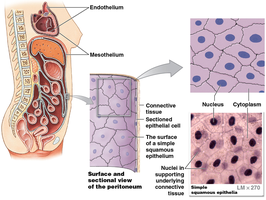
Simple squamous epithelium: Single layer of flat cells; allows for rapid diffusion and filtration. Found in alveoli of lungs, lining of blood vessels (endothelium), and serous membranes (mesothelium).
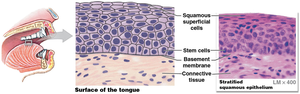
Stratified squamous epithelium: Multiple layers; protects against abrasion. Found in the skin, mouth, esophagus, and vagina.
Keratinized vs. Nonkeratinized Stratified Squamous Epithelium
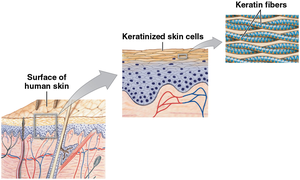
Keratinized: Surface cells contain keratin, a tough, protective protein; found in the epidermis of the skin.
Nonkeratinized: Lacks keratin; found in moist linings such as the mouth and esophagus.
Cuboidal and Transitional Epithelia
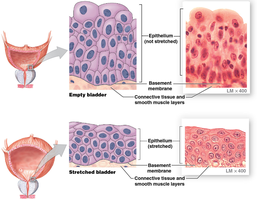
Cuboidal epithelial cells are cube-shaped and involved in secretion and absorption. Transitional epithelium is specialized to stretch and is found in the urinary bladder.
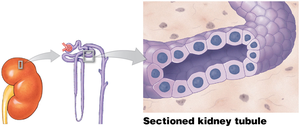
Simple cuboidal epithelium: Single layer; found in kidney tubules and glands.
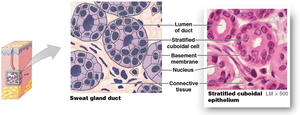
Stratified cuboidal epithelium: Multiple layers; found in ducts of sweat glands.
Transitional epithelium: Multiple layers; cells change shape when stretched. Found in the urinary bladder, ureters, and part of the urethra.
Columnar Epithelia
Columnar epithelial cells are tall and column-shaped, specialized for absorption and secretion. Types include:
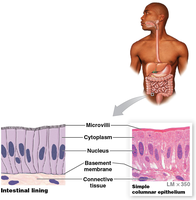
Simple columnar epithelium: Single layer; lines digestive tract, often with microvilli for absorption.
Pseudostratified columnar epithelium: Appears layered but all cells touch the basement membrane; often ciliated, found in respiratory tract.
Stratified columnar epithelium: Rare; found in some ducts and glands.
Glandular Epithelia
Glandular epithelia are specialized for secretion. Glands are classified as:
Endocrine glands: Release hormones into the bloodstream (ductless).
Exocrine glands: Release secretions onto epithelial surfaces via ducts.
Exocrine glands secrete by three methods:
Merocrine secretion: Product released by exocytosis (e.g., sweat glands).
Apocrine secretion: Part of the cell is shed with the secretion (e.g., mammary glands).
Holocrine secretion: Entire cell ruptures to release product (e.g., sebaceous glands).
Unicellular exocrine glands include goblet cells that secrete mucus.
Section 2: Connective Tissue
General Structure of Connective Tissue
Connective tissues are diverse in appearance and function, found throughout the body but never exposed to the surface. They provide support, protection, and bind other tissues together. All connective tissues share three basic components:
Specialized cells
Extracellular protein fibers
Ground substance (fluid or semi-solid matrix)
The combination of fibers and ground substance forms the matrix that surrounds cells.
Subdivisions of Connective Tissue
Connective tissue proper: Syrupy ground substance; includes loose and dense connective tissues.
Fluid connective tissue: Watery matrix; includes blood and lymph.
Supporting connective tissue: Densely packed matrix; includes cartilage and bone.
Loose Connective Tissue
Loose connective tissue contains more ground substance and fewer fibers. Types include:
Areolar tissue: Most common; cushions organs, provides support but permits movement.
Adipose tissue: Stores fat, insulates, and protects organs.
Reticular tissue: Provides supporting framework in organs like liver, kidney, spleen, lymph nodes, and bone marrow.
Cells in connective tissue proper are classified as fixed (e.g., fibroblasts, adipocytes, melanocytes, fixed macrophages) or wandering (e.g., plasma cells, free macrophages, mesenchymal cells, neutrophils, eosinophils, lymphocytes).
Dense Connective Tissue
Dense connective tissue contains more fibers and less ground substance. Types include:
Dense regular connective tissue: Fibers aligned in parallel; found in tendons and ligaments.
Dense irregular connective tissue: Fibers in a meshwork; found in dermis of skin, organ capsules.
Elastic tissue: Contains elastic fibers; found in walls of large arteries and some ligaments.
Cartilage
Cartilage is a supporting connective tissue with a firm gel matrix containing chondroitin sulfates and proteoglycans. The cells, called chondrocytes, reside in spaces called lacunae. Types of cartilage include:
Hyaline cartilage: Most common; found in joints, nose, trachea.
Elastic cartilage: Contains elastic fibers; found in ear and epiglottis.
Fibrocartilage: Contains dense collagen fibers; found in intervertebral discs, pubic symphysis.
Bone (Osseous Tissue)
Bone tissue is a supporting connective tissue with a solid, crystalline matrix composed mainly of calcium salts. It provides structural support and protection. The matrix is organized in concentric layers called osteons, with osteocytes (mature bone cells) in lacunae connected by canaliculi. The periosteum covers the outer surface of bone.
Section 3: Muscle Tissue and Nervous Tissue
Muscle Tissue
Muscle tissue is specialized for contraction, enabling movement of the body and its parts. There are three types:
Skeletal muscle tissue: Voluntary, striated, attached to bones for movement.
Cardiac muscle tissue: Involuntary, striated, found only in the heart; contains intercalated discs for synchronized contraction.
Smooth muscle tissue: Involuntary, non-striated, found in walls of hollow organs (e.g., blood vessels, digestive tract).
Nervous Tissue
Nervous tissue is specialized for the conduction of electrical impulses, allowing rapid communication throughout the body. It is primarily found in the brain and spinal cord. There are two main cell types:
Neurons: Conduct electrical impulses; consist of dendrites, a cell body, and an axon.
Neuroglia (glial cells): Support, protect, and nourish neurons.
Summary Table: Types of Epithelial Tissue
Type | Structure | Location | Function |
|---|---|---|---|
Simple squamous | Single layer, flat cells | Alveoli, blood vessels, serous membranes | Diffusion, filtration |
Stratified squamous | Multiple layers, flat surface cells | Skin, mouth, esophagus, vagina | Protection |
Simple cuboidal | Single layer, cube-shaped cells | Kidney tubules, glands | Secretion, absorption |
Stratified cuboidal | Multiple layers, cube-shaped cells | Sweat gland ducts | Protection, secretion |
Transitional | Multiple layers, variable shape | Urinary bladder, ureters | Stretching, distension |
Simple columnar | Single layer, tall cells | Digestive tract lining | Absorption, secretion |
Pseudostratified columnar | Single layer, appears stratified | Respiratory tract | Secretion, movement of mucus |
Additional info: This summary integrates and expands upon the provided lecture content, ensuring a comprehensive, exam-ready overview of tissue types, their structure, and function.
