 Back
BackTissues and the Integumentary System: Structure, Function, and Classification
Study Guide - Smart Notes
 Tailored notes based on your materials, expanded with key definitions, examples, and context.
Tissues: Structure and Function
Introduction to Tissues
Tissues are collections of specialized cells and cell products that perform specific functions. The four primary tissue types in the human body are epithelial, connective, muscle, and nervous tissue. Each type has distinct structural and functional characteristics that contribute to the overall physiology of the body.
Epithelial Tissue
General Characteristics
Epithelial tissue covers exposed surfaces, lines internal passageways and chambers, and forms glands.
Functions include protection, control of permeability, sensation, and secretion.
Epithelia are avascular and rely on diffusion or absorption for nutrient delivery.
Cells are tightly bound by specialized junctions and attached to a basement membrane.
High regenerative capacity due to rapid stem cell division.
Specializations of Epithelial Cells
Polarity: Apical (exposed) and basal (attached) surfaces differ in structure and function.
Microvilli increase surface area for absorption/secretion; cilia move substances across surfaces.
Cell junctions include tight junctions, gap junctions, and desmosomes, providing integrity and communication.
Classification of Epithelia
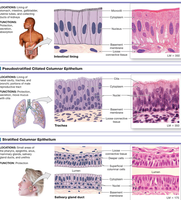
By layers: Simple (one layer) or stratified (multiple layers).
By shape: Squamous (flat), cuboidal (cube-shaped), columnar (tall).
Glandular Epithelia
Endocrine glands release hormones into the bloodstream (ductless).
Exocrine glands secrete onto epithelial surfaces or into ducts.
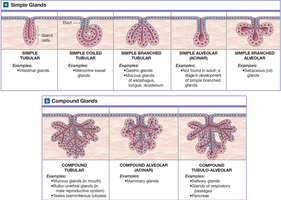
Exocrine glands are classified by structure (unicellular/multicellular, simple/compound) and mode of secretion (merocrine, apocrine, holocrine).
Connective Tissue
General Characteristics
Connective tissue supports, connects, and protects other tissues and organs.
All connective tissues have specialized cells, extracellular protein fibers, and ground substance (matrix).
Types include connective tissue proper, fluid connective tissues (blood, lymph), and supporting connective tissues (cartilage, bone).
Connective Tissue Proper
Loose connective tissue (areolar, adipose, reticular) and dense connective tissue (regular, irregular, elastic).
Contains fibroblasts, fibrocytes, adipocytes, macrophages, mast cells, and other immune cells.
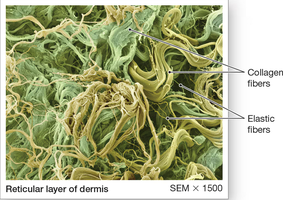
Fibers: Collagen (strength), reticular (support), elastic (flexibility).
Supporting Connective Tissues: Cartilage and Bone
Cartilage: Chondrocytes in lacunae, avascular, flexible matrix with chondroitin sulfate.
Bone: Osteocytes in lacunae, highly vascular, rigid matrix with calcium salts and collagen fibers.
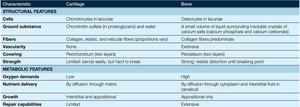
Characteristic | Cartilage | Bone |
|---|---|---|
Cells | Chondrocytes in lacunae | Osteocytes in lacunae |
Ground substance | Chondroitin sulfate in proteoglycans and water | Small volume of liquid; crystals of calcium salts (calcium phosphate and calcium carbonate) |
Fibers | Collagen, elastic, and reticular fibers (proportions vary) | Collagen fibers predominate |
Vascularity | None | Extensive |
Covering | Perichondrium (two layers) | Periosteum (two layers) |
Strength | Limited; bends easily, hard to break | Strong; resists distortion until breaking point |
Oxygen demand | Low | High |
Nutrient delivery | By diffusion through matrix | By diffusion through cytoplasm and interstitial fluid in canaliculi |
Growth | Interstitial and appositional | Appositional only |
Repair capabilities | Limited | Extensive |
Muscle Tissue
Types of Muscle Tissue
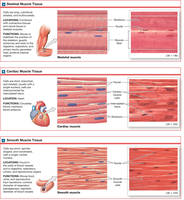
Skeletal muscle: Long, multinucleate, striated, voluntary; moves skeleton.
Cardiac muscle: Short, branched, striated, involuntary; found in heart, connected by intercalated discs.
Smooth muscle: Short, spindle-shaped, non-striated, involuntary; found in walls of hollow organs.
Nervous Tissue
Structure and Function
Specialized for conduction of electrical impulses.
Contains neurons (transmit signals) and neuroglia (supporting cells).
Neurons have a cell body, dendrites (receive signals), and an axon (transmits signals).
The Integumentary System
Overview and Functions
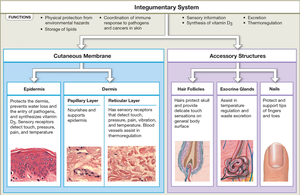
Composed of the cutaneous membrane (epidermis and dermis) and accessory structures (hair, glands, nails).
Functions: protection, excretion, temperature regulation, vitamin D3 synthesis, lipid storage, sensory detection, immune coordination.
Cutaneous Membrane
Epidermis: Stratified squamous epithelium; provides protection, prevents water loss, and keeps out pathogens.
Dermis: Papillary layer (areolar tissue, capillaries, nerves) and reticular layer (dense irregular connective tissue, collagen, and elastic fibers).
Accessory Structures
Hair follicles: Produce hair for protection and sensation.
Exocrine glands: Sebaceous (oil) and sweat glands; assist in thermoregulation and waste excretion.
Nails: Protect tips of fingers and toes.
Summary Table: Simple and Compound Glands
Type | Structure | Examples |
|---|---|---|
Simple Tubular | Unbranched, tube-like | Intestinal glands |
Simple Coiled Tubular | Coiled tube | Merocrine sweat glands |
Simple Branched Tubular | Branched tubes | Gastric glands, mucous glands of esophagus, tongue, duodenum |
Simple Alveolar (Acinar) | Unbranched, sac-like | Not found in adults |
Simple Branched Alveolar | Branched sacs | Sebaceous (oil) glands |
Compound Tubular | Branched, tube-like | Mucous glands (mouth), bulbourethral glands (male reproductive system), testes (seminiferous tubules) |
Compound Alveolar (Acinar) | Branched, sac-like | Mammary glands |
Compound Tubulo-Alveolar | Branched, tubes and sacs | Salivary glands, glands of respiratory passages, pancreas |
Summary
Tissues are organized groups of cells with specialized functions.
Epithelial tissue covers surfaces and forms glands; connective tissue supports and connects; muscle tissue contracts for movement; nervous tissue transmits impulses.
The integumentary system protects, regulates, and senses the external environment, and is composed of the skin and its accessory structures.
