 Back
BackTissues: Structure, Classification, and Function in Human Anatomy & Physiology
Study Guide - Smart Notes
 Tailored notes based on your materials, expanded with key definitions, examples, and context.
Tissues in Human Anatomy & Physiology
Overview of Tissue Types
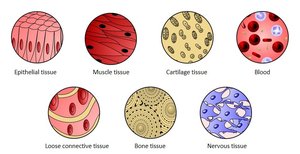
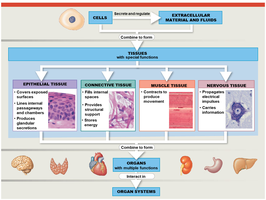
Tissues are groups of cells with similar structure and function, forming the basic building blocks of organs and organ systems. There are four primary tissue types in the human body: epithelial, connective, muscle, and nervous tissue. Each type has distinct roles essential for maintaining homeostasis and supporting life.
Epithelial tissue: Covers surfaces, lines cavities, and forms glands.
Connective tissue: Supports, binds, and protects other tissues; transports substances; stores energy.
Muscle tissue: Specialized for contraction and movement.
Nervous tissue: Conducts electrical impulses and processes information.
Epithelial Tissue
General Characteristics
Epithelial tissue consists of closely packed cells with minimal extracellular material. It forms continuous sheets that cover body surfaces, line internal cavities, and form glands. The classification of epithelial tissue is based on cell shape and the number of cell layers.
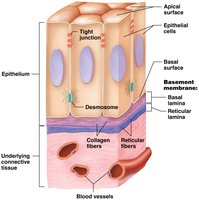
Polarity: Distinct apical (top) and basal (bottom) surfaces.
Cellularity: Cells are tightly joined by specialized junctions.
Attachment: The basal surface is attached to a noncellular basement membrane.
Avascularity: Lacks blood vessels; nutrients diffuse from underlying tissues.
Regeneration: High capacity for renewal via stem cell division.
Functions of Epithelial Tissue
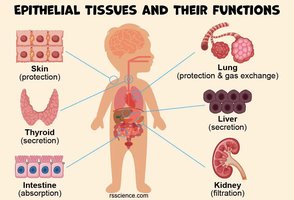
Protection: Shields underlying tissues from abrasion, dehydration, and pathogens.
Control of Permeability: Regulates entry and exit of substances.
Secretion: Forms glands that release hormones, enzymes, and other substances.
Sensation: Contains sensory nerve endings for detecting stimuli.
Basement Membrane
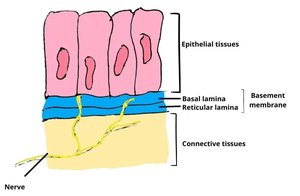
The basement membrane is a specialized structure that anchors epithelial tissue to underlying connective tissue. It consists of two layers:
Basal lamina: Closest to the epithelial cells; composed of glycoproteins and collagen.
Reticular lamina: Deeper layer; contains reticular fibers and provides structural support.
Classification of Epithelia
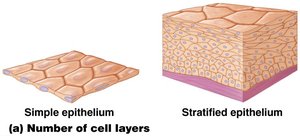
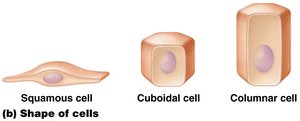
Epithelia are classified by the number of cell layers and the shape of the cells at the apical surface:
Simple epithelium: Single layer of cells.
Stratified epithelium: Multiple layers of cells.
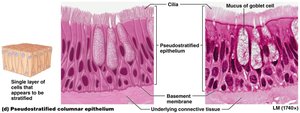
Pseudostratified epithelium: Appears layered but all cells touch the basement membrane.
Squamous cells: Flat and thin.
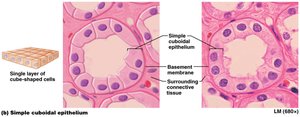
Cuboidal cells: Cube-shaped.
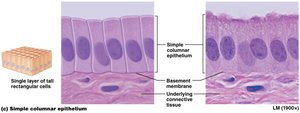
Columnar cells: Tall and column-like.
Transitional cells: Change shape when stretched.
Types of Epithelial Tissue
Type | Function | Location | Representative Image |
|---|---|---|---|
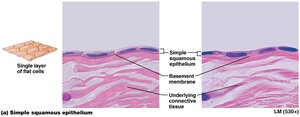
Simple Squamous | Absorption, diffusion, filtration, secretion | Air sacs of lungs, lining of blood vessels, serosa |
|
Simple Cuboidal | Secretion, absorption | Glands, ducts, kidney tubules, thyroid |
|
Simple Columnar | Secretion, absorption, protection | Lining of stomach, intestines, gall bladder, uterus |
|
Pseudostratified Columnar | Secretion, propulsion of mucus | Upper respiratory tract |
|
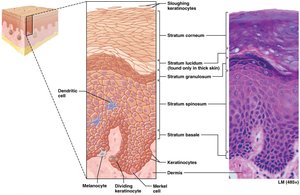
Stratified Squamous (Keratinized) | Protection against abrasion, dehydration | Epidermis of skin |
|
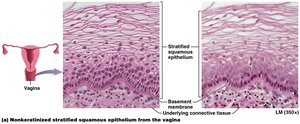
Stratified Squamous (Non-keratinized) | Protection; remains moist | Mouth, throat, esophagus, anus, vagina |
|
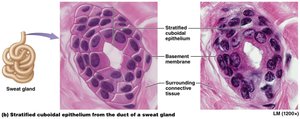
Stratified Cuboidal | Protection, secretion, absorption | Sweat, mammary, salivary gland ducts (rare) |
|
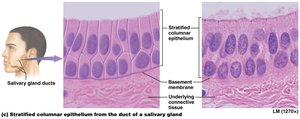
Stratified Columnar | Protection | Pharynx, anus, urethra (rare) |
|
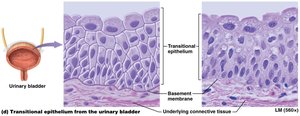
Transitional | Permits stretching | Urinary bladder, ureters |
|
Cell Junctions in Epithelia
Cell junctions are specialized structures that connect epithelial cells, providing strength and communication:
Tight junctions: Prevent passage of substances between cells.
Desmosomes: Provide mechanical strength by anchoring cells together.
Gap junctions: Allow ions and small molecules to pass between cells for communication.
Summary Table: Epithelial Tissue Types
Type | Layers | Shape | Main Function | Example Location |
|---|---|---|---|---|
Simple Squamous | 1 | Flat | Diffusion, filtration | Alveoli, capillaries |
Simple Cuboidal | 1 | Cube | Secretion, absorption | Kidney tubules |
Simple Columnar | 1 | Tall/column | Absorption, secretion | Digestive tract |
Pseudostratified Columnar | 1 (appears multi) | Tall/column | Secretion, movement | Trachea |
Stratified Squamous | Multiple | Flat | Protection | Skin, mouth |
Stratified Cuboidal | Multiple | Cube | Protection | Gland ducts |
Stratified Columnar | Multiple | Column | Protection | Pharynx |
Transitional | Multiple | Variable | Stretching | Bladder |
Other Tissue Types (Overview)
Connective Tissue
Connective tissue supports, binds, and protects organs. It includes connective tissue proper (loose and dense), fluid connective tissue (blood, lymph), and supporting connective tissue (cartilage, bone).
Muscle Tissue
Muscle tissue is specialized for contraction and movement. The three types are skeletal, cardiac, and smooth muscle.
Nervous Tissue
Nervous tissue is responsible for detecting stimuli and transmitting electrical impulses throughout the body. It consists of neurons and supporting glial cells.
Key Concepts and Applications
Classification of epithelia is based on cell shape and number of layers, which determines their function and location in the body.
Specialized structures such as cell junctions and the basement membrane are essential for epithelial integrity and function.
Clinical relevance: Understanding tissue types is foundational for diagnosing diseases, understanding organ structure, and interpreting histological slides.
