 Back
Transport of Respiratory Gases and Control of Respiration
Study Guide - Smart Notes
 Tailored notes based on your materials, expanded with key definitions, examples, and context.
Transport of Respiratory Gases by Blood
Oxygen Transport
Oxygen is transported in the blood primarily by binding to hemoglobin within red blood cells, with a small fraction dissolved directly in plasma. The efficiency of oxygen transport and delivery is essential for cellular metabolism and overall tissue function.
Hemoglobin Structure: Each hemoglobin (Hb) molecule consists of four polypeptide chains, each containing an iron-bearing heme group. Each heme can bind one O2 molecule, so one Hb can carry up to four O2 molecules.
Oxyhemoglobin (HbO2): Hemoglobin bound to oxygen.
Deoxyhemoglobin (HHb): Hemoglobin that has released its oxygen.
Oxygen Loading and Unloading: The binding and release of O2 are facilitated by conformational changes in hemoglobin. As O2 binds, affinity increases; as O2 is released, affinity decreases.
Hemoglobin Saturation: Fully saturated Hb has all four hemes bound to O2; partial saturation means one to three hemes are bound.
Key Equation:
Oxygen-Hemoglobin Dissociation Curve: The relationship between the partial pressure of oxygen (PO2) and hemoglobin saturation is sigmoidal (S-shaped), reflecting cooperative binding. This curve ensures efficient oxygen loading in the lungs and unloading in the tissues.
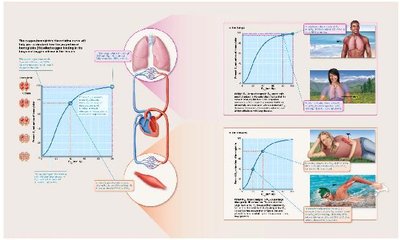
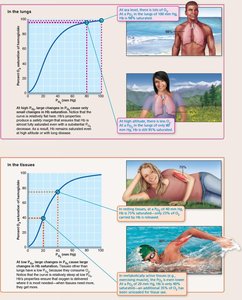
Arterial Blood: PO2 ≈ 100 mm Hg, Hb ≈ 98% saturated.
Venous Blood: PO2 ≈ 40 mm Hg, Hb ≈ 75% saturated (venous reserve).
Factors Affecting Hemoglobin Saturation
Several factors can shift the oxygen-hemoglobin dissociation curve, altering hemoglobin's affinity for oxygen and thus affecting oxygen delivery to tissues.
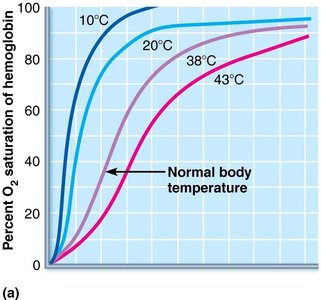
Temperature: Increased temperature decreases Hb affinity for O2, enhancing unloading in active tissues.
Blood pH (Bohr Effect): Lower pH (more acidic) decreases affinity, promoting O2 release.
PCO2: Higher CO2 levels decrease affinity, shifting the curve right.
BPG (2,3-bisphosphoglycerate): Produced during glycolysis; increased BPG decreases affinity for O2.
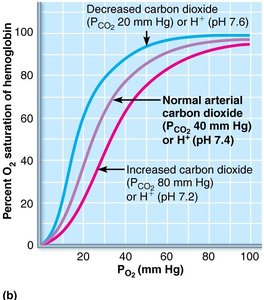
Bohr Effect: Increased CO2 and H+ weaken the Hb-O2 bond, facilitating oxygen unloading where it is most needed.
Carbon Dioxide Transport
Forms of CO2 Transport
Carbon dioxide is transported in the blood in three main forms:
Dissolved in plasma: 7–10% of CO2 is transported this way.
Carbaminohemoglobin: About 20% binds to the globin part of hemoglobin (not the heme).
Bicarbonate ions (HCO3–): About 70% is converted to bicarbonate in plasma, a process catalyzed by carbonic anhydrase in RBCs.
Key Equation:
Chloride Shift: As HCO3– exits RBCs, Cl– enters to maintain ionic balance.
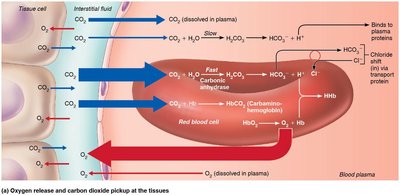
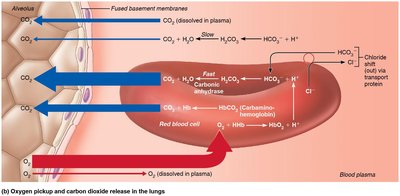
Haldane Effect
The amount of CO2 transported is influenced by the degree of hemoglobin oxygenation. Deoxygenated hemoglobin binds CO2 more readily, facilitating CO2 uptake in tissues and release in the lungs.
CO2 and Blood pH
The carbonic acid–bicarbonate buffer system helps maintain blood pH. Changes in respiratory rate can adjust blood pH by altering CO2 levels.
Slow, shallow breathing: Increases CO2, lowers pH (acidosis).
Rapid, deep breathing: Decreases CO2, raises pH (alkalosis).
Control of Respiration
Neural Mechanisms
Respiratory rhythms are regulated by centers in the brainstem, primarily the medulla and pons.
Ventral Respiratory Group (VRG): Generates the basic rhythm of breathing.
Dorsal Respiratory Group (DRG): Integrates input from peripheral receptors and modifies VRG output.
Pontine Respiratory Centers: Smooth transitions between inspiration and expiration.
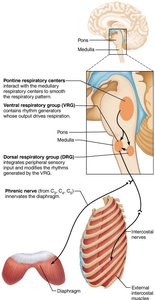
Factors Influencing Breathing Rate and Depth
Chemical Factors: The most important regulators are PCO2, PO2, and pH, detected by central and peripheral chemoreceptors.
Central Chemoreceptors: Located in the brainstem, respond to changes in CO2-derived H+.
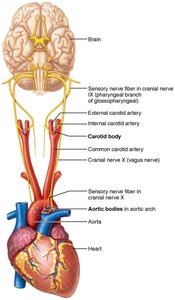
Peripheral Chemoreceptors: Located in the carotid and aortic bodies, respond to changes in PO2 and pH.
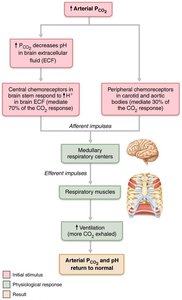
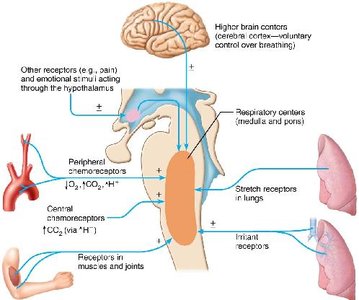
Other Influences: Higher brain centers (cerebral cortex, hypothalamus), pulmonary irritant reflexes, and the inflation (Hering-Breuer) reflex also modulate breathing.
Respiratory Adjustments
Exercise
During exercise, ventilation increases (hyperpnea) to meet metabolic demands. PO2, PCO2, and pH remain relatively constant due to efficient regulation.
High Altitude
At high altitudes, lower atmospheric pressure and PO2 can cause acute mountain sickness. Long-term acclimatization involves increased ventilation and red blood cell production.
Lung Diseases
Chronic Obstructive Pulmonary Disease (COPD)
COPD is characterized by irreversible airflow limitation, most commonly due to emphysema and chronic bronchitis. Smoking is a major risk factor.
Emphysema: Destruction of alveolar walls, loss of elasticity, and air trapping.
Chronic Bronchitis: Chronic inflammation and excess mucus production.
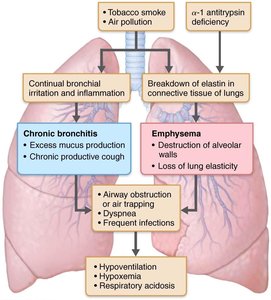
Symptoms: Dyspnea, hypoventilation, hypoxemia, respiratory acidosis.
Treatment: Bronchodilators, corticosteroids, oxygen therapy, and sometimes surgery.
Asthma
Asthma is marked by acute, reversible airway inflammation and bronchospasm, often triggered by allergens or irritants.
Tuberculosis (TB)
TB is an infectious disease caused by Mycobacterium tuberculosis, leading to chronic cough, fever, and weight loss. Treatment requires prolonged antibiotic therapy.
Lung Cancer
Lung cancer is the leading cause of cancer death, with smoking as the primary risk factor. Types include adenocarcinoma, squamous cell carcinoma, and small cell carcinoma.
Sleep Apnea
Sleep apnea involves repeated episodes of breathing cessation during sleep, leading to daytime sleepiness and increased risk of cardiovascular disease. Obstructive sleep apnea is most common and can be treated with CPAP devices.
Developmental Aspects of the Respiratory System
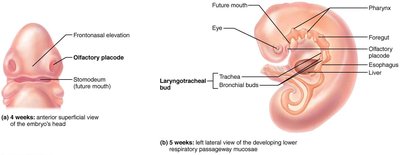
The respiratory system develops early in embryogenesis, with functional maturation continuing after birth. Respiratory efficiency declines with age.
Cystic Fibrosis
Cystic fibrosis is a genetic disorder causing thick, sticky mucus that obstructs airways and leads to recurrent infections. It is caused by mutations in the CFTR gene affecting chloride transport.
Treatment: Mucus-thinning drugs, antibiotics, gene therapy research.
