 Back
Understanding Primary and Secondary Active Transport in Cell Membranes
Study Guide - Smart Notes
 Tailored notes based on your materials, expanded with key definitions, examples, and context.
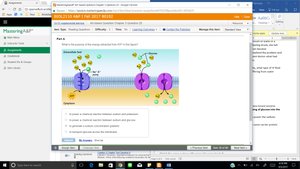
Q1. Which of the following choices would decrease the rate of glucose endocytosis based on the figure below?
Background
Topic: Cell Membrane Transport Mechanisms
This question tests your understanding of primary and secondary active transport, specifically how ATP and ion gradients affect the movement of glucose across the cell membrane.
Key Terms and Formulas
Primary Active Transport: Uses ATP directly to move ions against their concentration gradient (e.g., sodium-potassium pump).
Secondary Active Transport: Uses the energy from the movement of one ion (often sodium) down its gradient to transport another molecule (like glucose) against its gradient.
ATP (Adenosine Triphosphate): The energy currency of the cell, required for primary active transport.
Endocytosis: The process by which cells internalize molecules from the extracellular environment.
Ion Gradients: Differences in ion concentration across the membrane, crucial for secondary active transport.
Step-by-Step Guidance
Examine the diagram: Identify the two transporters shown. The left transporter is likely a primary active transporter (such as the sodium-potassium pump), and the right is a secondary active transporter (such as a sodium-glucose symporter).
Recall that primary active transport uses ATP to create a sodium gradient by pumping sodium out of the cell.
Secondary active transport relies on the sodium gradient established by the primary transporter. Sodium moves back into the cell, bringing glucose with it.
Consider how changes in ATP, sodium, and potassium levels affect these processes. For example, decreasing intracellular ATP would reduce the activity of the sodium-potassium pump, which in turn would affect the sodium gradient needed for glucose transport.
Think about which option would most directly disrupt the sodium gradient or ATP availability, thereby decreasing glucose endocytosis.
Try solving on your own before revealing the answer!
Final Answer: Decrease intracellular ATP
Decreasing intracellular ATP reduces the activity of the sodium-potassium pump, which is essential for maintaining the sodium gradient. Without this gradient, secondary active transport of glucose is impaired.
