Back

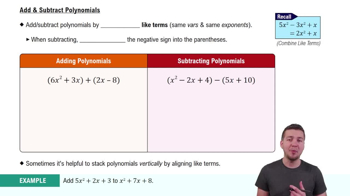
Adding and Subtracting Polynomials definitions

Control buttons has been changed to "navigation" mode.
1/15
  • Polynomial

    An algebraic expression made up of terms with variables raised to whole number exponents and real number coefficients.
  • Like Terms

    Parts of an expression sharing identical variables and exponents, allowing them to be combined through addition or subtraction.
  • Coefficient

    A numerical factor multiplying a variable in a term, indicating how many times the variable is counted.
  • Exponent

    A small number written above and to the right of a variable, showing how many times the variable is multiplied by itself.
  • Constant

    A term in a polynomial without any variables, representing a fixed value.
  • Parentheses

    Curved symbols used to group terms, indicating that operations inside should be performed before others.
  • Negative Sign

    A symbol placed before a term or group to indicate subtraction or to reverse the sign of each term inside parentheses.
  • Vertical Alignment

    A method of organizing polynomials by stacking like terms directly above or below each other for easier calculation.
  • Descending Powers

    An arrangement of terms in a polynomial from highest to lowest exponent for each variable.
  • Expression

    A combination of numbers, variables, and operations without an equality sign, representing a mathematical phrase.
  • Operation

    A mathematical process such as addition or subtraction applied to terms or expressions.
  • Term

    A single part of a polynomial, consisting of a coefficient, variable, and possibly an exponent.
  • Sign

    A symbol indicating whether a term is positive or negative, affecting how terms are combined.
  • Addition

    A process of combining terms to increase their total value, especially when terms are like.
  • Subtraction

    A process of removing or decreasing value by distributing a negative sign and combining like terms.