Back

Evaluating Expressions definitions

Control buttons has been changed to "navigation" mode.
1/14
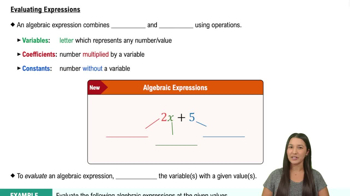
  • Algebraic Expression

    A combination of numbers and letters representing values, connected by operations like addition, subtraction, multiplication, or division.
  • Variable

    A letter, such as x or y, that stands in for a value which can change depending on the situation.
  • Coefficient

    A fixed number placed in front of a variable, indicating how many times the variable is counted.
  • Constant

    A number in an expression that does not have a variable attached and remains unchanged.
  • Operation

    A mathematical process such as addition, subtraction, multiplication, or division used to combine numbers or variables.
  • Exponent

    A small raised number showing how many times a base is multiplied by itself, as in y³.
  • Order of Operations

    A set of rules that determines the sequence in which calculations are performed in an expression.
  • Term

    A single part of an expression, which can be a number, a variable, or a product of both.
  • Polynomial

    An expression made up of one or more terms, each consisting of variables raised to whole-number exponents and coefficients.
  • Monomial

    An expression with only one term, which may include a variable, a coefficient, and possibly an exponent.
  • Degree

    The highest exponent of a variable in a polynomial, indicating its greatest power.
  • Standard Form

    A way of writing expressions where terms are ordered by decreasing exponents of the variable.
  • Scientific Notation

    A method of expressing very large or small numbers as a product of a number between 1 and 10 and a power of ten.
  • Substitution

    The process of replacing variables in an expression with specific given values to simplify or evaluate.