Back

Factoring by Greatest Common Factor & Grouping definitions

Control buttons has been changed to "navigation" mode.
1/15
  • Polynomial

    An algebraic expression made up of terms added or subtracted, each term containing variables raised to whole number exponents.
  • Term

    A single part of an expression, consisting of a number, a variable, or their product, separated by plus or minus signs.
  • Greatest Common Factor

    The largest expression that divides evenly into every term of a polynomial, including both numbers and variables.
  • Prime Factorization

    A breakdown of a number or term into a product of prime numbers and variables with exponents.
  • Coefficient

    The numerical part of a term, which multiplies the variable or variables in that term.
  • Exponent

    A small raised number indicating how many times a variable is multiplied by itself in a term.
  • Factored Form

    A way of writing an expression as a product of its factors, making it easier to simplify or solve.
  • Grouping

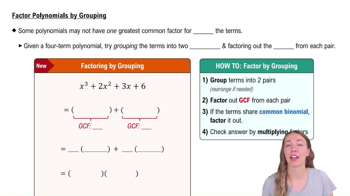
    A factoring method where terms are paired to factor out common elements from each pair, often used with four-term polynomials.
  • Binomial

    An algebraic expression consisting of exactly two terms joined by addition or subtraction.
  • FOIL

    A method for multiplying two binomials by multiplying First, Outside, Inside, and Last terms and adding the results.
  • Distributive Property

    A property that allows multiplication to be distributed over addition or subtraction inside parentheses.
  • Variable

    A symbol, usually a letter, representing an unknown or changeable value in an expression.
  • Divisibility

    A condition where one number or term can be divided by another without leaving a remainder.
  • Product

    The result of multiplying numbers, variables, or expressions together.
  • Reverse Distribution

    A process of factoring where a common factor is pulled out from terms, essentially undoing the distributive property.