Skip to main content
Beginning Algebra
My Course
Learn
Exam Prep
AI Tutor
Study Guides
Flashcards
Try the app
My Course
Learn
Exam Prep
AI Tutor
Study Guides
Flashcards
Try the app
Back
Introduction to Radical Expressions quiz
You can tap to flip the card.
What is the square root of 16?
You can tap to flip the card.
👆
What is the square root of 16?
The square roots of 16 are 4 and -4, because both 4 × 4 and (-4) × (-4) equal 16.
Track progress
Control buttons has been changed to "navigation" mode.
1/15
Related flashcards
Related practice
Recommended videos
Introduction to Radical Expressions definitions
Introduction to Radical Expressions
13 Terms
Introduction to Radical Expressions
9. Roots and Radicals
5 problems
Topic
ErnestBlazevic
Simplifying Radical Expressions
9. Roots and Radicals
5 problems
Topic
ErnestBlazevic
9. Roots and Radicals
4 topics
12 problems
Chapter
ErnestBlazevic
Guided course
03:40
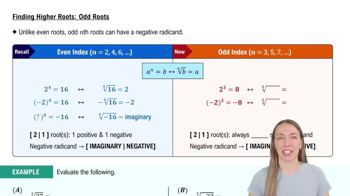
Finding Higher Roots: Odd Roots
48
views
1
rank
Guided course
05:49
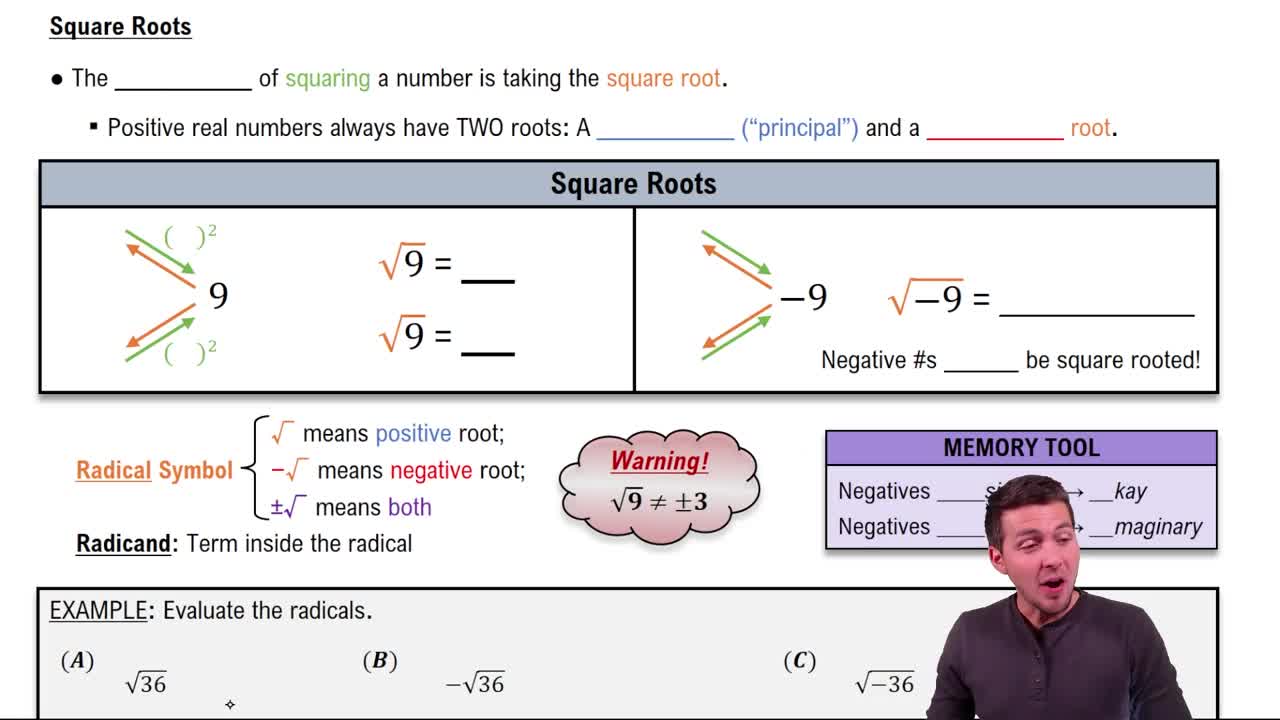
Square Roots
112
views
3
rank
Guided course
04:44
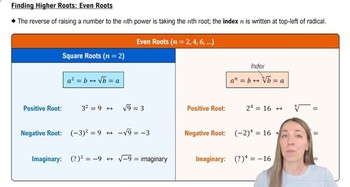
Finding Higher Roots: Even Roots
46
views
1
rank
Terms in this set (15)
Hide definitions
What is the square root of 16?
The square roots of 16 are 4 and -4, because both 4 × 4 and (-4) × (-4) equal 16.
What does the radical symbol (√) represent?
The radical symbol (√) represents the principal (positive) square root of a number.
How do you indicate the negative square root of a number using notation?
You place a negative sign in front of the radical symbol, like -√9, to indicate the negative square root.
What are the square roots of 9?
The square roots of 9 are 3 and -3, since both squared give 9.
If you see √36, what is the answer?
√36 means the principal root, which is 6.
What does -√36 mean?
-√36 means the negative square root of 36, which is -6.
What does ±√9 mean?
±√9 means both the positive and negative square roots, so both 3 and -3.
Why can't you take the square root of a negative number in real numbers?
Because no real number squared gives a negative result; the answer is imaginary.
What is the result of √(-9)?
√(-9) is imaginary because there is no real number that squares to -9.
What is the difference between a negative outside and inside the radical symbol?
A negative outside the radical is fine and gives a negative root, but a negative inside means the result is imaginary.
If you see -√25, what is the answer?
-√25 is -5, the negative square root of 25.
What is the principal square root of 49?
The principal square root of 49 is 7.
How many real square roots does a positive real number have?
A positive real number has two real square roots: one positive (principal) and one negative.
What should you write if you want to indicate both square roots of a number?
You should write ± in front of the radical, like ±√16, to indicate both roots.
Why is proper notation important when writing square roots?
Proper notation distinguishes between the positive and negative roots and helps avoid errors in solving equations.
 BackBack
 03:40
03:40