Beginning Algebra
My Course
Learn
AI Tutor
Study Guides
Flashcards
Try the app
My Course
Learn
AI Tutor
Study Guides
Flashcards
Try the app
Back
Linear Inequalities in Two Variables quiz
You can tap to flip the card.
How do you determine if an ordered pair is a solution to a two-variable linear inequality?
You can tap to flip the card.
👆
How do you determine if an ordered pair is a solution to a two-variable linear inequality?
Plug the x and y values into the inequality; if the statement is true, the ordered pair is a solution.
Track progress
Control buttons has been changed to "navigation" mode.
1/15
Related flashcards
Recommended videos
Linear Inequalities in Two Variables definitions
Linear Inequalities in Two Variables
15 Terms
Guided course
7:02
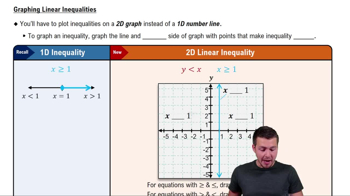
Graphing Linear Inequalities in Two Variable
30
views
05:47
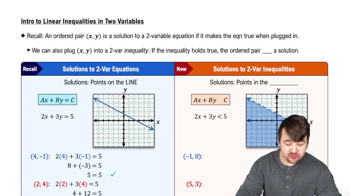
Intro to Linear Inequalities in Two Variables
40
views
Guided course
3:55
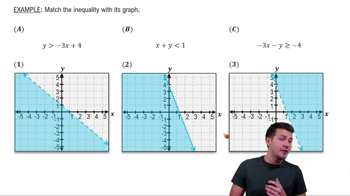
Graphing Linear Inequalities in Two Variable Example 1
41
views
Terms in this set (15)
Hide definitions
How do you determine if an ordered pair is a solution to a two-variable linear inequality?
Plug the x and y values into the inequality; if the statement is true, the ordered pair is a solution.
What is the difference between the solution set of a linear equation and a linear inequality in two variables?
A linear equation's solutions lie on a line, while a linear inequality's solutions form a region on the graph.
What type of line do you draw for the inequality y < 2x - 4?
You draw a dashed line because the inequality symbol is '<' (less than).
When do you use a solid line when graphing a linear inequality?
Use a solid line when the inequality symbol is ≤ (less than or equal to) or ≥ (greater than or equal to).
How do you decide which side of the line to shade when graphing a linear inequality?
Test a point not on the line (often (0,0) if possible); if it makes the inequality true, shade that side.
What does the shaded region represent in the graph of a linear inequality?
The shaded region contains all the points (ordered pairs) that satisfy the inequality.
If the inequality is y > 2x - 4, which region do you shade?
Shade the region above the line y = 2x - 4.
What is the first step in graphing a linear inequality in two variables?
Graph the corresponding line by replacing the inequality symbol with an equal sign.
How do you check if a point like (5, 3) is a solution to an inequality?
Substitute x = 5 and y = 3 into the inequality and see if the resulting statement is true.
What does a dashed line indicate when graphing a linear inequality?
A dashed line means points on the line are not included in the solution set (for < or >).
How is graphing x ≥ 1 on a two-dimensional graph different from a one-dimensional number line?
On a two-dimensional graph, x = 1 is a vertical line, and you shade all points to the right of the line.
What shortcut can you use if the inequality is solved for y (e.g., y > mx + b)?
If y is isolated, shade above the line for '>' or '≥', and below for '<' or '≤'.
Why is it helpful to test the point (0,0) when graphing inequalities?
It's easy to substitute and often not on the line, making it a convenient test point.
What happens if the test point does not satisfy the inequality?
You shade the opposite side of the line from where the test point is located.
How do you graph the inequality y ≤ x?
Draw a solid line for y = x and shade the region below the line.