Beginning Algebra
My Course
Learn
AI Tutor
Study Guides
Flashcards
Try the app
My Course
Learn
AI Tutor
Study Guides
Flashcards
Try the app
Back
Multiplying and Dividing Complex Numbers quiz
You can tap to flip the card.
What is the standard form for expressing a complex number after multiplication?
You can tap to flip the card.
👆
What is the standard form for expressing a complex number after multiplication?
The standard form is a + bi, where a is the real part and b is the imaginary part.
Track progress
Control buttons has been changed to "navigation" mode.
1/15
Related flashcards
Recommended videos
Multiplying and Dividing Complex Numbers definitions
Multiplying and Dividing Complex Numbers
14 Terms
Guided course
05:10
Higher Powers of i
27
views
1
rank
Guided course
04:10
Powers of i
35
views
1
rank
Guided course
04:56
Higher Powers of i Example 1
19
views
1
rank
Terms in this set (15)
Hide definitions
What is the standard form for expressing a complex number after multiplication?
The standard form is a + bi, where a is the real part and b is the imaginary part.
What is the value of i squared (i^2) and how is it used when multiplying complex numbers?
i^2 equals -1; it is used to simplify terms involving i^2 during multiplication.
When multiplying (3i) by (7 - 2i), what is the result in standard form?
The result is 6 + 21i.
What method is used to multiply two complex numbers, each with two terms?
The FOIL method is used to multiply two binomial complex numbers.
What is the result of multiplying (-6 + 2i) by (3 + 4i) in standard form?
The result is -26 - 18i.
How do you find the complex conjugate of a complex number a + bi?
Reverse the sign of the imaginary part; the conjugate is a - bi.
What is the complex conjugate of 1 + 2i?
The complex conjugate is 1 - 2i.
What happens when you multiply a complex number by its conjugate?
The result is always a real number.
What shortcut can you use when multiplying a complex number by its conjugate?
The product is a^2 + b^2, where a and b are the real and imaginary parts.
Why do we multiply by the complex conjugate when dividing complex numbers?
Multiplying by the conjugate eliminates i from the denominator, making it real.
What is the result of dividing 3 by (1 + 2i) and expressing it in standard form?
The result is (3/5) - (6/5)i.
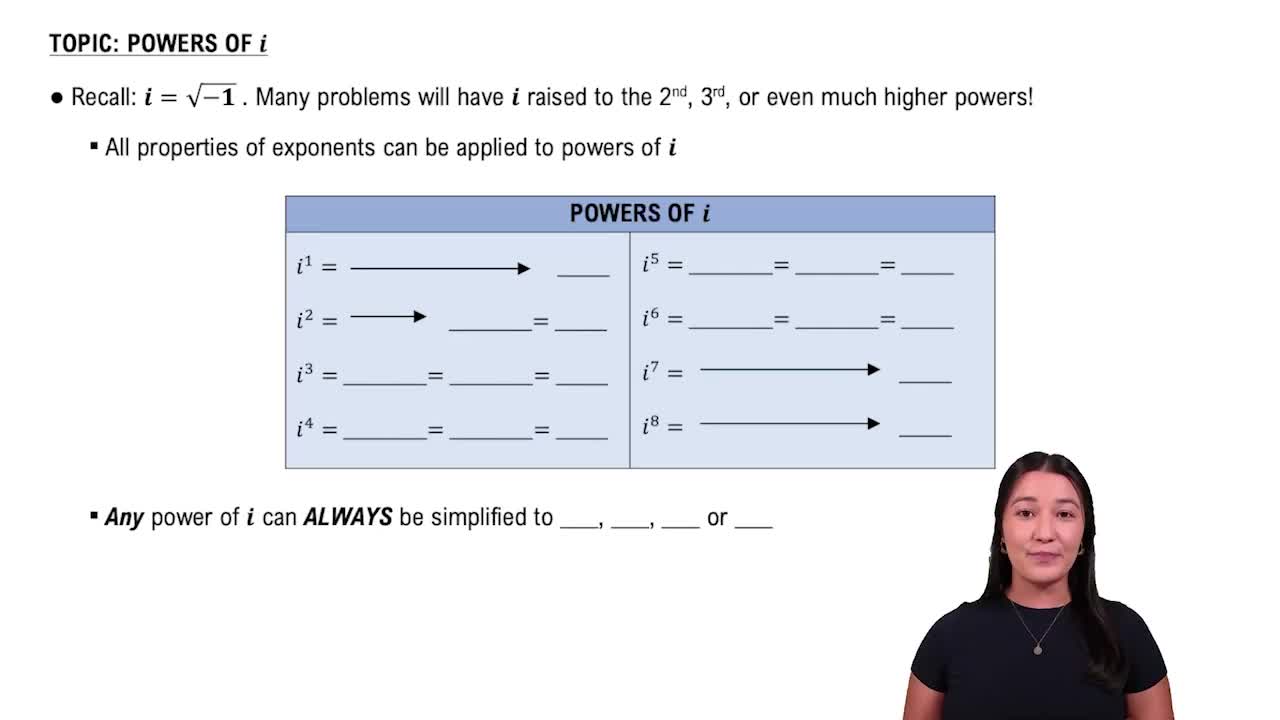
What are the four possible values for powers of i?
The four values are i, -1, -i, and 1.
What is the value of i to the 4th power (i^4)?
i^4 equals 1.
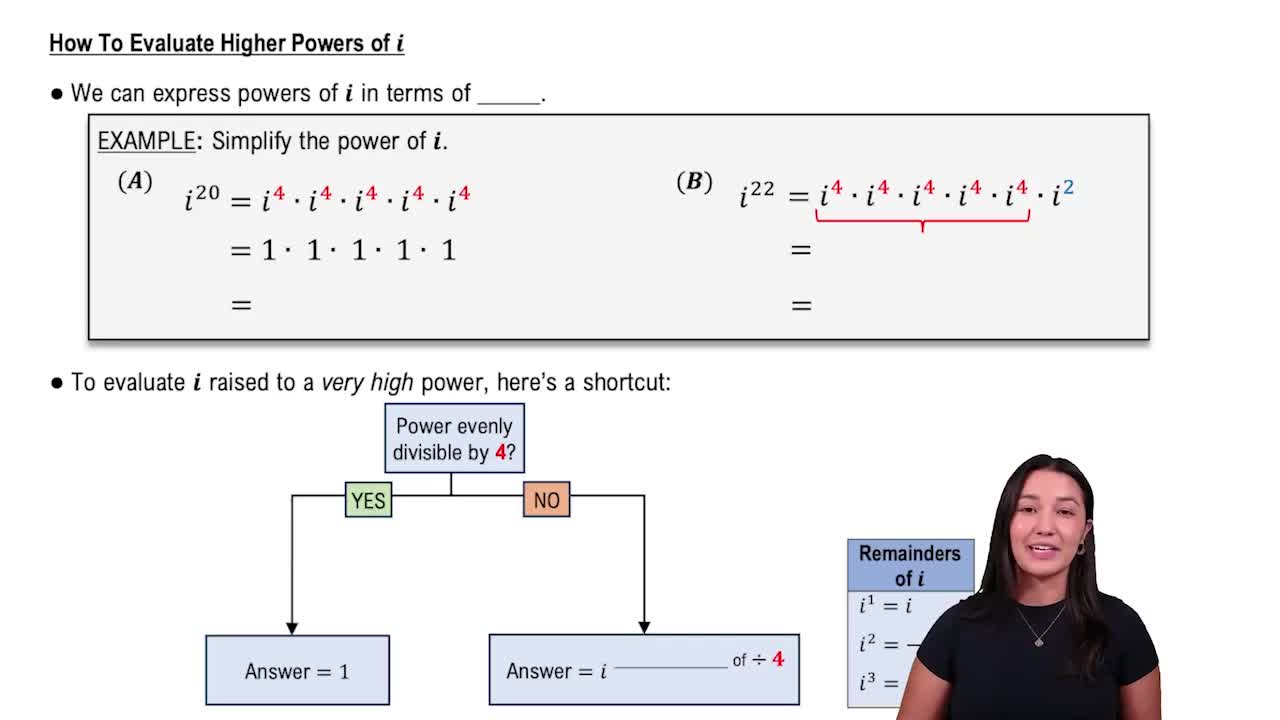
How do you quickly determine the value of i raised to a high power, like i^100?
Divide the exponent by 4; if the remainder is 0, the value is 1.
If the remainder after dividing the exponent by 4 is 2, what is the value of i to that power?
The value is -1, since i^2 equals -1.