Skip to main content
Beginning Algebra
My Course
Learn
Exam Prep
AI Tutor
Study Guides
Flashcards
Try the app
My Course
Learn
Exam Prep
AI Tutor
Study Guides
Flashcards
Try the app
Back
Multiplying, Dividing, and Rationalizing Radicals definitions
You can tap to flip the card.
Radical
You can tap to flip the card.
👆
Radical
A mathematical symbol representing the root of a number, often used to indicate square roots or higher roots.
Track progress
Control buttons has been changed to "navigation" mode.
1/15
Related flashcards
Related practice
Recommended videos
Multiplying, Dividing, and Rationalizing Radicals quiz
Multiplying, Dividing, and Rationalizing Radicals
15 Terms
Multiplying, Dividing, and Rationalizing Radicals
9. Roots and Radicals
5 problems
Topic
ErnestBlazevic
Adding and Subtracting Radicals
9. Roots and Radicals
5 problems
Topic
David-PaigeMcFarlane
9. Roots and Radicals
4 topics
12 problems
Chapter
ErnestBlazevic
Guided course
03:00
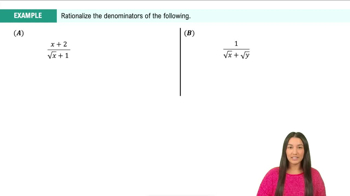
Rationalizing Denominators Using Conjugates Example 5
62
views
1
rank
Guided course
02:58
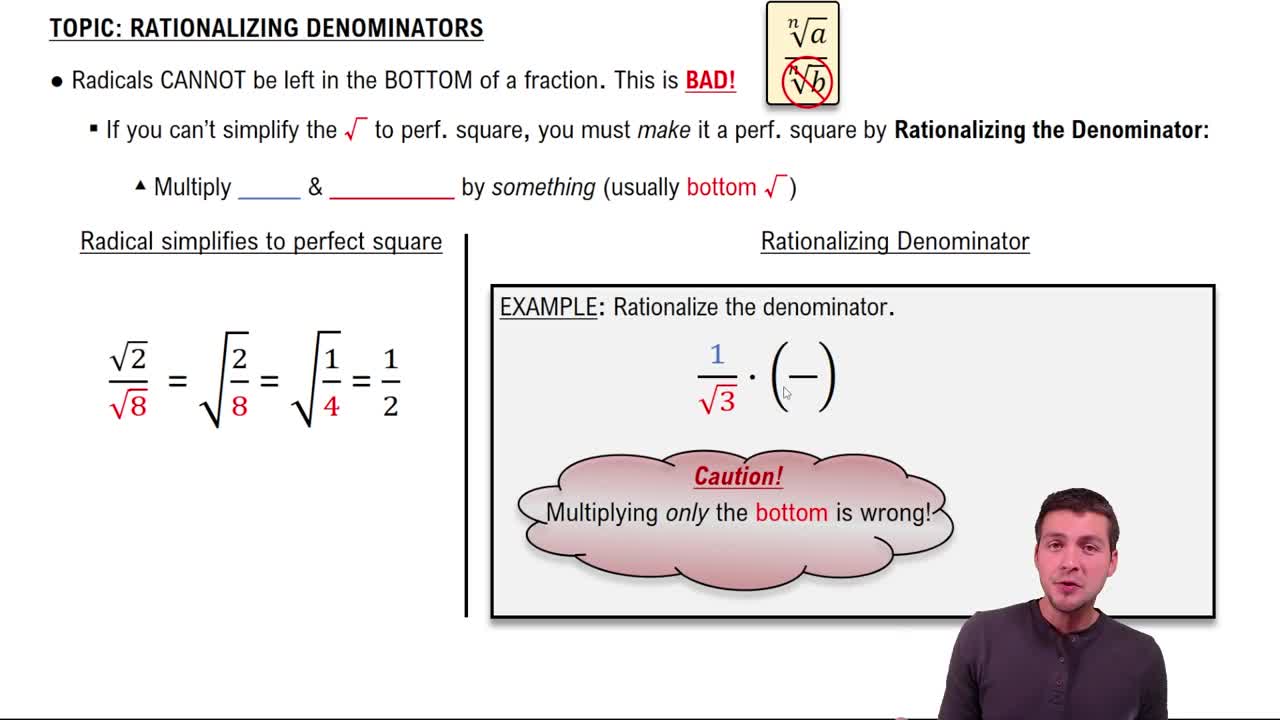
Rationalizing Denominators
65
views
1
rank
Guided course
05:51
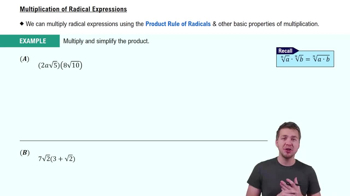
Multiplication of Radical Expressions
48
views
Terms in this set (15)
Hide definitions
Radical
A mathematical symbol representing the root of a number, often used to indicate square roots or higher roots.
Denominator
The bottom part of a fraction, indicating how many equal parts the whole is divided into.
Numerator
The top part of a fraction, showing how many parts are being considered.
Perfect Square
A value obtained when a number is multiplied by itself, resulting in a whole number under a radical.
Rational Number
A value that can be expressed as a fraction with integers in both the numerator and denominator.
Conjugate
A binomial formed by changing the sign between two terms, used to eliminate radicals in denominators.
Binomial
An algebraic expression containing exactly two terms, often separated by a plus or minus sign.
Difference of Squares
A pattern where two squared terms are subtracted, allowing simplification when multiplying conjugates.
FOIL
A method for multiplying two binomials by combining First, Outer, Inner, and Last terms.
Expression
A combination of numbers, variables, and operations without an equality sign.
Fraction
A numerical quantity expressed as one value divided by another, with a numerator and denominator.
Standard Form
A way of writing mathematical expressions where denominators contain no radicals.
Equivalence
A property where two expressions represent the same value, even if they look different.
Square Root
A value that, when multiplied by itself, gives the original number under the radical.
Simplification
The process of rewriting an expression in a more concise or standard form, often by removing radicals from denominators.
 BackBack

 03:00
03:00