Back

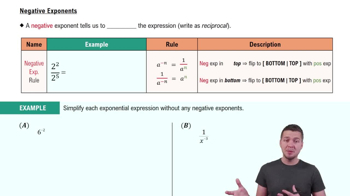
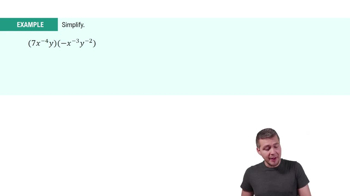
Negative Exponents definitions

Control buttons has been changed to "navigation" mode.
1/15
  • Negative Exponent

    Indicates the reciprocal of a base raised to a positive exponent, often requiring flipping the expression in a fraction.
  • Reciprocal

    A value that, when multiplied by the original number, results in one; used to rewrite negative exponents as positive.
  • Base

    The repeated factor in an exponential expression, found below the exponent.
  • Exponent

    A small number written above and to the right of a base, showing how many times the base is used as a factor.
  • Numerator

    The top part of a fraction, which can contain expressions with negative exponents to be rewritten.
  • Denominator

    The bottom part of a fraction, where negative exponents can be moved to the numerator as positive exponents.
  • Quotient Rule

    A rule stating that when dividing like bases, subtract the exponents to simplify the expression.
  • Fraction

    A mathematical expression representing division, often used to rewrite negative exponents as positive.
  • Standard Form

    An expression where all exponents are positive, achieved by applying the negative exponent rule.
  • Simplification

    The process of rewriting an expression in a more concise or standard way, often by removing negative exponents.
  • Variable

    A symbol, often a letter, representing an unknown value in an expression with exponents.
  • Power

    The result of raising a base to an exponent, indicating repeated multiplication.
  • Expression

    A combination of numbers, variables, and exponents representing a mathematical idea.
  • Factor

    A number or variable multiplied by itself a certain number of times as indicated by the exponent.
  • Term

    A single part of an expression, which may include a base, exponent, and coefficient.