Skip to main content
Beginning Algebra
My Course
Learn
Exam Prep
AI Tutor
Study Guides
Flashcards
Try the app
My Course
Learn
Exam Prep
AI Tutor
Study Guides
Flashcards
Try the app
Back
Quadratic Equations & Applications definitions
You can tap to flip the card.
Quadratic Equation
You can tap to flip the card.
👆
Quadratic Equation
An expression in the form ax² + bx + c = 0, used to model scenarios like projectile paths and business analysis.
Track progress
Control buttons has been changed to "navigation" mode.
1/15
Related flashcards
Related practice
Recommended videos
Quadratic Equations & Applications quiz
Quadratic Equations & Applications
15 Terms
Quadratic Equations & Applications
7. Factoring
5 problems
Topic
ErnestBlazevic
Factoring Special Products
7. Factoring
5 problems
Topic
ErnestBlazevic
7. Factoring - Part 1 of 2
4 topics
12 problems
Chapter
JustinRaimundo
7. Factoring - Part 2 of 2
1 topic
3 problems
Chapter
ErnestBlazevic
Guided course
03:20
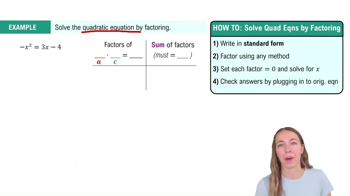
Solving Quadratic Equations by Factoring Example 1
116
views
1
rank
Guided course
05:56
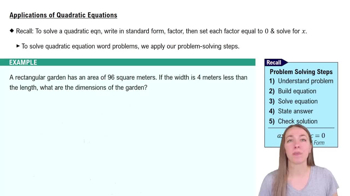
Applications of Quadratic Equations
72
views
2
rank
Guided course
01:41
Applications of Quadratic Equations Example 6
58
views
2
rank
Terms in this set (15)
Hide definitions
Quadratic Equation
An expression in the form ax² + bx + c = 0, used to model scenarios like projectile paths and business analysis.
Standard Form
A way of writing equations where all terms are on one side and ordered by decreasing exponents, set equal to zero.
Trinomial
A polynomial with exactly three terms, often seen in quadratic equations before factoring.
Binomial
An algebraic expression with two terms, typically resulting from factoring a quadratic.
Zero Product Property
A rule stating that if a product of factors equals zero, at least one factor must be zero.
Coefficient
A numerical factor multiplying a variable in an algebraic term, such as the 'a' or 'b' in ax² + bx + c.
Exponent
A number indicating how many times a variable is multiplied by itself, as in the squared term of a quadratic.
Factoring
A process of rewriting a polynomial as a product of simpler expressions, often used to solve quadratics.
Solution
A value for the variable that makes the equation true, often found by setting factors to zero.
Polynomial
An algebraic expression made up of terms with variables raised to whole number exponents and coefficients.
Monomial
A single term algebraic expression, such as 3x or -4.
Area
A measure of surface, often calculated as length times width in rectangular problems involving quadratics.
Variable
A symbol representing an unknown quantity, commonly solved for in equations.
Trial and Error Method
A strategy for factoring by testing pairs of numbers that multiply to one value and add to another.
Application Problem
A real-world scenario translated into an equation, requiring algebraic methods for solution.
 BackBack

 03:20
03:20