Skip to main content
Beginning Algebra
My Course
Learn
Exam Prep
AI Tutor
Study Guides
Flashcards
Try the app
My Course
Learn
Exam Prep
AI Tutor
Study Guides
Flashcards
Try the app
Back
Quadratic Equations & Applications quiz
You can tap to flip the card.
What is the standard form of a quadratic equation?
You can tap to flip the card.
👆
What is the standard form of a quadratic equation?
The standard form is ax^2 + bx + c = 0, where a, b, and c are constants.
Track progress
Control buttons has been changed to "navigation" mode.
1/15
Related flashcards
Related practice
Recommended videos
Quadratic Equations & Applications definitions
Quadratic Equations & Applications
15 Terms
Quadratic Equations & Applications
7. Factoring
5 problems
Topic
ErnestBlazevic
Factoring Special Products
7. Factoring
5 problems
Topic
ErnestBlazevic
7. Factoring - Part 1 of 2
4 topics
12 problems
Chapter
JustinRaimundo
7. Factoring - Part 2 of 2
1 topic
3 problems
Chapter
ErnestBlazevic
Guided course
03:20
Solving Quadratic Equations by Factoring Example 1
116
views
1
rank
Guided course
05:56
Applications of Quadratic Equations
72
views
2
rank
Guided course
01:41
Applications of Quadratic Equations Example 6
58
views
2
rank
Terms in this set (15)
Hide definitions
What is the standard form of a quadratic equation?
The standard form is ax^2 + bx + c = 0, where a, b, and c are constants.
What is the first step when solving a quadratic equation?
The first step is to write the equation in standard form.
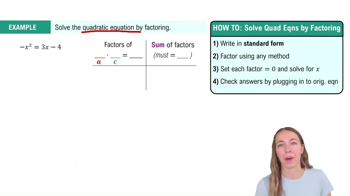
How do you factor a quadratic equation like x^2 + 10x + 21 = 0?
Find two numbers that multiply to 21 and add to 10; in this case, 3 and 7.
What is the zero product property?
It states that if the product of two numbers is zero, then at least one of the numbers must be zero.
After factoring a quadratic equation, what do you do next?
Set each factor equal to zero and solve for x.
What are the solutions to x^2 + 10x + 21 = 0?
The solutions are x = -3 and x = -7.
How can you check if your solutions to a quadratic equation are correct?
Plug the solutions back into the original equation to see if they make the equation true (equal to zero).
What real-world situations can quadratic equations model?
They can model projectile motion, business sales versus costs, and other scenarios involving parabolic relationships.
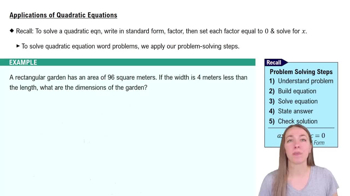
How do you set up a quadratic equation from a word problem about area?
Express the area formula in terms of variables, substitute known relationships, and rearrange to standard form.
If a garden has area 96 m^2 and width is 4 meters less than length, how do you write the equation?
Write 96 = l(l - 4), then expand and rearrange to get l^2 - 4l - 96 = 0.
How do you factor l^2 - 4l - 96 = 0?
Find two numbers that multiply to -96 and add to -4; these are 8 and -12, so the factors are (l + 8)(l - 12).
Why do you reject negative solutions in some quadratic application problems?
Negative values may not make sense in the context, such as negative lengths or widths.
What are the dimensions of the garden in the example problem?
The length is 12 meters and the width is 8 meters.
How do you verify your answer in a quadratic application problem?
Check that the calculated values satisfy the original conditions, such as area equals length times width.
What key algebraic concepts are reinforced by solving quadratic equations?
Understanding coefficients, terms, exponents, factoring, and the importance of standard form.
 BackBack

 03:20
03:20