Back

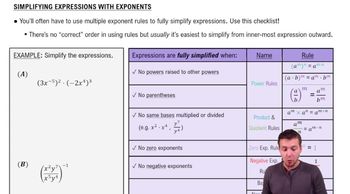
Simplifying Exponential Expressions Using All Exponent Rules definitions

Control buttons has been changed to "navigation" mode.
1/16
  • Exponent

    A small number written above and to the right of a base, indicating how many times the base is used as a factor.
  • Base

    The number or variable that is repeatedly multiplied by itself as indicated by an exponent.
  • Power Rule

    A guideline stating that when raising a power to another power, the exponents are multiplied.
  • Product Rule

    A guideline stating that when multiplying like bases, their exponents are added together.
  • Quotient Rule

    A guideline stating that when dividing like bases, their exponents are subtracted.
  • Negative Exponent

    An exponent less than zero, indicating the reciprocal of the base raised to the corresponding positive exponent.
  • Reciprocal

    A flipped version of a fraction or expression, often used to rewrite negative exponents as positive.
  • Coefficient

    A numerical factor that multiplies a variable or product of variables in an algebraic term.
  • Parentheses

    Symbols used to group parts of an expression, indicating which operations to perform first.
  • Standard Form

    An arrangement of an expression with no parentheses, negative exponents, or zero exponents, and all terms simplified.
  • Polynomial

    An algebraic expression consisting of variables and coefficients, involving only non-negative integer exponents.
  • Degree

    The highest sum of exponents in any single term of a polynomial, indicating its overall order.
  • Zero Exponent

    An exponent of zero, which makes any nonzero base equal to one.
  • Like Bases

    Bases that are identical, allowing their exponents to be combined using exponent rules.
  • Numerator

    The top part of a fraction, representing the dividend in a division expression.
  • Denominator

    The bottom part of a fraction, representing the divisor in a division expression.